

Last Updated: October 28, 2026
Quick Summary
To calculate fabric weight, cut a 10cm x 10cm sample, weigh it in grams, and multiply by 100 to get GSM. Convert GSM to ounces per square yard by dividing by 33.906, or roughly 34.
- A digital kitchen scale with 0.1 g resolution and a precisely cut square keep readings accurate.
- The formula is GSM = (sample weight in grams ÷ sample area in cm²) × 10,000.
- A 240 GSM fabric converts to about 7.1 oz/yd² for U.S. pattern matching.
- Take three samples from different areas of the bolt and average them to account for variation.
- Weight per area and weight per length are not interchangeable; check the unit label before converting.
Table of Contents
- Why Fabric Weight Matters Before You Cut
- How to Measure Fabric Weight at Home
- How to Calculate GSM for Fabric
- GSM to Ounces per Yard Conversion
- Fabric Weight Chart for Sewing
- Handling Stretchy, Textured, and Irregular Fabric
- Shop Fabrics by the Numbers
- Frequently Asked Questions
Why Fabric Weight Matters Before You Cut
Fabric weight is the mass of a given area of cloth, and it decides how a garment hangs, how warm it feels, and whether your machine can even sew it cleanly. Weight is commonly measured in grams per square meter (GSM) or ounces per square yard, according to Nak Sewing's fabric density guide.
Here's the part most guides get wrong: weight is not the same thing as pattern yardage. Yardage tells you how much fabric to buy. Weight tells you what that fabric will do once it becomes a dress, a curtain, or a pair of pants.
Below, we show you exactly how to measure weight at home, run the math, and convert the result. You will also get a chart that turns those numbers into real sewing decisions.
How to Measure Fabric Weight at Home
Measuring fabric weight at home takes three tools and about ten minutes. You need a small sample, an accurate scale, and a calculator. That is it.
Tools You Need
- A digital kitchen scale that reads in grams (0.1 g resolution is ideal)
- A ruler or measuring tape
- Sharp fabric scissors
- A pen and paper, or a calculator
- A flat, draft-free work surface
A postal scale works well too. Skip bathroom scales, since they round too heavily for small samples.
Cutting and Weighing a Fabric Sample
Cut a square of fabric and weigh it. That is the whole method. Cut Sew's measurement tutorial recommends a 10cm x 10cm square, weighed in grams, then multiplied by 100 to reach GSM.
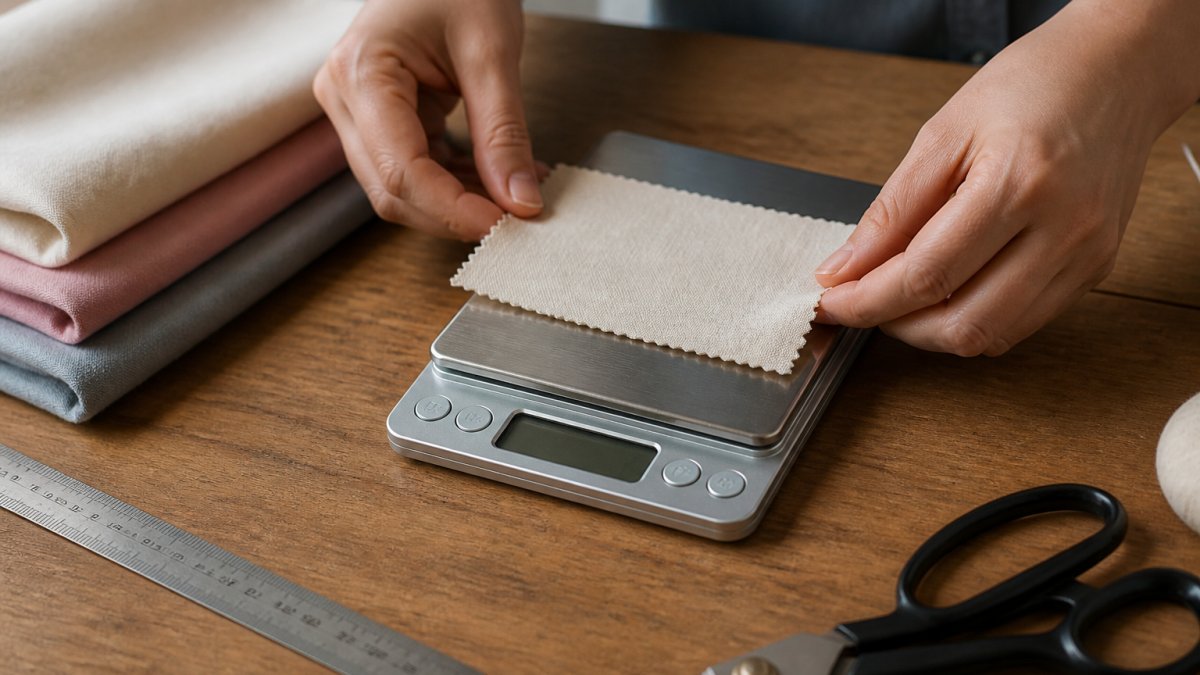
Three habits keep your numbers honest:
- Cut the square precisely. A sloppy edge skews the result.
- Weigh twice. If the readings differ, your scale or your sample is the problem.
- Note the fabric's right side and grain direction before you cut.
If you need inexpensive fabric to practice on, our Ivory Muslin Natural 100 Cotton fabric is a practical choice for test samples.
How to Calculate GSM for Fabric
To calculate GSM for fabric, weigh a sample of known area and scale the result up to one square meter. This is the standard formula sewists use, and it works on any woven or knit.
The Sample Formula and a Worked Example
Here is the formula in plain terms:
GSM = (sample weight in grams ÷ sample area in cm²) × 10,000
A worked example makes it concrete. Say your 10cm x 10cm sample weighs 2.4 grams.
- Sample area: 10 × 10 = 100 cm²
- 2.4 ÷ 100 = 0.024
- 0.024 × 10,000 = 240 GSM
That puts the fabric in medium-weight territory. Run the same steps on a second sample from a different part of the bolt. Warp and weft density can shift slightly across the width, so two readings beat one.
GSM to Ounces per Yard Conversion
Converting GSM to ounces per square yard uses one fixed number: divide GSM by 33.906. Most sewists round that to 34. In the United States, fabric weight is generally listed in ounces per square yard, per Allie Olson's fabric weight reference, so this conversion matters for matching a pattern to a listing.
- 240 GSM ÷ 33.906 = 7.1 oz/yd²
- 100 GSM ÷ 33.906 = 2.9 oz/yd²
- 380 GSM ÷ 33.906 = 11.2 oz/yd²
To go the other way, multiply ounces per square yard by 33.906.
Quick-Reference Conversion Table
Use this table to skip the math for common fabric weights. Values are rounded to one decimal place, which is precise enough for sewing decisions.
| GSM | oz/yd² (approx.) | Typical Fabric Example |
|---|---|---|
| 50 | 1.5 | Sheer chiffon, organza |
| 75 | 2.2 | Light lining, voile |
| 100 | 2.9 | Cotton voile, lightweight jersey |
| 125 | 3.7 | Quilting cotton, broadcloth |
| 150 | 4.4 | Poplin, light linen |
| 175 | 5.2 | Shirting, light twill |
| 200 | 5.9 | Medium cotton, light canvas |
| 240 | 7.1 | Ponte, medium denim |
| 280 | 8.3 | Heavy twill, suiting |
| 320 | 9.4 | Heavy denim, upholstery |
| 380 | 11.2 | Canvas, coating |
| 450 | 13.3 | Heavy upholstery, bag canvas |
Rounding and Common Pitfalls
Rounding 33.906 to 34 is fine for quick estimates, but it introduces a small error that grows with heavier fabrics. At 400 GSM, dividing by 34 gives 11.8 oz/yd², while dividing by 33.906 gives 11.8 oz/yd² as well after rounding, the difference is negligible for sewing.
A common pattern is for U.S. fabric listings to quote ounces per linear yard at a stated width, while pattern envelopes and international listings quote GSM. Always check the unit label before you convert. If a listing says "7 oz/yd²," that is area weight.
Ponte de Roma | New Creation Fabric & Foam →
Weight per Area vs. Weight per Length
These two figures are not interchangeable. Weight per area measures mass across a surface, like GSM or oz/yd². Weight per length measures mass along a running yard of a specific width.
A 100 GSM broadcloth at 58 inches wide weighs roughly 4 ounces per linear yard. Change the width and the per-length number changes too. Always check which unit a listing uses before you compare two fabrics. Our Dull Stretch Lamour Satin listing is a good place to see ounce figures in context.
To convert between them, you need the fabric width. The formula is: weight per linear yard (oz) = weight per area (oz/yd²) × width (inches) ÷ 36. For example, a 7 oz/yd² fabric at 58 inches wide weighs 7 × 58 ÷ 36 = 11.3 oz per linear yard.
Fabric Weight Chart for Sewing
Use this chart to turn a number into a decision. Ranges are general guides, and exact feel varies by weave and fiber.
| Weight Class | GSM Range | oz/yd² Range | Best For |
|---|---|---|---|
| Lightweight | 30-150 | 1-4.4 | Blouses, linings, sheer curtains |
| Medium-weight | 150-350 | 4.4-10.3 | Dresses, pants, skirts, tablecloths |
| Heavyweight | 350+ | 10.3+ | Coats, upholstery, structured bags |
Weight drives more than warmth. Lighter fabric drapes and moves; heavier fabric holds shape and blocks light. Heavier cloth also needs a stronger needle and slower machine speed.
Our Ponte de Roma sits at 320 GSM, a useful real-world benchmark for what medium-heavy feels like in hand. Compare it against the chart before you commit to a pattern.

Handling Stretchy, Textured, and Irregular Fabric
Stretchy and textured fabrics need extra care because they resist a flat, even cut. Knits curl at the edges, pile fabrics like velvet or faux fur trap air and shift on the scale, and loosely woven fabrics can distort when handled. The goal is a sample that represents the fabric as it will behave in a garment, not as it behaves under tension or compression.
Why These Fabrics Skew Results
Three mechanisms cause most errors:
- Curl and edge distortion: Knits and some wovens curl at cut edges, reducing the effective area of your sample. A 10cm square that curls inward might present only 9.5cm of flat surface to the scale.
- Compression and pile: Velvet, faux fur, and terry cloth have pile that compresses under the weight of the sample itself or the scale's platform. The same fabric can read differently depending on how it is placed.
- Stretch and tension: Elastane and rib knits stretch under their own weight if held, and a stretched sample weighs more per unit area than a relaxed one because you are measuring more fabric in the same footprint.
A Reliable Sampling Method for Difficult Fabrics
Use this sequence for knits, pile, and loose weaves:
- Cut oversize. Cut a square at least 12cm x 12cm, then trim to exactly 10cm x 10cm on a hard, flat surface using a rotary cutter and ruler. This gives clean edges and a true square.
- Relax the fabric. Lay the sample flat and let it rest for a few minutes. For knits, do not pull or smooth aggressively; let it settle.
- Weigh pile fabrics pile-up. Place the sample pile-up on the scale, then flip and weigh pile-down. Average the two readings. The difference reveals how much the pile is affecting the result.
- Take three samples. Cut from different areas of the bolt, near the selvage, center, and opposite selvage. Average the three readings. This accounts for widthwise variation.
- Record the conditions. Note whether the fabric was washed or unwashed. Some fabrics shrink and density changes after washing, which affects weight per area.
Worked Example: Stretchy Jersey
Suppose you cut three 10cm x 10cm samples from a jersey knit and weigh them: 2.1g, 2.3g, and 2.2g. The average is 2.2g. Using the formula from earlier: (2.2 ÷ 100) × 10,000 = 220 GSM. Converted to ounces per square yard: 220 ÷ 33.906 = 6.5 oz/yd². That places the jersey in medium-weight territory, suitable for a t-shirt or light dress.
Measuring Irregular Shapes and Remnants
Not every fabric sample is a perfect square. For remnants or irregular scraps, cut the largest rectangle you can and measure its dimensions precisely. Use the same formula with the actual area in cm². For a rectangle measuring 8cm by 12cm, the area is 96 cm².
A common mistake is measuring a stretched knit and recording a weight the fabric will never actually have in a garment. Our Stretch Power Mesh shows the kind of open, irregular structure that makes careful sampling worthwhile.
Shop Fabrics by the Numbers
Some sewers intentionally overbuy rather than trust precise math, a habit discussed in sewing communities per The Ruffled Purse's pattern weight guide. Overbuying is a valid hedge. Knowing the weight is still the smarter first move.
A quick buying checklist:
- Confirm the listing states GSM or oz/yd²
- Convert to the unit you think in
- Check width, since per-length weight depends on it
- Order a swatch for anything over a few yards
For a stable, easy-to-sew first purchase, our Aqua Woven Polyester Poplin is a sensible starting point once you can read weight with confidence.
Fabric weight can be calculated with a scale and a formula. New Creations Fabric & Foam Inc provides fabrics for fashion brands, with consistency and refined finishes for production.
Explore fabrics from New Creations Fabric & Foam Inc.
Frequently Asked Questions
How do you calculate the weight of fabric?
Cut a 10cm x 10cm square of fabric, weigh it in grams on a digital scale, then multiply that number by 100 to get GSM. For ounces per square yard, divide the GSM by 33.906. Always cut from a flat, relaxed section of the fabric and weigh at least two samples to average out slight variations.
What does GSM mean in fabric?
GSM stands for grams per square meter, a measure of how much a square meter of fabric weighs. Lower numbers like 100 GSM indicate lightweight fabric, while 300 GSM and above signals heavyweight fabric.
How do you convert GSM to ounces per yard?
Divide the GSM figure by 33.906 to get ounces per square yard. For example, a 320 GSM Ponte de Roma converts to about 9.4 oz/yd². Note that this is weight per area, not weight per linear yard.
Does fabric weight affect how much fabric I need?
Fabric weight does not change the yardage a pattern requires, but it affects how the fabric behaves during cutting and sewing. Heavier fabric takes up more space when folded and may need a longer stitch length and a stronger needle. Lighter fabric can shift more during cutting. Always buy based on the pattern's yardage requirement and the fabric's width, then adjust your machine settings for the weight.
