

Last Updated: November 11, 2026
Quick Summary
To use fusible seam tape on fabric edges, fold and press the raw edge under, slide the tape inside the fold with the adhesive against the fabric, then press with a warm iron for a few seconds per section using a press cloth. Let it cool before peeling the backing away, and test the bond on a scrap first.
- Press the fabric flat and test the tape on a scrap before applying it to the garment.
- Keep steam off during the initial bond because moisture can cool the adhesive.
- Press and lift the iron rather than sliding, which shifts tape and stretches edges.
- Work in short sections around pant legs so the tape does not shift on curves.
- A hair straightener on low heat gives only a temporary bond that will not survive a wash.
Table of Contents
- What Fusible Seam Tape Is and When to Use It on Fabric Edges
- Choosing the Right Tape for Your Fabric and Project
- Preparing the Fabric and Hem Before You Apply Tape
- Fusible Web Tape Instructions: Position, Press, and Secure the Edge
- How to Use Hemming Tape on Pants
- How to Use Hemming Tape Without an Iron
- Why Won't My Hemming Tape Stick? Troubleshooting Failed Bonds
- Testing, Washing, and Long-Term Durability
- Bring Your Next Project to Life with the Right Fabric
- Frequently Asked Questions
What Fusible Seam Tape Is and When to Use It on Fabric Edges
Fusible seam tape is a thin strip of heat-activated adhesive used to bond fabric edges and hems without visible stitching. You place the tape between two layers of fabric, press it with a warm iron, and the adhesive melts into the fibers to hold the edge.
The tape itself is simple: a backing paper you peel away and an adhesive side that bonds under heat. Beginners can start with the best fabrics for beginner sewing projects before choosing tape.
Hem Tape, Fusible Web, Seam Tape, and Edge Tape: What's the Difference
These four terms get used interchangeably, and that causes real mistakes. Fusible hem tape is a narrow strip, usually with a paper backing, made for folding and holding a hem. Fusible web is a looser, web-like adhesive with no backing, used to bond two pieces of fabric across a wider area. Seam tape is a strip meant to sit along a seam line, often to reinforce or seal it. Edge tape is a broader label for any tape that finishes a raw edge, whether a hem, a facing, or an open cut.
The practical difference comes down to width, backing, and bond strength. Grab the wrong one and you get a bond that fails or a stiff, gummy mess.
When Tape Beats Stitching, and When It Doesn't
Tape wins when speed matters, when the fabric is too delicate for a needle, or when you need a temporary hold before final stitching. Understanding the woven vs knit fabric differences helps you decide whether tape or stitching suits the fabric structure.
Tape loses when the edge has to survive real wear. A fusible tape guide from Linda's makes the point clearly: tape can position or stabilize an edge, but stitching may still be needed when the finished edge must withstand handling and washing.
Choosing the Right Tape for Your Fabric and Project
Match the tape to the fabric weight and fiber content.
Most tutorials stop at "use low heat for delicates." That is not enough to prevent a scorched sample or a bond that peels.
| Fabric type | Starting iron setting | Press time per section | Tape to reach for |
|---|---|---|---|
| Sheer and delicate (chiffon, organza, lining) | Lowest setting, often the "silk" or synthetic mark | 3-5 seconds | Light fusible web, narrow width |
| Cotton and linen | Medium, with steam off | 8-10 seconds | Standard fusible hem tape |
| Knits and stretch fabric | Medium-low | 5-8 seconds | Stretch-friendly tape that moves with the fabric |
| Velvet and faux fur | Low, press cloth mandatory | 5-8 seconds, iron moving | Wider tape or web, test first |
| Synthetics (polyester, nylon) | Low, below the synthetic mark | 3-5 seconds | Light tape, press cloth |
| Upholstery and heavy woven | Medium-high | 10-15 seconds | Strong web or wide tape |
A few rules sit above the table.
Watch out: a wide tape on a light fabric adds bulk you cannot hide, and a narrow tape on a heavy fabric peels at the first tug.
A common mistake is choosing tape by width alone. If you are unsure of your fabric's weight, our guide on how to calculate fabric weight for sewing projects walks through the method. For synthetics, heat setting matters more than pressure, and our guide on how to finish raw edges on polyester fabric covers those settings in detail.
Press time per section by fabric type
Preparing the Fabric and Hem Before You Apply Tape
Preparation decides whether the bond holds. Press the fabric flat before you touch the tape. A wrinkled edge will bond wrinkled, and no amount of heat fixes that later.
Then do these three things:
- Test on a scrap. Press a small piece of tape to a hidden corner and check the bond and the fabric's reaction to heat.
- Mark your hem allowance. Fold and press the hem first, so the tape sits inside a crease that already holds its shape.
- Clean the edge. Lint, sizing, and fabric finish can block the adhesive. A quick press with a dry cloth removes most of it.
Watch out: pressing tape onto an unwashed fabric with a factory finish is one of the most common reasons a bond fails. Many fabrics ship with a coating that resists adhesive. A pre-wash or a light press with a damp cloth solves it.
Fusible Web Tape Instructions: Position, Press, and Secure the Edge
The core method is the same for any fusible web tape: position the tape on the wrong side of the fabric, cover it with the backing or a press cloth, and press with a warm iron until the adhesive melts.
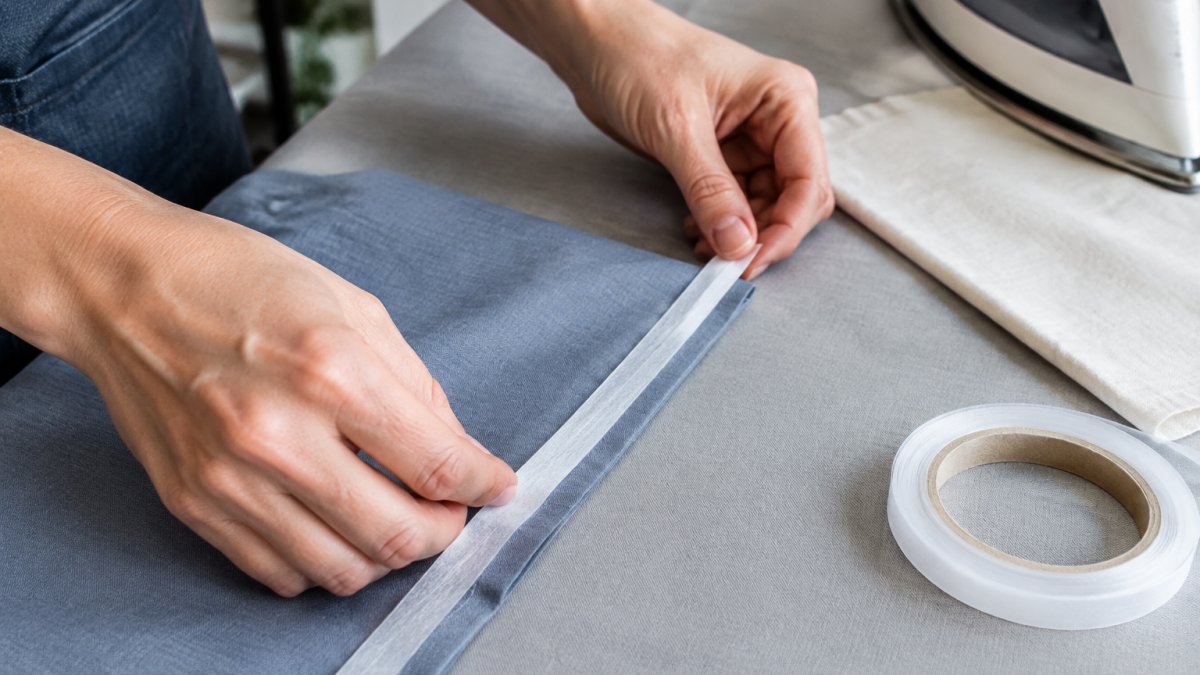
Step-by-Step: Finishing a Raw Fabric Edge
- Press the raw edge under by the hem allowance, wrong side up.
- Cut a strip of tape to the length of the edge.
- Slide the tape under the fold, adhesive side against the fabric, backing paper facing you.
- Press with a warm iron for a few seconds per section, using a press cloth.
- Let it cool before you peel the backing paper away.
- Check the bond by lifting a corner gently. If it releases, re-press with a bit more heat.
- Trim any excess tape close to the edge.
For polyester and other synthetics, the heat setting matters more than the pressure. Our guide on how to finish raw edges on polyester fabric covers the fabric-specific settings in detail.
How to Use Hemming Tape on Pants
Pants are the most common use case, and the one where tape earns its keep. Turn the pants inside out, fold the hem to the length you want, and press the fold flat.
Two things matter here. First, keep the tape inside the fold, not on the outside face of the fabric, or you will see a shiny line. Second, work in sections around the leg rather than pressing the whole hem at once, because the curve of the leg makes the tape shift.
How to Use Hemming Tape Without an Iron
No iron, no problem, but the result is temporary. A hair straightener on low heat works for small areas if you keep it moving and use a press cloth.
If you have no iron, use tape only to hold the fold while you hand-sew or to get through a fitting. Do not expect a permanent finish from a hair tool. Uneven heat is the number one cause of a bond that peels.
Why Won't My Hemming Tape Stick? Troubleshooting Failed Bonds
A failed bond almost always comes down to one of four causes: not enough heat, not enough time under the iron, a contaminated edge, or a tape that was never rated for the job. The table below diagnoses each symptom against its likely cause and the fix, but the sequence matters as much as the table. Work from the cheapest fix upward: check the tape rating first, then the edge prep, then the heat, then the press time. Changing heat before you check the edge is how people scorch fabric chasing a problem that was never thermal.
| Problem | Likely Cause | Fix |
|---|---|---|
| Tape peels right away | Iron too cool or pressed too briefly | Raise heat slightly, hold longer per section |
| Bond holds, then releases after washing | Tape not rated for washing, or edge not stitched | Add a stitch line, or switch to a washable tape |
| Fabric scorched or shiny | Iron too hot, no press cloth | Use a press cloth, lower the heat |
| Edge puckers or stretches | Iron slid across the fabric | Press and lift, do not slide |
| Adhesive residue on the iron | Backing paper left on, or tape melted through | Clean the iron, always use the backing or a cloth |
| Tape shows through the face fabric | Tape placed on the outside of the fold, or too wide | Reposition inside the fold, trim width |
| Bond weak along a raw edge | Edge fraying under the tape | Seal or stabilize the raw edge before taping |
Raw fabric edges deserve their own note, because most troubleshooting advice is written for hems. Our article on how to prevent fraying on synthetic fabrics covers the prep steps that make tape hold on these tricky materials.
Synthetic fabrics are the usual suspects. They resist adhesive and fray at the same time, so a bond that looks fine on the board fails after a day of handling. If the tape lifts at a corner, do not keep adding heat.
Testing, Washing, and Long-Term Durability
Test every bond before you commit. Press a sample, let it cool, then tug it gently and wash it once. If it survives a wash cycle, it will likely hold for the life of the garment. If it lifts at the corner, stitch the edge.
Durability depends on three factors: the tape's wash rating, the fabric's weight, and whether the edge gets stress. A hem on dress pants sees less stress than a hem on a work shirt. For pieces that will be washed often, treat tape as a positioning aid and finish with a stitch.
Bring Your Next Project to Life with the Right Fabric
The tape is only half the equation. The fabric underneath decides how the edge behaves, how the bond holds, and how the finished piece reads.
That is where we come in. At New Creations Fabric & Foam Inc, we offer a wide variety of fabric types, including sequins, velvet, and faux fur, designed for fashion brands and production needs.
Ready to match your next project with fabric that holds its finish? Browse our collection and see the difference consistency makes.
Frequently Asked Questions
How do I apply fusible seam tape to a raw fabric edge?
Fold the raw edge over by your chosen hem allowance and press it flat. Slide a strip of fusible seam tape under the fold, adhesive side against the fabric, and hold a hot iron over a press cloth for 10 to 15 seconds. Let the piece cool completely before moving it, since the bond sets as it cools. For edges that will be handled or washed often, add a line of stitching after the tape has cooled for extra hold.
Is fabric fusing tape permanent?
Most fusible seam tape forms a permanent bond once it cools, but durability depends on the fabric, the heat setting, and how the finished piece is washed. Bonds on cotton and other woven fabrics usually hold through repeated laundering, while stretch and synthetic fabrics may need a lower heat setting and extra pressing time. Always test on a scrap first, and add stitching on edges that take heavy wear.
What is the difference between fusible seam tape and hemming tape?
Hemming tape is a narrow strip of fusible adhesive used to hold a folded hem in place without stitching. Fusible seam tape works the same way but is often used to bond seams, stabilize edges, or attach trims. Fusible web is a sheet or roll of web-like adhesive you cut to shape, while edge tape is designed specifically for finishing raw fabric edges. All four rely on heat and pressure to activate the adhesive.
Can you use hemming tape without an iron?
An iron gives the most reliable results because it delivers steady heat and pressure, but you can use a hair straightener or a heat press set to the fabric's temperature as a substitute. Work in small sections, hold the tool over a press cloth for 10 to 15 seconds, and let each section cool before moving on. A clothes dryer or hot kettle will not generate enough consistent heat to activate the adhesive properly.
