

Table of Contents
- Why Polyester Edges Fray and What Makes This Fabric Different
- Machine Settings for Finishing Polyester Edges
- How to Finish Fabric Edges Without a Serger
- Overlock Stitch for Polyester Fabric: When a Serger Wins
- How to Finish Sheer Fabric Edges
- How to Seal Polyester Satin Edges
- Choosing a Seam Finish by Garment, Weight, and Use
- Frequently Asked Questions
Last Updated: October 18, 2026
Why Polyester Edges Fray and What Makes This Fabric Different
At New Creations Fabric & Foam Inc, we see this in every bolt of polyester we ship. The same slick finish that makes polyester poplin stain-resistant and wrinkle-resistant also makes its cut edges unstable.

Fraying is not a sign of poor quality. It is how woven polyester behaves. The fix is a seam finish that locks the edge before it can travel.
Identifying Polyester and Its Heat Sensitivity
Polyester is a synthetic fiber made from petroleum-based polymers, and it melts rather than burns at high heat. That single fact drives every finishing decision.
How to spot it:
- It feels smooth and slightly cool to the touch
- It holds a crease well and springs back from wrinkles
- A burn test melts into a hard bead instead of ash
- It dries fast and resists stains
That heat sensitivity matters. An iron set too hot will glaze, shine, or melt the surface. Use a low synthetic setting or a pressing cloth every time.
Machine Settings for Finishing Polyester Edges
Polyester punishes a machine that is set up for cotton. The fiber is slick, it heat-softens instead of scorching, and it holds a needle hole. Getting the machine dialed in is half the battle, and the other half is knowing why each setting matters for a synthetic.
A standard universal needle can leave visible holes in polyester poplin and can skip on satin. Switch to a sharp or microtex needle for wovens; for polyester knits, use a ballpoint so the needle pushes between loops instead of cutting them.
Needle, Thread, and Stitch Length
Here are starting settings for polyester on a home sewing machine:
| Setting | Recommendation | Why It Matters |
|---|---|---|
| Needle | 70/10 or 80/12 sharp (microtex) for wovens; 75/11 ballpoint for knits | Prevents holes and skipped stitches; ballpoint avoids running knits |
| Thread | All-purpose polyester | Matches fabric stretch and care; cotton can shrink and pucker |
| Stitch length | 2.5 to 3.0 mm | Longer stitch reduces puckering on slick fabric |
| Stitch width | 3 to 4 mm for zigzag | Wide enough to wrap the edge without adding bulk |
| Presser foot | Standard, overcast, or walking foot | Keeps slippery fabric feeding evenly |
| Tension | Slightly loose (one number lower than balanced) | Tight tension pulls and waves the edge |
| Presser-foot pressure | Reduce if adjustable | Less pressure stops slick fabric from shifting |
Slippery polyester can shift under the needle. A walking foot, a strip of tissue paper under the seam, or a few dabs of temporary fabric glue along the edge helps it feed evenly. Clips often hold slick polyester flatter than pins, which can slide out.
Testing Heat and Stitch on Scrap First
Before you sew the real piece, run a two-part test on a scrap of the same polyester.
- Heat test: Set the iron to the synthetic/low setting, place a pressing cloth over the scrap, and press for a few seconds. Check for shine, glazing, or distortion. If the surface changes, lower the heat or add a thicker cloth. Polyester melts rather than burns, so a too-hot iron leaves a permanent shine or a hole that cannot be repaired.
- Stitch test: Sew a 6-inch line of your chosen finish at the settings above. Look for puckering, skipped stitches, and whether the stitch wraps the edge. Tug the edge gently to see if fibers slip. Adjust length, width, or tension and test again.
A common pattern is to set the machine once for cotton and never revisit it. Polyester rewards a fresh setup every time: fresh needle, polyester thread, slightly longer stitch, and a pressing cloth within reach.
How to Finish Fabric Edges Without a Serger
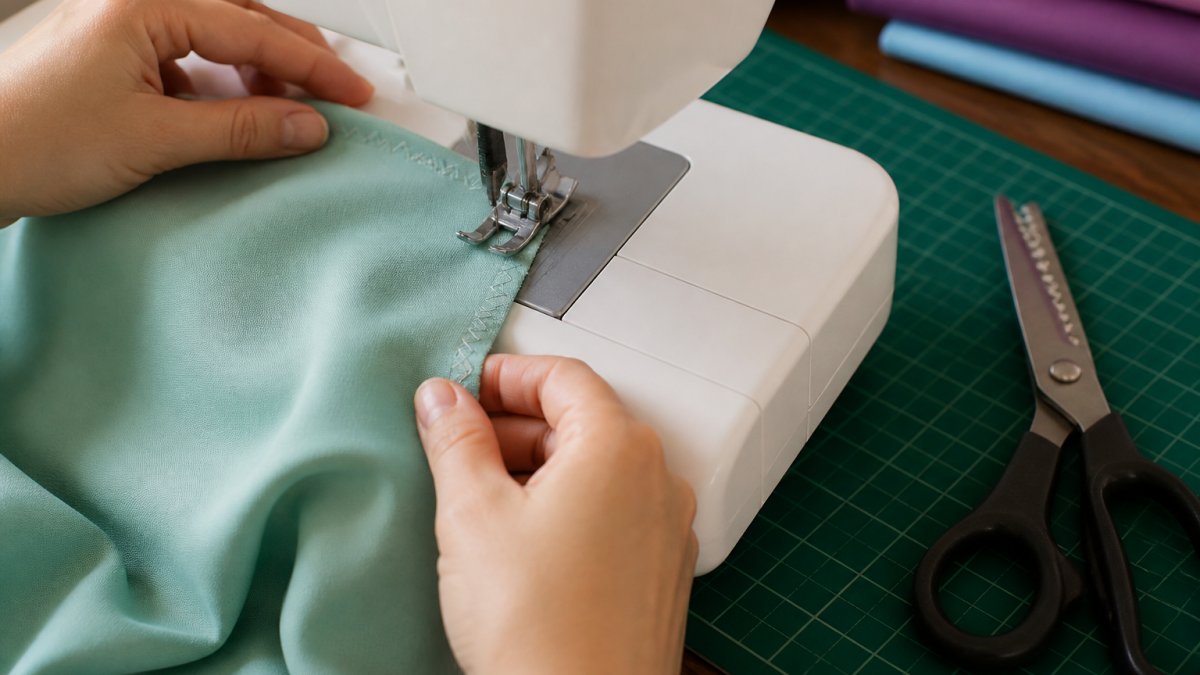
You do not need a serger to learn how to finish raw edges on polyester fabric. A standard sewing machine with a zigzag or overcast stitch handles most jobs cleanly.
Zigzag Stitch Finish
The zigzag stitch is the fastest no-serger finish for polyester. It wraps thread around the raw edge and stops the fibers from slipping. On polyester, the goal is a stitch that falls just off the edge on one side so the thread encloses the fibers rather than sitting on top of them.
How to do it:
- Set your machine to a zigzag stitch
- Set stitch width to 3 to 4 mm and length to 2.5 mm
- Place the raw edge under the needle so the stitch wraps just past it
- Sew along the edge, letting the needle fall off the fabric on one side
- Backstitch at both ends to lock the thread
- Trim any loose threads close to the stitch
This finish works well on medium-weight polyester like poplin. On very lightweight fabric, the zigzag can add bulk and show through. In that case, trim with pinking shears first, then zigzag, or switch to a French seam.
Overcast Stitch and Turned Edges
The overcast stitch is a step up from zigzag. It sews a dense, angled stitch that wraps the edge more completely and mimics the look of a serged edge without the extra machine.
Many machines have a dedicated overcast foot and setting. If yours does, use it. If not, a narrow zigzag with a slightly longer stitch gets close.
Turned edges are the other no-serger option. Fold the raw edge under twice and stitch it down.
- Double-fold hem: Fold under 1/4 inch, then again 1/2 inch, and stitch
- Best for: Lightweight polyester, sheer fabrics, and clean hems
- Watch for: Bulk on heavier fabric, so trim the seam allowance first
Which No-Serger Finish Holds Up
Durability depends on how the garment is used. A zigzag or overcast edge survives normal washing but can abrade in high-friction areas like underarms and crotches. A double-fold hem or French seam encloses the raw edge and generally outlasts an open zigzag through repeated washing. For high-wash garments, test a finished sample: wash it two or three times and check for raveling, pilling, or stitch distortion before committing to a production run.
Polyester Poplin 60" Wide| New Creations Fabric & Foam Inc. →
Overlock Stitch for Polyester Fabric: When a Serger Wins
An overlock stitch for polyester fabric is the cleanest, most durable finish when a serger is available. It trims the edge and wraps it in thread in one pass, so the fabric cannot fray.
A serger wins on:
- High-fray fabrics and heavy handling
- Production sewing where speed matters
- Seams that will see repeated washing
- Knit and stretch polyester blends
For a home sewist finishing a few pieces, a zigzag or overcast stitch is enough. For a small brand producing in volume, a serger pays for itself in speed and consistency.
Set your serger to a narrow, tight stitch for polyester. Loosen the differential feed slightly if the fabric puckers. Always test on a scrap first.
How to Finish Sheer Fabric Edges
Sheer polyester edges need a delicate finish because heavy stitches show through. A French seam, a narrow rolled hem, or a fine zigzag keeps the edge clean without adding bulk.
The best options for sheer fabric:
- French seam: Sew a narrow seam, trim, then enclose it in a second seam
- Rolled hem: A serger rolled hem or a machine rolled hem foot
- Fine zigzag: A narrow, short zigzag on very lightweight sheer
- Pinking: For non-fraying sheers used in decor
Avoid wide, dense stitches on sheer fabric. They add weight and show through the front. Keep your thread matched to the fabric color for the cleanest look.
How to Seal Polyester Satin Edges
The best way to seal polyester satin edges is a clean, narrow finish that hides the raw edge without pressing shine into the face. Satin shows every pucker and every iron mark.
Use these methods:
- French seam: Ideal for lightweight satin garments
- Rolled hem: Gives a fine, elegant edge on satin
- Bound edge: A bias strip wraps the raw edge for a decorative finish
- Pinking plus a narrow zigzag: A quick option for non-show edges
Press satin from the wrong side with a pressing cloth on low heat. Never press the face directly. A pressing cloth protects the sheen that makes satin worth using.
For satin garments, we recommend a bound or French seam. Both give the refined finish that formal wear and event pieces demand, and both hold up to repeated wear.
Choosing a Seam Finish by Garment, Weight, and Use
Match the finish to the fabric weight and how the garment will be used. A finish that works on a heavy poplin can ruin a sheer overlay.
| Fabric / Use | Best Finish | Why |
|---|---|---|
| Medium polyester poplin | Zigzag or overcast | Fast, durable, low bulk |
| Lightweight polyester | French seam or rolled hem | Hides the raw edge cleanly |
| Sheer polyester | French seam or fine zigzag | Keeps bulk and show-through down |
| Satin | Bound edge or French seam | Preserves sheen and drape |
| High-wash garments | Serger overlock | Strongest against fraying |
| Event decor and backdrops | Pinking plus zigzag | Quick, bulk-friendly, holds up |
A common mistake is choosing a finish by habit instead of by fabric. What most guides miss is that the same stitch that saves a poplin seam can pucker a sheer. Test first, then commit.
For brands scaling production, consistency matters as much as technique. Our Polyester Poplin 60" Wide is a 7-ounce, color-fast spun weave built to hold a clean seam finish through repeated washing, so your finishing choices stay consistent from roll to roll.
Frequently Asked Questions
How do you stop polyester fabric from fraying?
Polyester frays because its smooth, tightly woven filaments slip out of the cut edge. The fastest fix is a zigzag stitch run close to the raw edge, which wraps thread around the fibers and locks them in place. For a cleaner look, encase the edge in a French seam or fold it under and stitch. Avoid pinking shears on polyester: the synthetic fibers still slip past the zigzag cut, so the edge keeps unraveling. Always test your stitch on a scrap first to check tension.
Can you use a lighter to seal polyester fabric edges?
Yes, polyester melts rather than burns, so a flame can fuse the cut edge and stop fraying. Hold the fabric edge near, not in, a small flame and move steadily so the fibers melt into a bead. Work in a ventilated area and keep water nearby. The result is a hard, slightly darkened edge, so this method suits hidden seams and craft projects rather than visible hems. Test on a scrap first, since lightweight polyester can melt faster than expected.
What stitch should you use to finish polyester seams?
A narrow zigzag stitch is the most reliable choice on a standard sewing machine. Set stitch length around 2.5 mm and width around 3 to 4 mm, then stitch just inside the seam allowance. For stretch polyester, a three-step zigzag adds give so the seam does not pop. If you have a serger, a three- or four-thread overlock stitch gives the neatest, most durable finish. Press the seam flat afterward with a low heat setting.
Does polyester satin fray when cut?
Polyester satin frays readily because its smooth filament yarns slide apart at a cut edge. The fabric is also heat sensitive, so press it on a low synthetic setting with a pressing cloth to avoid shine or melting. For a clean finish, use a French seam on lightweight satin or a narrow rolled hem. A small flame can seal hidden edges, and a fine sharp needle with lightweight thread reduces pulling along the seam line.
Polyester edges will fray if you leave them raw, but the fix is within reach of any sewing machine. Match your needle, thread, and stitch to the fabric, test on a scrap, and pick a finish by weight and use. At New Creations Fabric & Foam Inc, we supply fabrics with the consistency and refined finishes that make professional-scale production possible. Explore our collections to find the right polyester for your next project and finish every edge with confidence.