

Table of Contents
- Woven vs Knit: A Quick Comparison for Apparel Makers
- How to Identify Knit vs Woven Fabric by Hand and Eye
- Stretch, Elasticity, and Recovery: What Each Construction Delivers
- Durability, Wrinkle Resistance, and Breathability Compared
- How to Verify Fabric Drape Online Before You Buy
- Choosing the Right Construction for Specific Sewing Patterns
- Care and Maintenance for Knit and Woven Apparel
- Conclusion
- Frequently Asked Questions
Last Updated: October 3, 2026
Woven vs Knit: A Quick Comparison for Apparel Makers
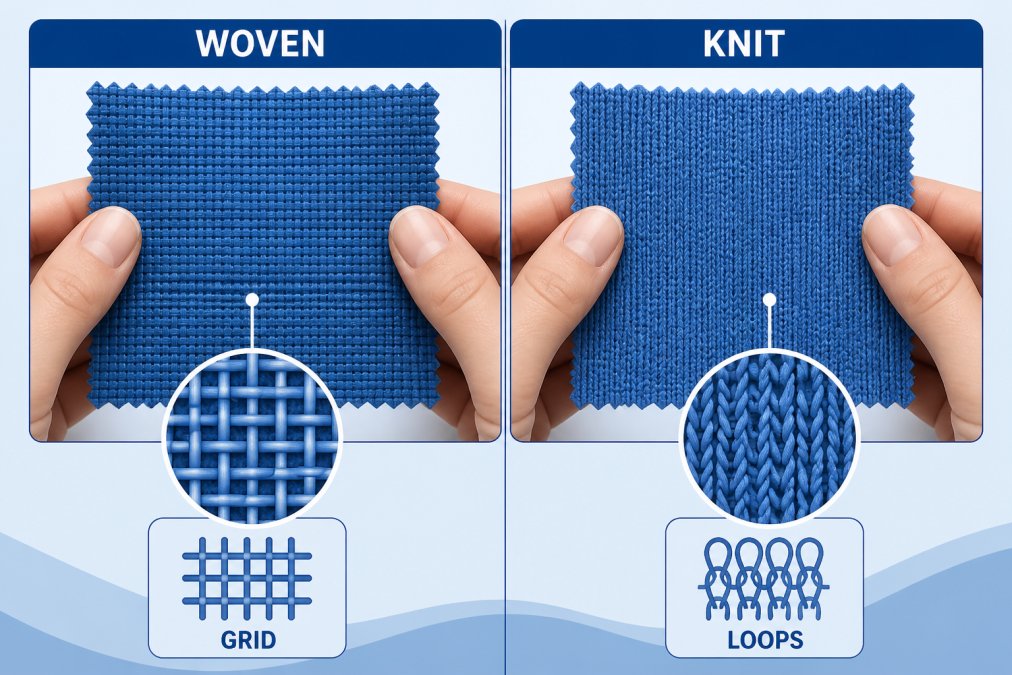
The difference in woven vs knit fabrics comes down to one structural fact: woven fabrics interlace two sets of yarns at right angles, while knit fabrics loop a single yarn back through itself. That distinction drives everything from stretch to drape to how a garment ages.
If your pattern needs stretch and recovery, you want a knit. If it needs stability and a crisp press, you want a woven. Below, we break down the structural differences, how to tell them apart by touch, and which construction suits which pattern.
| Factor | Woven | Knit |
|---|---|---|
| Structure | Interlaced warp and weft | Interlocking loops |
| Stretch | Minimal, on the bias only | Significant, often 4-way |
| Wrinkle resistance | Low, presses crisp | High, resists creasing |
| Fraying | Frays at cut edges | Curls, rarely frays |
| Best for | Shirts, denim, tailored wear | T-shirts, activewear, dresses |
Structural Differences: Interlacing vs Looping
Woven fabric is built on a loom from two yarn sets: warp yarns run lengthwise and weft yarns cross them at right angles, interlacing over and under in a grid. Knit fabric is built from a single yarn formed into loops that link through one another, row by row. The grid gives woven fabric dimensional stability; the loops give knit fabric stretch and recovery. Twill, satin, and denim are woven. Jersey, interlock, and scuba are knit.
How to Identify Knit vs Woven Fabric by Hand and Eye
The fastest test is the stretch test: pull the fabric gently along the grainline. A woven barely gives, while a knit stretches and springs back. Next, look at the cut edge: woven fabric frays into loose threads, while knit curls and may run but does not fray the same way.
Stretch, Elasticity, and Recovery: What Each Construction Delivers
Knit fabric wins on stretch and recovery. The loop structure lets a knit elongate and return to shape, which is why jersey and scuba dominate activewear and fitted dresses. Woven fabric stretches only on the bias and does not recover the way a knit does, a feature, not a flaw, since a woven garment holds the shape you cut, which is what tailoring needs.
Fabric Stretch and Recovery Testing at Home
Cut a 10 cm strip along the grainline and a second on the bias. Mark a 10 cm section, stretch it by hand, and measure. For recovery, hold the stretch for 30 seconds, release, and measure again after a minute. A knit that returns close to its original mark has good recovery; one that stays elongated will sag at the knees and elbows.
Durability, Wrinkle Resistance, and Breathability Compared
Durability, wrinkle behavior, and breathability are not fixed properties of "woven" or "knit", they emerge from how the structure interacts with fiber, yarn size, and weight.
Wrinkle resistance. Woven fabrics crease because the interlaced yarns have little room to recover once bent, the crease is essentially a permanent bend in the yarn path. A cotton jersey knit still wrinkles less than a cotton poplin of similar weight.

Breathability. Air permeability depends on the size and number of gaps between yarns, not on the woven-versus-knit label alone. A loosely woven cotton gauze (often 60-90 GSM) moves air freely, while a tightly woven, high-thread-count shirting can feel clammy.
| Property | Woven | Knit |
|---|---|---|
| Abrasion resistance | High, flat interlaced yarns share load | Moderate, loops shift and absorb |
| Snag behavior | Pulled thread can run along yarn | Localized loop distortion, limited spread |
| Wrinkle resistance | Low, creases set in yarn bends | High, loops flex and recover |
| Breathability driver | Weave tightness and thread count | Loop density and GSM |
| Seam stability | High, no stretch to accommodate | Needs stretch stitch or serger |
Reading GSM and Weight Before You Buy
GSM (grams per square meter) is the standard weight metric for apparel fabric, and it is more useful than vague labels like "lightweight" or "medium." Reference points most sourcing teams use:
- Lightweight wovens: 60-120 GSM, cotton gauze, voile, chiffon
- Midweight wovens: 120-200 GSM, shirting, poplin, light twill
- Heavyweight wovens: 200-400+ GSM, denim, canvas, coating
- Lightweight knits: 120-160 GSM, single jersey, ribbed tank knits
- Midweight knits: 160-220 GSM, interlock, French terry
- Heavyweight knits: 220-350+ GSM, ponte, scuba, fleece
When a listing gives only ounces per square yard (oz/yd²), convert: 1 oz/yd² is roughly 33.9 GSM. A 6 oz/yd² cotton twill is about 203 GSM. Asking for GSM and fiber content together gives a far more reliable picture of drape, warmth, and durability than any single descriptor.
How to Verify Fabric Drape Online Before You Buy
You cannot touch a screen, but you can read the specs that predict drape. Start with weight in GSM: lighter fabrics flow, heavier fabrics hold structure. Then check fiber content and listed stretch percentages, a knit with high vertical stretch and a soft hand hangs with movement, while a stiff, low-stretch double knit stands away from the body.
- Ask for the exact GSM and thickness in millimeters, not a vague "medium weight" label
- Request a swatch or sample yard before committing to a bulk order
- Check whether the listing shows the fabric photographed on a model or hanging, not flat
- Confirm the width, since a 58/60-inch fabric cuts differently than a 44-inch one
- Read the care instructions, because they hint at how the fabric will behave after washing
Choosing the Right Construction for Specific Sewing Patterns
Match the construction to the pattern's demands, not personal preference. Patterns drafted for woven fabric assume zero stretch, so cutting them in a knit throws off the fit; patterns drafted for knit assume negative ease and rely on stretch to shape the garment.
Cotton Jersey Spandex Knit 58" Wide | New Creation Fabric & Foam Inc. →
- Button-up shirts, blazers, trousers: woven, for crisp seams and structure
- T-shirts, leggings, fitted dresses: knit, for stretch and shape recovery
- Structured dresses and costumes: a double knit such as scuba holds shape while still stretching
- Swim cover-ups, blouses, quilts: a lightweight woven like cotton gauze drapes softly
- Baby clothes and swaddles: a soft cotton jersey knit suits gentle, stretchy fits
For teams sourcing at scale, our Cotton Jersey Spandex Knit is a 95% cotton, 5% spandex knit at 180 GSM that stretches 50% vertically and 25% horizontally, which suits t-shirts, dresses, and athleticwear. When a pattern calls for structure with give, our Neoprene Scuba Fabric is a 2 mm double knit that holds a sculpted line.


Care and Maintenance for Knit and Woven Apparel
Most guides stop at construction and never explain how to keep each fabric type alive, yet this is where the real cost of a garment is decided. Knit and woven garments fail in different ways, so they need different care routines.
Why Knits and Wovens Fail Differently
Knit failure modes. A knit's stretch comes from spandex (elastane) blended into the yarn and from the loop geometry itself, and heat is the enemy of both. Repeated hot-water washing and high-heat drying break down spandex over time, which is why leggings slowly lose their snap and bag at the knees.
Woven failure modes. A woven fabric's main vulnerabilities are fraying at cut edges, seam slippage under stress, and crease fatigue. Fraying is a construction issue, the interlaced yarns have no loop to lock them, so any raw edge sheds threads.
Washing, Drying, and Storing Each Type
Knits. Wash in cold or cool water (most practitioners use 30°C / 85°F or below) to slow spandex degradation, and turn garments inside out to reduce abrasion and pilling. Skip the dryer when you can, air drying flat preserves both the spandex and the loop shape.
Wovens. Wovens tolerate warmer washing than knits, but check the fiber first: a 100% cotton woven can take warm water, while a wool or rayon blend needs cold and gentle handling. Wovens benefit from pressing, a steam iron restores the flat, crisp surface that defines the look.
A Quick Reference
| Care Step | Knit | Woven |
|---|---|---|
| Wash temperature | Cold / cool | Cool to warm (fiber-dependent) |
| Dry method | Air dry flat preferred | Tumble low or line dry |
| Ironing | Low heat, avoid stretching | Medium to high, press flat |
| Storage | Folded | Hung |
| Main risk | Spandex breakdown, pilling, loop stretch | Fraying, seam slippage, crease set |
Extending Garment Life
A few habits make the biggest difference over a garment's lifetime. Wash less often, many knits and wovens only need airing between wears. Use a mesh laundry bag for delicate knits and anything with spandex, and avoid fabric softener on knits, since it coats the fibers and can reduce moisture-wicking performance. For wovens, trim fraying threads as they appear rather than letting them pull. Rotate your wardrobe: giving a knit a day to recover lets the spandex relax and the loops return to shape.
Conclusion
Sourcing the right construction for a production run is where good design meets reliable supply, and inconsistent fabric is what derails a timeline. New Creations Fabric & Foam Inc supplies both knit and woven fabrics built for professional-scale manufacturing, with the consistency and refined finishes your patterns depend on. Our range covers stretch knits, structured double knits, and lightweight wovens, sold by the yard or in bulk by the roll. Explore Fabrics and lock in materials your production team can count on.
Frequently Asked Questions
Which is better for apparel, knit or woven fabric?
Neither is universally better; the right choice depends on the garment. Knit fabrics stretch and conform to the body, making them ideal for t-shirts, leggings, and athleticwear. Woven fabrics hold their shape and resist stretching, which suits structured pieces like dress shirts, denim, and tailored jackets. Consider the fit, movement, and drape your design requires before selecting a construction.
Are T-shirts woven or knit?
T-shirts are almost always made from knit fabric. The looping structure of knits allows the fabric to stretch over the head and shoulders without needing zippers or buttons, and it recovers its shape after wearing. Common knit options for t-shirts include cotton jersey, which offers breathability and a soft hand, and interlock, which has a smoother, more stable surface on both sides.
What are the downsides of woven fabric in clothing?
Woven fabric has minimal natural stretch, so garments must be cut with extra ease or include closures like zippers and buttons. It can also fray at raw edges, requiring seam finishes such as serging or French seams. Additionally, woven fabrics tend to wrinkle more than knits and may feel restrictive in close-fitting styles unless blended with stretch fibers.
How do I know if a fabric is knit or woven without touching it?
Look at the edge of the fabric. Woven fabrics fray into straight threads that pull away individually, while knits unravel into loops that curl. You can also stretch a small section: if it gives easily in one or both directions and springs back, it is likely a knit. If it has little to no give and feels firm, it is likely woven.
Does fabric construction affect the drape and fit of a garment?
Yes, construction directly influences how a garment falls and moves. Knit fabrics typically drape softly and conform to curves, which works well for casual and athletic styles. Woven fabrics hold a defined shape and create crisp lines, which benefits structured silhouettes. Testing drape before cutting helps you match the fabric behavior to your pattern's intended fit.