

Last Updated: November 1, 2026
Quick Summary
A fabric swatch library is a labeled, searchable reference of fabric samples that helps you match materials, avoid reordering the wrong fabric, and show clients exact options. Start with a core set of base fabrics, cut every swatch to one standard size, and give each one a consistent label record.
- Cut every swatch to one standard size, such as 4 x 4 inches, for a uniform look.
- Cut along the grain, because bias cuts stretch and warp over time.
- Give each sample a unique ID that matches its label, page, and digital record.
- Write the weight unit once on the binder cover so records are never misread.
- Mark retired fabrics as discontinued instead of deleting them, since they are often needed for matching later.
Table of Contents
- What a Fabric Swatch Library Is For
- Gathering Fabric Samples and Supplies
- Cutting and Preparing Swatches to a Consistent Size
- Building a Fabric Swatch Book Template
- Setting Up a Fabric Swatch Labeling System
- Organizing Samples and Keeping a Digital Fabric Swatch Library
- Fabric Swatch Book Examples and Your Next Step
- Frequently Asked Questions
What a Fabric Swatch Library Is For
A fabric swatch library is a organized collection of small fabric samples that you can search, compare, and reuse.
A fabric swatch library is a labeled, searchable reference of fabric samples. It helps you match materials, avoid reordering the wrong fabric, and show clients exact options.
Most people start with a pile of loose scraps. Within a few months, that pile becomes hard to use. A proper library fixes that.
A good library helps you:
- Compare weight, drape, and texture side by side
- Confirm color before you buy yardage
- Share exact samples with clients or production teams
- Track which fabrics you have used before
If you build apparel, the library also supports consistent production.
Gathering Fabric Samples and Supplies
Start by deciding which fabric types your library needs. Most small libraries begin with a core set of base fabrics and add more as projects demand them.
Good starting choices include:
- 100% cotton for a versatile, easy-to-sew base. Our Solid 100% Cotton Fabric 58" Wide is priced at $14.95 per yard.
- Cotton canvas for sturdier projects. The 10 Oz Fine Arts Unprimed Cotton Canvas is priced at $14.95 per yard.
- Polyester poplin for smooth, wrinkle-resistant swatches. The Polyester Poplin 60" Wide is priced at $7.95 per yard.
You will also need basic supplies:


- Sharp fabric scissors or a rotary cutter
- A metal ruler and cutting mat
- Cardstock or a binder for mounting
- Label stickers or a fine-tip marker
- A notebook or spreadsheet for records
Collect at least two samples from each supplier. Keep the selvage and label so you can record the full specs later.
The article's starter fabrics and their listed prices can be summarised at a glance:
| Fabric | Best for | Price |
|---|---|---|
| 100% Cotton | Versatile, easy-to-sew base | $14.95 per yard |
| Cotton Canvas (10 Oz) | Sturdier projects | $14.95 per yard |
| Polyester Poplin | Smooth, wrinkle-resistant swatches | $7.95 per yard |
Cutting and Preparing Swatches to a Consistent Size
Consistent sizing makes a library look professional and easy to flip through. Pick one standard size and stick to it.
A common approach is a 4 x 4 inch square for most fabrics. Use a larger 6 x 6 inch piece when you need to show pattern repeat or print scale.
Here is a simple process:
- Press each fabric flat to remove wrinkles.
- Measure and mark your cut lines with a ruler.
- Cut straight along the grain.
- Trim any fraying threads, but leave the edges intact.
- Stack and sort the swatches by fabric type.
Watch out: cutting on the bias makes swatches stretch and warp over time, so always cut along the grain.
Building a Fabric Swatch Book Template
A fabric swatch book template gives every page the same layout. This saves time and keeps your library uniform.
Solid 100% Cotton Fabric 58" Wide| New Creations Fabric & Foam Inc. →
Design a simple printable template with these fields:
- Swatch window (the mounted fabric piece)
- Fabric name and code
- Fiber content and weight
- Width and care instructions
- Supplier and date received
- Notes on use or project
Print the template on cardstock. Leave a margin on the binding side so pages open easily. Test one page first to check that the swatch fits the window.
Setting Up a Fabric Swatch Labeling System
A labeling system is what turns a pile of samples into a usable library. Every label should give enough detail to identify the fabric without checking anywhere else, and enough structure that the same record can be searched, shared, and reordered later.
Most hobby swatch books stop at a name and a fiber content. A professional library uses a fixed catalog record so every sample answers the same questions. A common pattern is to define the fields once, then apply them to every swatch without exception.
A complete label record usually includes:
- Sample ID, a short unique code, such as COT-001 or POP-014, that never gets reused
- Fabric name and supplier SKU, the exact product name and the supplier's item number
- Fiber content, for example, 100% cotton or 65/35 polyester-cotton
- Weave or knit structure, plain weave, twill, poplin, canvas, jersey, and so on
- Weight, record it in ounces per square yard (oz/yd²) or grams per square meter (GSM); pick one unit and stay with it
- Width, in inches, measured selvage to selvage
- Color, a descriptive name plus the supplier's color code, not just "blue"
- Finish, mercerized, water-repellent, flame-retardant, brushed, or none
- Care instructions, machine wash, dry clean, tumble dry low, and so on
- Supplier and date received, so you can trace the source and know how old the sample is
- Notes, intended use, project history, or handling quirks
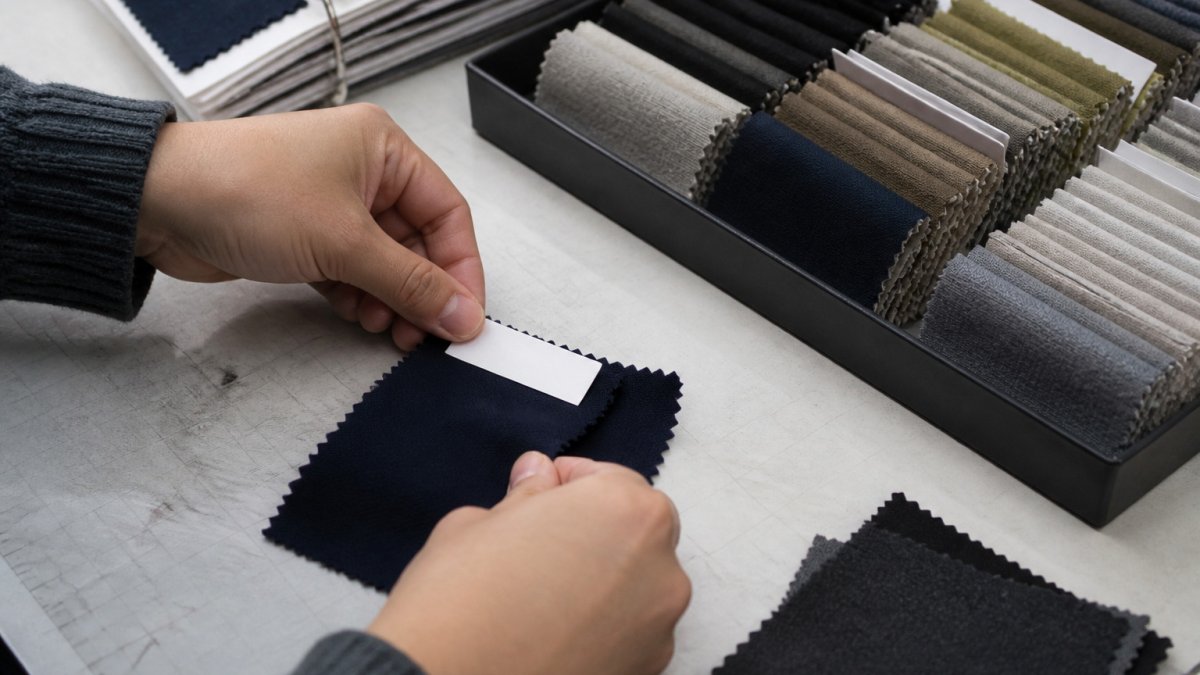
Use a consistent label format so the eye can scan it. A practical layout is the sample ID in the top corner, the fabric name and fiber content on the first line, and the technical fields (weave, weight, width, finish, care) grouped below. Print labels on cardstock or adhesive label stock, and attach them to the back of the swatch with a small amount of adhesive or a few stitches. Keep the same sample ID on the swatch, the page, and the digital record, that shared key is what makes the library searchable.
Organizing Samples and Keeping a Digital Fabric Swatch Library
Organize physical samples by fabric type first, then by project or color. That is the default because most people search by material before anything else. But a library that only grows in one direction becomes hard to search once it passes a few dozen samples, so plan the retrieval system before the collection gets large.
Common filing systems, and when each works best:
- By material type, cotton, canvas, poplin, knits, and so on. Best for sewing and design work where the material drives the decision.
- By end use, apparel, upholstery, outdoor, craft. Best for studios that serve multiple product lines.
- By color, useful for palette work, but weak on its own because color names drift between suppliers.
- By season or collection, best for fashion calendars and trend-driven work.
- By supplier, best for sourcing and reorder workflows.
A practical pattern is a primary sort by material type and a secondary index by supplier and color. Keep the physical binder in material order and let the digital record carry the cross-references.
A digital fabric swatch library adds a second layer of organization. Photograph or scan each swatch and log it in a spreadsheet with the same sample ID used on the label. A useful digital record carries the same fields as the label plus a few that only make sense on screen:
- Photo file name, match it to the sample ID so the image is findable
- Supplier link and reorder details, product URL, current price, minimum order quantity
- Status, active, low stock, discontinued, or archived
- Date added and date last checked, so you know when the record was verified
If you want faster retrieval, link the physical swatch to its digital record with a QR code. Print a small QR code on the label that opens the spreadsheet row, product page, or photo folder. That turns a binder page into a scannable entry point and saves flipping through a spreadsheet on a phone.
Keep both systems updated when you add or retire fabrics. Discontinued fabrics should stay in the library, marked clearly, so you can match them later. When a supplier changes a product name, weight, or fiber content, add a new version of the record rather than overwriting the old one, that history is what lets you explain why a past project used a fabric that no longer exists.
Fabric Swatch Book Examples and Your Next Step
Your fabric swatch book examples can be as simple as a ring binder with clear sleeves or as polished as a bound catalog. Look at a few samples before you finalize your layout.
Start small. Build a library of 10 to 15 core fabrics this week, then expand as your projects grow. A focused library you actually use beats a large one you never open.
Frequently Asked Questions
How do you make a fabric swatch book?
Start with a binder or ring-bound booklet and a stack of uniformly cut swatches, typically 4 by 4 inches. Mount each swatch on a sheet using a glue stick or double-sided tape, or punch holes and attach it with rings. Leave room under each swatch for a label with the fabric name, fiber content, width, weight, care instructions, and supplier. Build one page per fabric type or project so that you can flip through and compare samples quickly.
What information should be included on a fabric swatch label?
A useful label includes the fabric name or internal code, fiber content such as 100% cotton, fabric width in inches, weight in ounces per square yard, care instructions, supplier name, date acquired, and price per yard in USD. Add a unique sample ID that matches your digital record. Consistent fields across every label make the library searchable and prevent mix-ups when you order replacement yardage later.
What is the best way to store fabric swatches?
Keep swatches flat and protected from light, dust, and humidity. Archival sleeves or acid-free sheets help prevent fading and staining. Store the book upright on a shelf away from direct sunlight, and avoid stacking heavy items on top of it. Organize by fabric type, such as cotton, polyester, or canvas, so that retrieval takes seconds rather than a full search.
How often should a fabric swatch library be updated?
Update the library whenever you add a new supplier, discontinue a fabric, or receive a new dye lot, since colors can vary between batches. Review the full collection at least twice a year to remove faded samples, replace worn swatches, and mark discontinued items so designers do not specify them for new projects.
