

Table of Contents
- Why Verifying Fabric Quality Online Matters
- Step 1: Read Fiber Content and Textile Composition
- Step 2: Examine Product Specifications and Visual Details
- Step 3: Request Fabric Swatches, Best Practices
- Step 4: How to Check Fabric Drape Online
- Step 5: Evaluate Durability and Pilling Resistance
- Step 6: Use Return Policies and Customer Feedback as Quality Indicators
- Common Mistakes to Avoid When Ordering Fabric Online
Last Updated: August 17, 2026
Why Verifying Fabric Quality Online Matters
Ordering fabric online without seeing it in person feels like buying a car from a photograph. You're making a significant investment based on limited information, and the stakes are real. When you receive the wrong quality, you're not just out money, you're out time, production schedules, and credibility with your clients or customers.
At New Creations Fabric & Foam Inc, we understand this challenge intimately. Whether you're an apparel manufacturer scaling production, a costume designer sourcing specialty materials, or a small fashion brand building your first collection, how to verify fabric quality online directly determines whether your finished products meet your standards.
The real problem isn't that online fabric shopping is inherently risky, it's that most buyers rely on flawed methods: trusting photos, hoping for the best, and learning through expensive mistakes. According to textile industry quality standards from the American Society for Testing and Materials, proper fabric evaluation requires understanding specific technical specifications alongside visual assessment. This guide walks you through a systematic approach that combines technical literacy with practical inspection methods.
Step 1: Read Fiber Content and Textile Composition
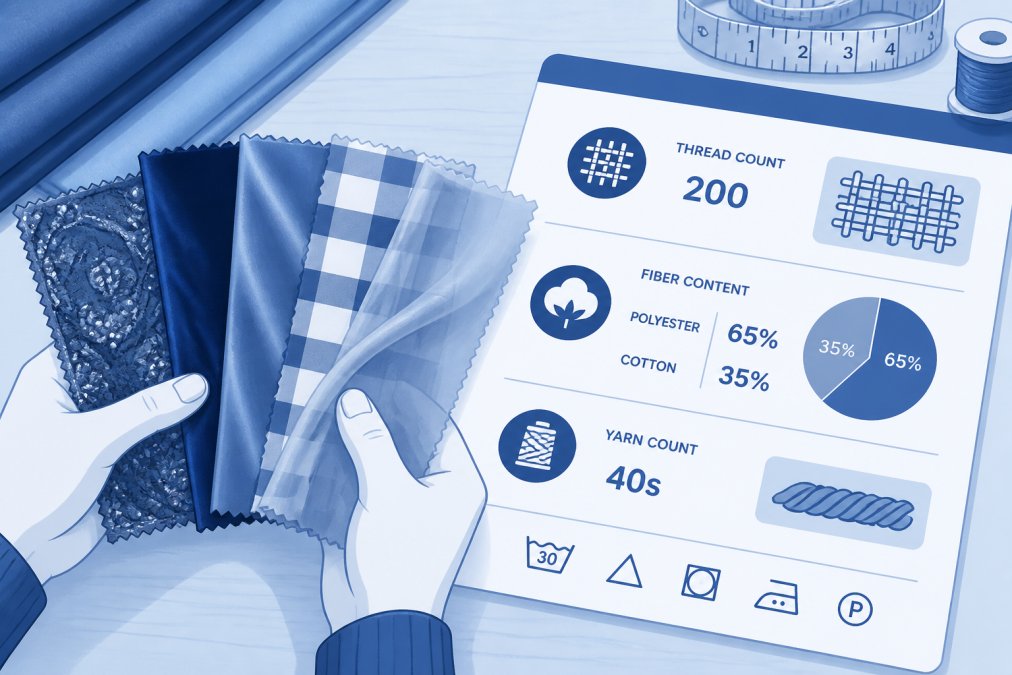
The first thing you need to know about any fabric is what it's actually made of. Fiber content determines how the fabric will perform, how it will age, and whether it meets your project requirements.
Understanding natural fibers versus synthetic blends
Natural fibers like cotton, linen, silk, and wool have distinct properties that synthetic alternatives cannot replicate. Cotton breathes and softens with washing. Linen is durable and crisp, ideal for structured garments. Silk drapes beautifully but requires careful handling. Wool provides warmth and elasticity.
Synthetic fibers like polyester, nylon, and acrylic offer affordability, easy care, and pilling resistance, but they don't breathe like natural fibers and can feel plastic-like if not blended properly.
Always read the fiber content label on the product page. A quality description lists percentages: "100% cotton," "65% polyester / 35% cotton," or "80% silk / 20% nylon." If the product listing doesn't specify fiber content, that's a red flag.

Why thread count and GSM matter for fabric quality
Thread count refers to the number of threads woven per square inch of fabric. Higher thread count generally indicates tighter weave, more softness, and greater durability. A thread count of 300-400 is considered high-quality for cotton sheets and apparel.
GSM stands for grams per square meter, a standardized measure of fabric weight. A lightweight cotton might be 100-150 GSM, while medium-weight fabric sits around 200-250 GSM, and heavyweight fabrics exceed 300 GSM. Understanding GSM is crucial because it directly affects drape, durability, and performance.
When shopping online, look for product descriptions that include these specifications. If a seller lists "200 GSM cotton twill" or "400 thread count," you're dealing with someone who understands fabric quality.
Step 2: Examine Product Specifications and Visual Details
Beyond fiber content, the product specifications page should tell you about weave structure, weight, width, and color information. These details separate a thorough supplier from a careless one.
Assessing weave structure and knit density from descriptions
The weave structure describes how threads interlace. A plain weave is simple and durable. A twill weave (diagonal lines) is sturdy and often used for workwear. A sateen weave creates a smooth, lustrous surface. A jacquard weave allows for complex patterns. Each weave affects how the fabric looks, feels, and performs.
The knit density matters for knitted fabrics. A tightly knitted fabric resists pilling and holds its shape. A loosely knitted fabric stretches more but may lose shape after washing. Product descriptions should specify whether the knit is single-knit, double-knit, or interlock.
When reading product specifications online, look for language like "tightly woven," "dense knit," or specific weave names. These indicate a seller who understands their inventory.
Checking for color consistency and dye uniformity
Color consistency is one of the most common complaints about online fabric orders. A photo might show a rich navy, but the fabric arrives with uneven dye or a completely different shade.
When examining product photos, look for multiple images showing the fabric in different lighting conditions. Check whether the color appears consistent across the entire visible swatch. Streaks, blotches, or obvious variations in tone suggest poor dye quality.
Also check the product description for information about dye lot. A responsible supplier will note whether multiple yards come from the same dye lot or whether color variation between orders is possible.
Step 3: Request Fabric Swatches, Best Practices
No amount of online research replaces holding the actual fabric in your hands. Requesting physical swatches is non-negotiable when ordering fabric for professional projects.
What to ask suppliers about material sourcing and durability
When you request a swatch, be specific about what you need to evaluate. Ask for a swatch large enough to assess drape, at least 4 inches by 6 inches. Ask whether the swatch comes from the same dye lot and production run as the bulk fabric you'll order. Ask about care instructions and whether the fabric has been pre-shrunk.
Include questions about durability. Ask how the fabric performs after repeated washing or dry cleaning. Ask whether it's prone to pilling. Ask about colorfastness. A quality supplier will answer these questions directly or provide test results.
When you receive the swatch, evaluate it in the same lighting conditions where your finished product will be used. If you're making apparel, hold it up to natural light and indoor light. Wash a corner of the swatch if the supplier permits, and observe whether the color holds and the fabric maintains its integrity.
Step 4: How to Check Fabric Drape Online
Drape is the way fabric falls and moves. It's one of the most difficult properties to assess from a photo, yet it's critical for apparel and many home decor applications.
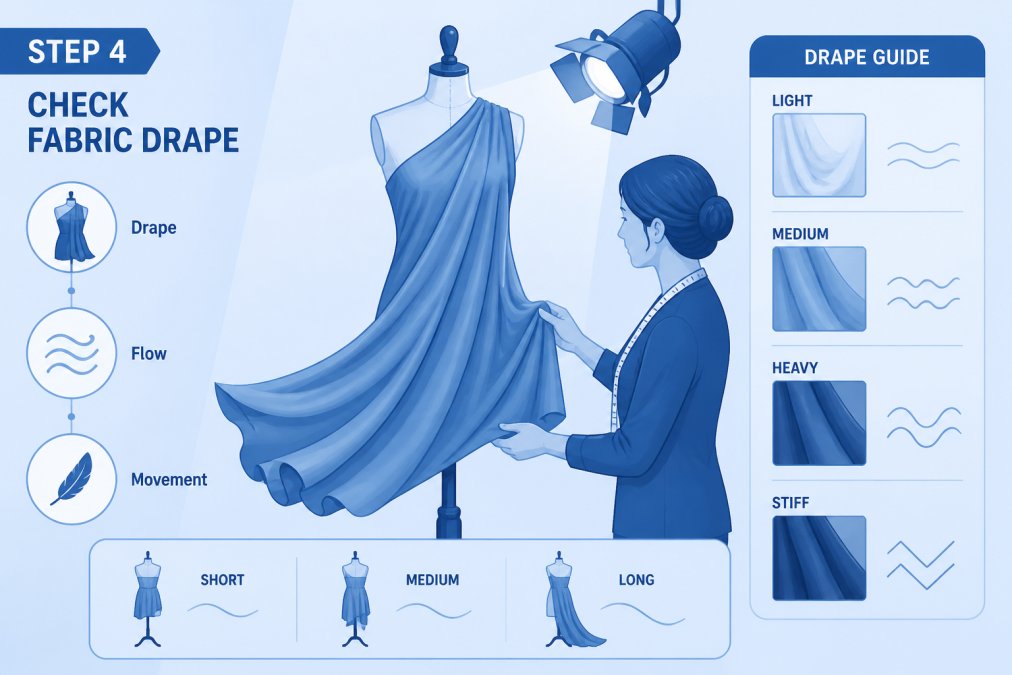
When evaluating drape online, look for product photos that show the fabric hanging or draped rather than laid flat. A photo of fabric pinned to a wall or hanging on a dress form gives you information about how it moves. A photo of fabric spread on a table tells you nothing about drape.
Pay attention to how structured or fluid the fabric appears. Heavyweight fabrics with tight weaves tend to hold their shape and create clean lines. Lightweight, loosely woven fabrics flow and create soft, curved silhouettes.
If the product photos don't show drape clearly, request a swatch. When you receive it, hold it vertically and observe how it falls. Does it hold a fold, or does it slide through your fingers? This tactile assessment is impossible to replicate online.
Step 5: Evaluate Durability and Pilling Resistance
Durability is where many online fabric purchases fail. A fabric might look and feel beautiful initially, but if it pills, frays, or loses shape after a few wears or washes, it's not quality fabric.
Pilling occurs when short fibers break free from the fabric surface and form small balls. Lower-quality fabrics pill easily, especially in high-friction areas. Higher-quality fabrics resist pilling because the fibers are tightly twisted and securely anchored in the weave.
When you read product descriptions, look for information about pilling resistance. Some sellers test fabrics using standard pilling tests and will share results. Look for language like "pill-resistant" or "low-pilling."
Fraying is another durability concern. Tightly woven fabrics fray less than loosely woven ones. Quality suppliers will mention whether the fabric frays significantly or holds its edges.
When you receive your swatch, test durability yourself. Rub the surface vigorously for several seconds and observe whether pills form. Gently pull at the edges and see whether threads pull free easily.
Step 6: Use Return Policies and Customer Feedback as Quality Indicators
A generous return policy is a quality signal. If a supplier stands behind their fabric with easy returns and exchanges, they're confident in their product. If they make returns difficult, that's a warning sign.
Read the return policy carefully. Look for policies that allow returns within 30 days, no questions asked. Some suppliers offer exchanges if the fabric doesn't meet your expectations.
Customer feedback is equally important. Read reviews from other buyers, especially those in your industry. Specific reviews are more valuable than generic praise. A review that says "perfect for quilting projects, holds color beautifully after washing" tells you more than "great fabric."
Pay attention to patterns in reviews. If multiple customers mention color variation, pilling, or durability issues, those are real problems. If reviews consistently praise consistency and quality, that's a strong indicator.
Common Mistakes to Avoid When Ordering Fabric Online
The first mistake is trusting photos alone. Lighting, camera settings, and monitor calibration all affect how fabric appears in images. Never order based on photos without requesting a swatch first.
The second mistake is ignoring specifications. Thread count, GSM, fiber content, and weave structure determine whether the fabric will perform as you need it to. Specifications are not optional information.
The third mistake is assuming all suppliers test their inventory equally. Some suppliers hand-inspect every roll. Others drop inventory without quality checks. When evaluating a supplier, ask about their quality control process.
The fourth mistake is ordering in bulk without testing. If you're new to a supplier, order a small quantity first. Evaluate how it performs in your actual workflow. Only after you're satisfied should you commit to larger orders.
The fifth mistake is not asking questions. A quality supplier welcomes questions about fiber content, durability, care instructions, and production details. If a supplier is evasive or dismissive, that's a red flag.
Ordering fabric online without verifying quality is a gamble that rarely pays off. The systematic approach outlined here, checking specifications, requesting swatches, assessing drape, and evaluating durability, transforms online fabric shopping from a risky proposition into a confident process. When you take the time to verify fabric quality before ordering, you protect your investment, maintain your production timeline, and ensure your finished products meet the standards your clients expect. New Creations Fabric & Foam Inc offers the consistency and refined finishes that come from rigorous quality verification. Explore our fabric collections and experience the difference that genuine quality control makes in every order.
| Verification Step | What to Evaluate | Why It Matters |
|---|---|---|
| Fiber Content | Natural vs. synthetic, percentage breakdown | Determines performance, breathability, and durability |
| Thread Count / GSM | Density and weight specifications | Indicates fabric substance and longevity |
| Weave Structure | Plain, twill, sateen, jacquard patterns | Affects appearance, durability, and suitable applications |
| Color Consistency | Dye uniformity across swatches | Ensures finished products look professional |
| Fabric Drape | How fabric falls and moves | Critical for apparel fit and aesthetic |
| Pilling Resistance | Durability under friction | Indicates quality of fiber and construction |
| Return Policy | Supplier confidence and flexibility | Protects you if fabric doesn't meet expectations |
| Customer Reviews | Real-world performance feedback | Reveals consistency and reliability patterns |
Frequently Asked Questions
How do you interpret fabric GSM and thread count online?
GSM (grams per square meter) measures fabric weight and density. Higher GSM typically indicates a heavier, more durable fabric. Thread count refers to the number of threads per square inch in the weave. For woven fabrics, a thread count of 200-400 is standard for quality apparel; higher counts feel softer and more durable. When shopping online, look for these metrics in the product specifications section. Suppliers like New Creations Fabric & Foam Inc list these details clearly, making it easier to compare fabrics before ordering.
What should I look for in fabric swatch request best practices?
Request multiple swatches of the same fabric to check for color consistency and dye uniformity across batches. Ask suppliers to send swatches in the exact shade and finish you plan to order. Include a note requesting samples that reflect production quality, not sample-grade material. Examine swatches under natural light and indoor lighting to assess how color behaves in different conditions. Test the hand feel, drape, and surface texture by manipulating the swatch. Check for pilling, fraying, or loose threads. Document your findings and compare swatches side-by-side before committing to a large order.
Is 60% cotton 40% polyester a good fabric blend?
A 60% cotton, 40% polyester blend is a solid, functional choice for many applications. Cotton provides breathability and natural comfort, while polyester adds durability, wrinkle resistance, and stretch recovery. This ratio balances the benefits of both fibers. However, the quality depends on the specific fiber quality, construction method, and finishing process, not just the percentages. Always check the GSM, thread count, and supplier reputation alongside the fiber content. For fashion apparel requiring premium feel, you may prefer higher cotton percentages (80-100%), while event decor and workwear often benefit from polyester blends for durability.
How can I determine fabric quality without touching it in person?
Read detailed product descriptions that specify fiber content, GSM, thread count, weave structure, and colorfastness standards. Request fabric swatches to evaluate hand feel, drape, and surface texture. Review customer feedback and photos from previous buyers showing how the fabric performs in real use. Check the supplier's return policy and quality assurance practices as indicators of confidence in their materials. Ask the supplier specific questions about durability, pilling resistance, and how the fabric behaves after washing or use. Many retailers, including New Creations Fabric & Foam Inc, provide comprehensive specifications and swatch options to help you make informed decisions before ordering.
This article was written using GrandRanker