

Table of Contents
- What to Look for in Wholesale Faux Fur for Coats
- Top Picks: Best Wholesale Faux Fur Options for 2026
- Best Faux Fur Pile Types for Outerwear
-
How to Source Faux Fur for Apparel Production
- Step 1: Order swatches and read the spec sheet
- Step 2: Test-sew a sample on your actual machine
- Step 3: Verify supply-chain transparency and certifications
- Step 4: Check dye lot consistency and continuous yardage
- Step 5: Plan for nap direction
- Cost-per-yard vs. bulk-roll pricing: when each makes sense
- Shipping and logistics for bulk faux fur
- High Quality Faux Fur Fabric Wholesale: Cost and Logistics
- Conclusion
- Frequently Asked Questions
Last Updated: September 10, 2026
What to Look for in Wholesale Faux Fur for Coats
Choosing the best wholesale faux fur for coats comes down to four specs: pile density, backing knit quality, pile height, and fiber composition. Get those right and you avoid the shedding, matting, and inconsistent drape of cheap rolls.

At New Creations Fabric & Foam Inc, we supply apparel manufacturers and independent designers who need consistent yardage across production runs. What separates coat-grade fabric from a craft-store roll:
- Pile density: Denser pile resists crushing at cuffs, collars, and elbows. Sparse pile looks bald after one season.
- Backing knit: A tight, stable backing holds the pile and takes industrial sewing without fraying. Loose backing sheds at every cut edge.
- Fiber composition: Polyester blends dominate coat production because they hold shape, resist moisture, and take dye evenly.
- Pile height: Long pile reads luxurious but catches on car doors and zippers. Short pile wears better for daily outerwear.
The American Apparel & Footwear Association's fiber and labeling guidance is a useful reference for material classification if you're labeling garments for retail. One insider note: fabric weight in ounces per yard matters less than pile density for coats. A 3 lb per yard roll with sparse pile will feel cheaper than a lighter, denser fabric.
Top Picks: Best Wholesale Faux Fur Options for 2026
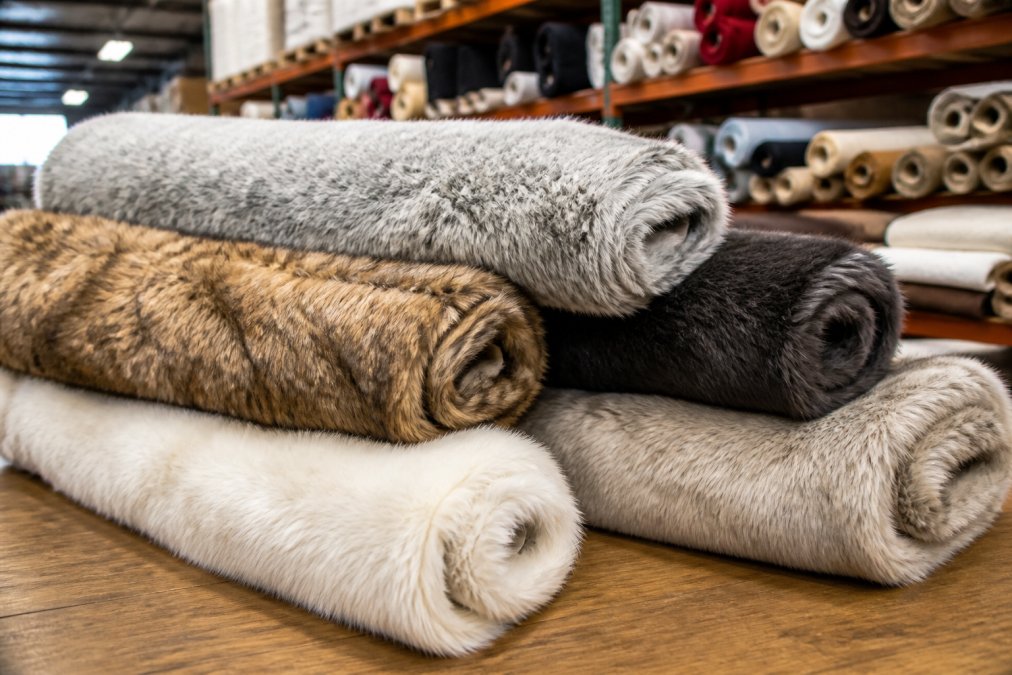
The best wholesale faux fur for coats in 2026 balances realistic texture with the durability coat construction demands. Four options cover nearly every outerwear use case.

Husky Faux Fur 58" Wide
The Husky Faux Fur is our top pick for coat production: a jacquard faux fur with roughly a 2 inch high pile that feels real to the touch. At $39.95 per yard, its density keeps collars and cuffs full through a season of wear.
Use it for jackets, coats, and statement trims. The 58-60 inch width means fewer seams per panel and less waste.
Where it falls short: The long pile needs careful pattern placement so nap direction stays consistent across panels. Cut carelessly and one sleeve will catch light differently than the other.
Solid Faux Fur 58" Wide
For designers who need a clean base for custom colorways, Solid Faux Fur at $29.95 per yard is the practical choice. The faux fox fur construction is fluffy and smooth, with a backing soft enough for garments that sit against skin. This fabric is made of quality faux fox fur, which is fluffy, soft and smooth, comfortable to touch, and the bottom of the fabric is also soft and friendly to the skin.
Solid faux fur is also the easiest pile type to cut and sew because there's no directional print to match, ideal for small-batch runs where you can't afford wasted yardage.
The tradeoff is visual: elegant, not dramatic. If your coat sells on texture alone, this delivers; if it sells on pattern, look elsewhere.
Shaggy Vegan Faux Fur 58" Wide
Shaggy Vegan Faux Fur at $29.95 per yard is the cruelty-free option that doesn't compromise on hand feel.
The honest limitation: Shaggy pile sheds more than jacquard or minky during cutting. Expect to clean your cutting table between lays, and finish every seam properly, sloppy finishing shows within weeks.
Rabbit Plush Minky Faux Fur 58" Wide
At $24.95 per yard, Rabbit Plush Minky is the budget-conscious pick. Its dense, velvety texture makes it a good choice for fitted coats, linings, and children's outerwear.
| Fabric | Price/Yard | Pile | Best For |
|---|---|---|---|
| Husky Faux Fur | $39.95 | ~2 inch jacquard | Statement coats, trims |
| Solid Faux Fur | $29.95 | Medium, faux fox | Custom colorways |
| Shaggy Vegan Faux Fur | $29.95 | Long shaggy | Oversized silhouettes |
| Rabbit Plush Minky | $24.95 | Short plush | Fitted coats, linings |
Best Faux Fur Pile Types for Outerwear
Pile type determines how a coat wears, not just how it looks. For production buyers, the useful layer is the technical spec behind each category: pile height in millimeters, fabric weight in GSM, backing construction, and behavior under an industrial needle.
Long pile (roughly 25-50 mm)
This is the fur-coat silhouette most buyers picture: dramatic, warm, and photogenic. It's also the hardest to sew and the most prone to crushing in storage.
- Typical weight: Heavier than plush or short pile, so long-pile rolls cost more to ship per yard.
- Backing: Usually a knitted or woven base with heavier pile tufting. A loose backing sheds at every cut edge; a tight one holds the pile through industrial sewing.
- Sewing notes: Use a walking or roller foot on an industrial machine, a fresh 90/14 or 100/16 needle, and a longer stitch length (3.0-3.5 mm). A standard presser foot drags the pile and produces uneven seams.
- Best for: Statement pieces, limited runs, dramatic collars and cuffs.
Plush (roughly 10-25 mm)
Plush sits in the middle: dense and velvety with a shorter surface. Plush faux fur drapes closer to the body, resists matting, and handles industrial sewing cleanly, the workhorse for production coats.

- Typical weight: Mid-range GSM, making it the easiest pile type to cut in multi-layer lays without shifting.
- Backing: Usually a stable knit that takes a serger or overlock cleanly, the pile type least likely to fray at cut edges.
- Sewing notes: A standard industrial machine with a 90/14 needle and 2.5-3.0 mm stitch length handles plush well. Finish raw edges with a serger or bind them, plush backing can unravel if left raw.
- Best for: Production coats, fitted silhouettes, linings layered under a long-pile shell.
Short pile (under 10 mm)
Short pile is the most durable and least expensive to work with. It won't deliver long pile's luxury finish, but it survives daily wear, car seats, and repeated cleaning.
- Typical weight: Lightest of the three, lowering freight cost per roll.
- Backing: Often a tighter knit or bonded backing, making short pile the most dimensionally stable under a needle.
- Sewing notes: Behaves closest to a standard apparel fabric. An 80/12 or 90/14 needle and 2.5 mm stitch length work for most constructions.
- Best for: Fitted coats, children's outerwear, linings, and any garment that will be machine-washed.
The spec sheet buyers should ask for
When you request swatches, ask for these numbers in writing. Most wholesale mills track them; many just don't publish them.
| Spec | Why it matters for coats |
|---|---|
| Pile height (mm) | Determines silhouette and how the coat photographs |
| Fabric weight (GSM) | Predicts drape, warmth, and freight cost per roll |
| Pile density (tufts per square inch) | Predicts crushing and shedding at cuffs and collars |
| Backing type (knit, woven, bonded) | Predicts fraying, stretch, and needle behavior |
| Fiber composition (% polyester, acrylic, modacrylic) | Predicts dye uptake, moisture resistance, and hand feel |
| Width (inches) | Determines panel yield and seam count per coat |
How to Source Faux Fur for Apparel Production
Sourcing faux fur for apparel production starts with matching pile type to garment, then verifying consistency and supply-chain claims before committing to a bulk order.
Step 1: Order swatches and read the spec sheet
Confirm pile height, backing, GSM, width, and color against your tech pack. Ask for the spec sheet in writing, if a supplier can't provide pile height in millimeters and weight in GSM, that signals how they'll handle a production problem later.
Step 2: Test-sew a sample on your actual machine
Run the fabric through your real machine and stitch settings. Faux fur backing behaves differently across industrial and home machines. Confirm needle size, stitch length, and presser foot before you scale. Backing that looks fine on a swatch can pucker, stretch, or jam under industrial feed dogs.
Step 3: Verify supply-chain transparency and certifications
This is the step most buyers skip, and it protects your brand. Ask three questions in writing:
- Where is the fabric milled? A named mill and country of origin is a baseline. "Imported" is not an answer.
- What fiber certifications apply? Look for recognized third-party programs. OEKO-TEX STANDARD 100 covers harmful substance testing for textiles. The Global Recycled Standard (GRS) covers recycled content claims. Both are administered by independent bodies and can be verified by certificate number.
- Is the fiber virgin or recycled polyester? Recycled polyester (rPET) is increasingly common in faux fur and is a legitimate marketing angle for brands selling on sustainability. Ask for the percentage and the certification that backs it.
For broader material traceability frameworks, the Textile Exchange's materials benchmarking resources is worth reviewing before you finalize a supplier relationship. For fiber content labeling rules on finished garments, the American Apparel & Footwear Association's fiber and labeling guidance is the reference most U.S. brands work from.
Step 4: Check dye lot consistency and continuous yardage
Order all yardage for a run at once: colors ordered at different times come from different dye lots and may not match. Most suppliers ship multiple yards as one continuous piece, but verify before ordering, seams mid-panel waste fabric and time.
Step 5: Plan for nap direction
Long-pile fabrics have a direction. Cut all panels in the same orientation or the finished garment looks uneven under light, the most common cause of a coat that looks wrong on the rack but fine on the cutting table.
Cost-per-yard vs. bulk-roll pricing: when each makes sense
The right answer depends on run size, storage, and how fast you turn inventory.
- By the yard (cut yardage): Best for sampling, small-batch runs, and testing a new colorway. You pay the highest per-yard rate, but you carry no inventory risk and can switch colors between runs. For a designer producing 10-50 coats, cut yardage is almost always the right call.
- By the roll (bulk): A full roll is typically 40-60 yards depending on the mill and pile type. Per-yard cost drops meaningfully at roll quantity, but you commit capital, storage space, and dye-lot risk to a single color. Bulk rolls make sense once a style is proven and you're producing the same coat repeatedly.
- The break-even question: Ask your supplier for both the cut-yard price and the roll price, then divide the roll price by the yard count. If the per-yard savings across your expected annual usage exceeds the cost of carrying the extra inventory, the roll wins. If you're not sure you'll use the full roll within a season, cut yardage usually wins even at a higher per-yard rate.
Shipping and logistics for bulk faux fur
Faux fur is bulky and heavy, making freight the hidden cost in wholesale sourcing.
- Vacuum-packing: Most mills vacuum-pack and fold fabric for shipping. This keeps freight cost down but leaves deep wrinkles. A hair dryer on low heat, brushed against the nap, restores the pile. Do this before cutting, not after, so panels lie flat for accurate pattern placement.
- Roll vs. flat-fold: Rolls ship better for long-pile fabric because they avoid permanent creases, but they take more container space. Flat-fold is cheaper to ship and fine for plush and short pile.
- Freight class and weight: Faux fur rolls are dense. Confirm the shipping weight per roll before you quote freight, and ask whether the supplier ships on your account or theirs.
- Lead time: Build lead time into your production calendar before you commit to a delivery date.
High Quality Faux Fur Fabric Wholesale: Cost and Logistics
High quality faux fur fabric wholesale pricing depends on pile type, fiber composition, and order volume, and the cost-per-yard math changes once you factor in shipping and waste.
Here's the practical breakdown for coat production:
- Cost per yard: Long-pile jacquard runs highest, plush and minky run lowest. Our faux fur collection includes options ranging from $24.95 to $39.95 per yard depending on pile type.
- Cost per coat:
- Shipping and logistics:
- Minimum order quantity:
Conclusion
That's the problem New Creations Fabric & Foam Inc exists to solve. Our faux fur collection spans jacquard, shaggy, minky, and solid pile types for fashion brands that need consistency and refined finishes at scale. We work with independent designers and large manufacturers alike, and ship continuous yardage so your panels match.
Explore Fabrics with New Creations Fabric & Foam Inc and build a coat line that holds up in the warehouse, on the machine, and on the rack.
Frequently Asked Questions
What should fashion brands look for when buying wholesale faux fur?
Focus on pile density, backing quality, and shedding resistance. A dense pile with a sturdy backing knit holds up better during cutting and sewing. Check if the supplier offers fabric swatches before bulk orders.
How can I tell if faux fur is high quality?
Check the backing: a tight knit or woven base prevents fraying. Request a swatch to test drape and weight before committing to a wholesale order.
What is the best faux fur material for durability in coats?
Polyester blends are often used for coat-making. A high-pile fabric with a dense backing knit can add structural integrity. For outerwear, consider fabrics that offer good drape and insulation.
How do I calculate cost per yard versus bulk roll pricing for wholesale faux fur?
Factor in shipping and minimum order quantities. Always request a quote that breaks down freight charges.
What are the best faux fur pile types for winter coats?
Long pile delivers a classic luxury look. Medium pile balances warmth and wearability. Short pile suits tailored or lightweight jackets. Consider the coat's intended use: fashion vs. function.