

Table of Contents
- Why Sourcing a BritexFabrics Alternative for Bulk Orders Matters
- Wholesale Fabric MOQ Requirements: What to Expect
- Wholesale Fabric Suppliers for Small Business: Selection Checklist
- Bulk Fabric Sourcing for Fashion Designers: Quality and Consistency
- Tiered Pricing and Cost-Per-Yard Breakdown for Bulk Fabric Orders
- Freight vs. Standard Shipping: Logistics for Large Fabric Orders
- Quality Control Checklist for Bulk Fabric Deliveries
- Conclusion: Choosing the Right Bulk Fabric Partner
- Frequently Asked Questions
Last Updated: September 11, 2026
Why Sourcing a BritexFabrics Alternative for Bulk Orders Matters
Searching for a BritexFabrics alternative for bulk orders usually starts with one frustrating experience: a shipment that looked nothing like the sample photos, or a production run that stalled because a supplier ran out of a core color. At New Creations Fabric & Foam Inc, we hear this from designers and event producers who need volume without gambling on quality. The real issue is not finding another storefront; it is finding a wholesale fabric partner whose inventory, dye lots, and lead times hold steady across repeat orders. This guide breaks down MOQ requirements, tiered pricing, freight logistics, and a quality control checklist.
Wholesale fabric sourcing is the process of purchasing textiles in volume directly from a supplier or mill, typically at a lower cost per yard than retail, with terms that account for minimum order quantities, lead times, and freight shipping.
Wholesale Fabric MOQ Requirements: What to Expect
Wholesale fabric MOQ requirements describe the smallest quantity a supplier will sell before pricing drops to wholesale tiers, and they vary widely by fabric type and supplier. Many set minimums per color rather than per order, which catches buyers off guard when they need five colors for one collection.
A common approach is a tiered system:
- Sample or swatch orders: single yards, retail pricing
- Small production runs: 25-50 yards per color (sba.gov)
- Full production runs: 100+ yards per color, lowest cost per yard
The trap is assuming all colors share one minimum: at 50 yards per color across six colors, that is 300 yards before you have sewn a single garment. Ask whether the minimum applies per color, per fabric, or per order.
Wholesale Fabric Suppliers for Small Business: Selection Checklist
Choosing among wholesale fabric suppliers for small business comes down to verifying six things before you place a bulk order. Small operations get burned not by bad fabric alone, but by suppliers who cannot support recurring, smaller-volume orders.
Use this checklist when evaluating any supplier:
- Vendor reliability: Ask for their fill rate on repeat orders, not just first orders. A supplier who ships 98% complete on first orders but 80% on reorders will stall your production calendar.
- Sample request workflow: Can you order swatches or headers before committing to bulk? A header is a cut of the actual production roll, not a marketing swatch, and the only way to confirm weight, hand, and color before committing yardage.
- Fiber content documentation: Do they provide fiber content and weight specs per roll, in writing, with the shipment?
- Dye lot policy: Will they hold a dye lot for reorders, or will colors shift between shipments? Ask for the lot number on every invoice.
- Lead times: What is the stated production and shipping window, and how often do they miss it? Ask for a recent on-time percentage, not a marketing claim.
- Returns and defects policy: What happens when a roll arrives flawed? Get the claim window in writing before you cut.
How to Run a Sample Request Workflow
A sample request is the first quality gate, run in three stages:
- Swatch request: Ask for a 4x4 inch to 8x8 inch swatch of each colorway. Swatches confirm color and approximate hand, but are cut from a sample roll and may not represent the production lot.
- Header request: Once you narrow to one or two colors, request a header (typically a 1/4 to 1/2 yard cut) from the actual production roll to confirm weight per yard, width, and drape against your pattern.
- Pilot yardage: For a first order with a new supplier, order a small pilot run (often 10-25 yards) before full production. Run it through your cutting and sewing process to catch shrinkage, needle damage, or finishing issues.
A supplier who cannot provide a header from the production roll is selling you a promise, not a fabric. Ask whether the swatch and bulk order come from the same dye lot; a vague answer is a red flag.
Reading a Supplier's Documentation
A supplier who cannot answer the dye lot question clearly will eventually send mismatched yardage. The documentation you want on file before ordering includes:
- Fiber content and weight (in ounces per square yard or grams per square meter, stated per roll)
- Width (in inches, with a tolerance range, since woven goods vary slightly)
- Dye lot number (on the invoice and on the roll label)
- Care and finishing specs (wash shrinkage, colorfastness, any applied finishes)
When a fabric is made to a supplier's own specification, as New Creations Fabric & Foam Inc does with its woven polyester poplin, the weight and finish stay controlled rather than depending on whatever a mill happened to run that month. That control lets a designer plan a production run with confidence, and it is why a documented spec sheet matters more than a low headline price.

Bulk Fabric Sourcing for Fashion Designers: Quality and Consistency
Bulk fabric sourcing for fashion designers lives or dies on consistency. A fabric that photographs beautifully but drapes differently from roll to roll produces a collection that looks mismatched on the rack, however well each garment is sewn.
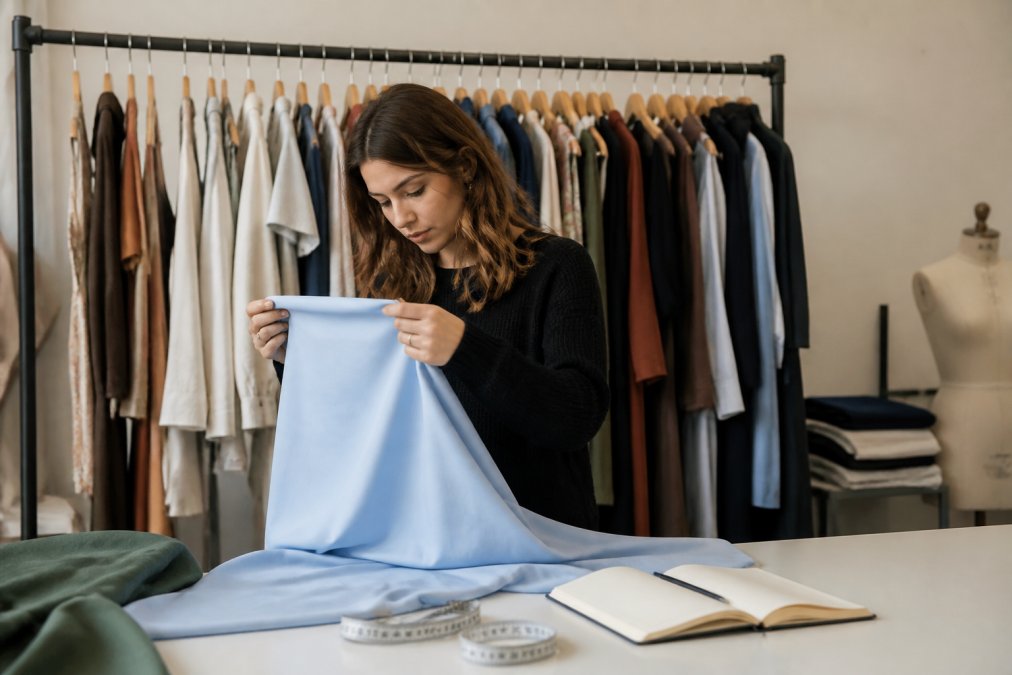
Textile consistency means the fabric's weight, weave, color, and drape stay within an acceptable range across every roll and reorder. The variables that matter most for apparel are fabric width, weight per yard, and fiber content. A poplin that runs 58 inches wide on one order and 60 on the next forces you to re-cut your patterns.
This is where a dedicated supplier relationship beats a marketplace listing. When a fabric is made to a supplier's own specification, as New Creations Fabric & Foam Inc does with its woven polyester poplin, the weight and finish stay controlled rather than depending on whatever a mill happened to run that month, control that lets a designer plan a production run with confidence.
Consistency is a documentation problem as much as a manufacturing one. A supplier who tracks dye lots and states weight specs per roll gives you something to hold them to.
Tiered Pricing and Cost-Per-Yard Breakdown for Bulk Fabric Orders
Tiered pricing rewards volume, but the savings only matter if the fabric is usable. Comparing cost per yard means comparing like-for-like weight and width, not just the headline number.
Here is how tiered pricing typically breaks down, using our own woven polyester poplin as a reference point:
| Order Volume | Typical Pricing Tier | Cost Per Yard (Reference) |
|---|---|---|
| Single yard | Retail | $7.95 (60" wide) |
| Small run | Retail, per color | $12.99 (58"/59" colors) |
| Production run | Negotiated wholesale | Quote required |
| Fabric Option | Width | Price Per Yard | Best For |
|---|---|---|---|
| Polyester Poplin 60" Wide | 60" | $7.95 | Tablecloths, backdrops, high-volume decor |
| Black Premium Woven Poplin | 58"/59" | $12.99 | Formal wear, event linens |
| Ivory Premium Woven Poplin | 58"/59" | $12.99 | Bridal, drapery, neutral palettes |
| Navy Blue Premium Woven Poplin | 58" | $12.99 | Uniforms, structured apparel |
| Olive Premium Woven Poplin | 58" | $12.99 | Casualwear, event accents |
The lower-priced 60-inch option is not a lesser fabric; it is a wider cut that reduces waste on large flat projects like tablecloths, changing the math on every bolt for decor producers running recurring orders.


Freight vs. Standard Shipping: Logistics for Large Fabric Orders
Freight shipping and standard parcel shipping solve different problems, and choosing wrong quietly eats your margin. Standard carriers handle small orders well; once you cross into multiple bolts, freight becomes cheaper and safer. Parcel rates climb sharply once an order exceeds roughly 150 pounds or fills more than two or three cartons.
The decision comes down to weight and volume:
- Standard shipping (parcel): Best for sample orders, single bolts, and swatch requests. Carriers like UPS, FedEx, and USPS handle these door-to-door with tracking.
- Freight (LTL, or less-than-truckload): Best for multi-bolt orders where weight makes parcel rates climb. Your shipment shares a trailer with other freight, so transit times run longer and delivery is typically to a commercial dock.
- Full truckload (FTL): Only makes sense at very high volume, generally when your order would fill most or all of a 53-foot trailer. Rare for fabric unless you are supplying a cut-and-sew operation.
The Real Cost Drivers in Freight
Freight quotes are a base rate plus accessorials, and the accessorials are where budgets break. The ones that hit fabric buyers most often:
- Liftgate: If your delivery address has no loading dock, you need a liftgate to get the pallet off the truck. This is a separate charge, often $75-$150 depending on the carrier and market.
- Residential delivery: Many carriers surcharge for residential addresses because the truck cannot maneuver or unload the same way. A small studio in a mixed-use building may still count as residential.
- Inside delivery: Standard freight delivery is to the dock or curbside. If you need the pallet brought inside, that is another accessorial.
- Limited access: Schools, churches, and some event venues count as limited-access locations and carry a surcharge.
- Redelivery: If no one is available to receive the shipment, the carrier charges for a second attempt.
Confirm every one of these before the order ships. A quoted freight rate that excludes liftgate and residential delivery can double at invoice.
Incoterms and Customs for International Orders
If you are sourcing from outside the country, the quoted price is rarely the landed cost. Incoterms determine who pays for what at each stage:
- EXW (Ex Works): You pay everything from the supplier's dock onward, including inland freight, export clearance, ocean or air freight, import clearance, and final delivery. Highest risk and coordination burden for the buyer.
- FOB (Free On Board): The supplier covers costs until the goods are loaded on the vessel at the origin port. You pay ocean freight, insurance, and import clearance.
- CIF (Cost, Insurance, Freight): The supplier covers ocean freight and insurance to your destination port. You still pay import clearance, duties, and inland delivery.
- DDP (Delivered Duty Paid): The supplier handles everything through final delivery, including duties. Highest cost to the supplier, so highest quoted price, but the least coordination for you.
For most small and mid-size fabric buyers, FOB or CIF is the common middle ground. Ask the supplier to state the Incoterm explicitly on the quote; a price without an Incoterm is not a comparable price.
On the import side, expect customs duties, merchandise processing fees, and possibly a customs broker fee, none included in an FOB or CIF quote. The duty rate depends on fiber content and country of origin under the Harmonized Tariff Schedule, so confirm the HTS classification with your supplier before ordering; a misclassified fabric can trigger an unbudgeted duty assessment (hts.usitc.gov).
Comparing Freight Quotes
When you request freight quotes, give every carrier the same information: weight, dimensions, number of pallets, pickup and delivery ZIP codes, and whether the destination has a dock. Then compare the all-in number, not the base rate. A carrier with a low base rate and three accessorials can cost more than one with a higher base and none.
For buyers ordering domestically, these complications largely disappear, a real argument for keeping a primary supplier close to your production. Domestic ground freight still requires the dock-or-liftgate decision, but it eliminates customs clearance, Incoterms, and currency risk.
Quality Control Checklist for Bulk Fabric Deliveries
Quality control for bulk deliveries is a process, not a single inspection. Catching a defect after cutting 40 yards is far more expensive than catching it when the bolt arrives.
Run this check on every bulk delivery before cutting:
- Count and measure: Confirm yardage and fabric width against the invoice
- Roll-by-roll color match: Lay rolls side by side under consistent lighting
- Weight check: Weigh a sample yard against the stated spec
- Defect scan: Look for fraying, pulls, holes, and slubs across the first and last few yards
- Drape test: Confirm the fabric hangs consistently across rolls
- Document everything: Photograph any discrepancy before you cut
A supplier who ships "multiple yards in one continuous piece" removes one common source of waste, since you are not losing usable yardage to cut ends. Ask whether continuous-piece shipping is standard or a request.
Conclusion: Choosing the Right Bulk Fabric Partner
The hard part of replacing a retail-first fabric source is not finding another storefront; it is finding a partner whose inventory, dye lots, and lead times hold steady when you scale. New Creations Fabric & Foam Inc ships multiple yards as one continuous piece and stocks a wide variety of colors. If your production timeline cannot afford another mismatched shipment, explore the collection and start with a sample. Explore Fabrics with New Creations Fabric & Foam Inc and build a supply chain that holds up across every run.
Frequently Asked Questions
Does Britex Fabrics offer wholesale pricing for bulk orders?
Britex Fabrics primarily serves retail customers and does not publish tiered wholesale pricing or volume discounts. For bulk fabric orders, buyers typically need a supplier with clear MOQ structures and transparent cost-per-yard rates. New Creations Fabric & Foam Inc offers polyester poplin starting at $7.95 per yard, with pricing that scales for larger production runs and a dedicated B2B focus.
What are the best online fabric stores for professional designers?
The best online fabric stores for professional designers combine consistent stock, clear fiber content, and reliable lead times. Look for suppliers that ship multiple yards in one continuous piece, provide swatches before bulk orders, and maintain textile consistency across dye lots. New Creations Fabric & Foam Inc stocks polyester poplin in 58-inch widths with stain and wrinkle resistance, making it suitable for repeated production runs.
How do I choose a reliable fabric supplier for apparel manufacturing?
Start by requesting swatches to verify hand feel, drape, and color accuracy against your screen. Confirm the supplier's MOQ, lead times, and policy on dye lot variation. Ask whether they ship continuous yardage and how they handle backorders. A reliable supplier will answer these questions directly and provide references from other production buyers. New Creations Fabric & Foam Inc ships multiple yards in one continuous piece.
Can I get fabric swatches from bulk suppliers before ordering?
Yes, most reputable bulk suppliers offer swatch programs or sample cuts for a small fee, sometimes credited toward your first order. Always request swatches before committing to a production run, especially for color-critical projects like bridal or uniform fabrics. Compare the swatch under natural and artificial light to catch metamerism issues. New Creations Fabric & Foam Inc recommends confirming color in person because monitor displays can shift tones.
What should I look for when comparing fabric wholesalers?
Compare MOQ thresholds, cost per yard at your order volume, shipping method (freight vs. standard), and quality control documentation. Ask about textile testing standards and whether the supplier provides batch consistency guarantees. Also check lead times and restocking speed. New Creations Fabric & Foam Inc offers polyester poplin at $7.95 to $12.99 per yard depending on color, with 58-inch widths and machine-washable durability suited for bulk purchasing.