

Table of Contents
- Canvas vs Vinyl for Outdoor Backdrops: Quick Comparison
- Durability and Weather Resistance
- Print Quality, Color Vibrancy, and Reflectivity
- How to Prevent Glare on Outdoor Backdrops
- Weight, Portability, and Installation
- Maintenance, Cleaning, and Repair
- Cost Comparison and Where to Source in Bulk
- Which Material Fits Your Event?
- Frequently Asked Questions
Last Updated: September 16, 2026
Canvas vs Vinyl for Outdoor Backdrops: Quick Comparison
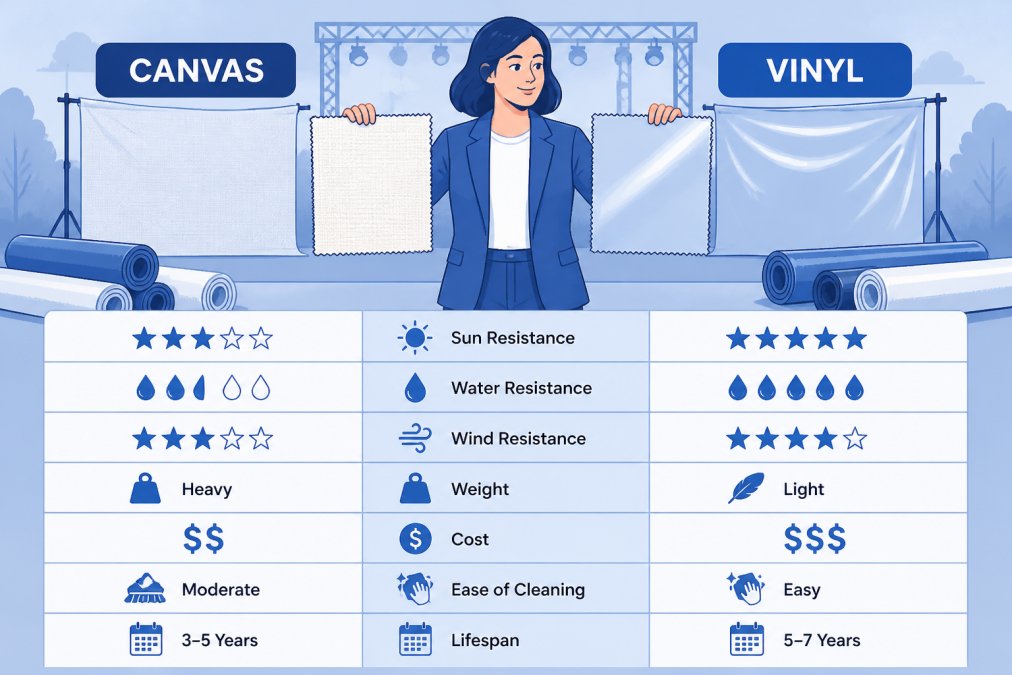
Choosing between canvas vs vinyl for outdoor backdrops comes down to one question: how long must the backdrop survive the elements? Canvas is a natural cotton substrate that absorbs light and photographs with a soft, painterly finish; vinyl is a PVC-based material that shrugs off rain, wind, and UV exposure without warping. At New Creations Fabric & Foam Inc, we supply both substrate families to event planners, trade show exhibitors, and production teams; the right pick depends on whether your backdrop is a one-weekend piece or a long-term installation.
Here is the short version before we break it down.
| Factor | Canvas | Vinyl |
|---|---|---|
| Weather resistance | Moderate; needs sealing | High; waterproof |
| Print quality | Matte, soft, painterly | Glossy, high-saturation |
| Reflectivity | Glare-free | Can glare under direct sun |
| Weight | Lighter per square yard | Heavier, denser |
| Installation | Tension frame or grommets | Grommets, pole pockets, or frame |
| Maintenance | Machine wash, spot clean | Wipe clean only |
| Cost per yard | Lower entry price | Higher, but longer service life |
| Best for | Indoor studios, short events | Outdoor trade shows, long displays |
Durability and Weather Resistance
Vinyl wins on raw durability. PVC-based substrates resist moisture, mold, and mildew in ways cotton cannot match without chemical treatment. Our Marine Vinyl 54" Wide carries a 600 GSM weight, a 0.85 mm thickness, and a cold crack rating of -10° F, so it stays flexible in a cold snap instead of turning brittle.

Canvas, by contrast, is a natural fiber. Our 10 oz Cotton Duck Canvas uses a 100% cotton basket weave with a tear strength of 1000 N warp and 700 N weft. That is tough fabric, but cotton absorbs ambient moisture, so untreated canvas left out overnight in humid conditions will sag and develop mildew.

The takeaway: vinyl for anything exposed to rain or overnight dew, canvas for covered or indoor-adjacent setups. For canvas outdoors, plan on a water-repellent treatment and a covered rigging point.
Print Quality, Color Vibrancy, and Reflectivity
Canvas produces the more flattering image; vinyl produces the bolder one. The two substrates take ink differently, and that difference shows in every photograph.
Canvas has a textured, matte finish that scatters light rather than bouncing it, so colors read softer and skin tones look natural in portraiture. Dye-sublimation and UV printing both bond well to cotton, and the light absorption means you rarely fight hotspots.
Vinyl is smoother and glossier. High-resolution UV printing on vinyl delivers intense color saturation and crisp edges, which is why you see it on trade show booth graphics and outdoor banners. The trade-off is reflectivity: a glossy vinyl surface under direct sun or a strong flash can throw glare that washes out part of the print.
Neither is objectively "better." A portrait studio backdrop wants canvas. A product-launch wall that needs to punch through a crowded expo hall wants vinyl.
How to Prevent Glare on Outdoor Backdrops
Glare is a lighting problem, not a material defect, and you can solve most of it before the event.
For vinyl backdrops, keep direct light off the surface. Angle spotlights at 45 degrees rather than head-on, diffuse hard sources with a scrim or softbox, and position the backdrop so the sun is not hitting it face-first during peak shooting hours. A matte-finish vinyl or matte overlaminate kills most specular reflection.
For canvas, glare is rarely the issue; uneven lighting is. Because cotton absorbs light, a single strong source creates a hot spot on one side and a dim falloff on the other. Bounce a fill light off the opposite side or use two matched sources at equal distance.
A simple test before doors open: walk the camera's actual shooting position and look at the backdrop through the lens. If you see a bright reflection or a blown-out patch, move the light, not the backdrop.
Marine Vinyl 54" Wide| New Creations →
Weight, Portability, and Installation
Vinyl is heavier and holds its shape; canvas is lighter and wrinkles more. That trade-off drives most logistics decisions.
A 600 GSM vinyl is dense and substantial.
Maintenance, Cleaning, and Repair
Most guides stop at "wipe vinyl, wash canvas." The real work is crease removal, stain triage, and repair, and those protocols differ sharply between substrates.
Cost Comparison and Where to Source in Bulk
Canvas carries the lower entry price; vinyl carries the longer service life. For a single short event, canvas is usually cheaper. For a backdrop reused across a season of outdoor events, vinyl's durability often makes it the better cost-per-use.
| Product | Material | Width | Price |
|---|---|---|---|
| Marine Vinyl | PVC, polyester backing | 54 in | $19.99/yd |
| 10 oz Cotton Duck Canvas | 100% cotton | 58/60 in | $12.95/yd |
| 10 oz Fine Arts Unprimed Canvas | 100% cotton | 58/60 in | $12.95/yd |
| 7 oz Fine Arts Canvas Roll | 100% cotton | 62 in | $120.95/roll |
Which Material Fits Your Event?
Match the substrate to the event's exposure, not to a generic "best material" ranking. Below is the practical mapping, followed by the two factors most buyers forget until the venue or the client asks.
- Outdoor trade show booth, multi-day: Vinyl. It handles weather, holds shape, and takes high-saturation UV printing.
- Indoor portrait studio: Canvas. Matte finish, glare-free, flattering color for portraiture.
- One-day outdoor event with a covered rig: Canvas with a moisture treatment. Cheaper and photographs beautifully.
- Recurring outdoor event series: Vinyl by the roll. Best cost-per-use and consistent color.
- Fine art reproduction backdrop: Unprimed cotton canvas. The natural texture is part of the look.
- High-traffic expo hall with strict venue rules: Whichever substrate carries the flame-retardant documentation the venue accepts. See below.
Fire safety and NFPA 701
This is the factor that stops setups at the loading dock. Many event venues, hotels, and convention centers require that any hanging fabric or backdrop pass a recognized flame-resistance standard before it goes up, and the one most commonly cited in the United States is NFPA 701, the Standard Methods of Fire Tests for Flame Propagation of Textiles and Films.
Environmental impact and end of life
Cotton canvas is a natural fiber that biodegrades at end of life and can often be repurposed or donated after an event. PVC vinyl is not recyclable in most municipal streams and does not biodegrade; when a vinyl backdrop reaches end of life, it typically goes to landfill. That trade-off cuts against vinyl's durability advantage in a way most comparisons ignore.
Frequently Asked Questions
What is the best material for an outdoor backdrop?
It depends on your event. Marine vinyl at 600 GSM is waterproof, mold and mildew resistant, and holds up to 200 hours of direct UV sunlight, making it the stronger pick for long-term outdoor displays and trade show booths. Cotton duck canvas at 315 GSM offers a natural matte finish that photographs beautifully for portrait sessions and short events, though it needs shelter from rain. Match the material to how long it stays outside.
Does vinyl hold up better than canvas in direct sunlight?
Vinyl generally wins on sun exposure. Marine vinyl resists up to 200 hours of direct UV light and is UV color fade resistant, so printed graphics stay sharp through repeated outdoor use. Cotton canvas resists fading and pilling, but prolonged direct sun will gradually soften its color. For backdrops that live outside for weeks, vinyl is the safer investment.
How do glare and reflection differ between canvas and vinyl backdrops?
Canvas has a matte, textured surface that absorbs light, so it produces almost no glare in photos. Vinyl has a smooth finish that can reflect direct sun or flash, creating hot spots. To prevent glare on outdoor backdrops made of vinyl, position the backdrop out of direct sunlight, use diffused lighting, or angle the surface away from the light source. Canvas rarely needs this adjustment.
Which backdrop material is more resistant to wind and tearing?
Both materials are tear resistant, but they fail differently. Cotton duck canvas has a tear strength of 1000 N warp and 700 N weft, so it flexes in wind without splitting. Marine vinyl has a tear strength of 30 N warp and 30 N weft, but its 18,000 double rub abrasion rating and 450 N warp tensile strength make it highly durable against surface wear. For windy outdoor setups, secure either material with grommets and weighted poles.
Is canvas or vinyl easier to clean after an outdoor event?
Vinyl is easier. Marine vinyl wipes clean with a brush, mild cleaning solution, and a spot clean, and its waterproof surface resists mold and mildew. Canvas can be machine washed with like colors and tumble dried on low, which handles dirt and dust well but takes more time. For events with food, mud, or rain exposure, vinyl saves hours of cleanup.