

Table of Contents
- Why Synthetic Fabrics Need a Different Needle
- Needle Types and Their Intended Uses
- Ballpoint vs Universal Sewing Needle: What's the Difference
- Needle Size for Polyester Fabric and Other Synthetics
- Sewing Machine Needle for Stretch Fabric: Spandex, ITY Knit, and Scuba
- Sewing Machine Needle Size Chart
- Test Before You Sew: Setup, Thread Pairing, and Troubleshooting
- Conclusion
- Frequently Asked Questions
Last Updated: October 21, 2026
Why Synthetic Fabrics Need a Different Needle
Choosing the right needle for synthetic fabrics starts with one fact: polyester, spandex, and other synthetics fight back against a standard needle. These fibers are smooth, dense, and often stretchy. A needle that works fine on cotton can snag, skip, or tear them.
At New Creations Fabric & Foam Inc, we supply polyester poplin, ITY knit, scuba, and neoprene to designers and production teams. The same question comes up again and again: why does my machine skip stitches on this fabric?

The answer is usually the needle. Synthetic fibers are manufactured, not grown. They have no natural texture to grip the thread. They also melt at low heat, so a dull or wrong-shaped point creates friction that damages the fabric.
Below, we break down needle types, sizes, and setup so you can match the needle to the fabric the first time.
Needle Types and Their Intended Uses
Three needle types cover most synthetic sewing: sharp, ballpoint, and stretch. Each has a different point shape, and that point decides how the needle moves through the fabric.
- Sharp (universal) needle: A slightly rounded point for woven fabrics. Good for polyester poplin and other stable synthetics.
- Ballpoint needle: A rounded tip that pushes between knit loops instead of piercing them. Best for jersey and interlock knits.
- Stretch needle: A special point and scarf that handle high-stretch fabrics. Made for spandex blends and elastic knits.
Sharp, Ballpoint, and Stretch Points Explained
The point shape is the whole story. A sharp needle cuts through woven fibers cleanly. A ballpoint needle slides between knit loops so it does not break the yarn. A stretch needle goes further, with a deeper scarf and a stronger shaft to handle弹性 fabrics without skipped stitches.
Get the point wrong and the damage shows up fast: snagging on knits, holes that grow after washing, or thread that breaks every few inches.
Ballpoint vs Universal Sewing Needle: What's the Difference
A ballpoint needle has a rounded tip that separates knit loops. A universal needle has a slightly rounded point designed for woven fabrics. The difference matters most on stretchy material.
Use a universal needle on stable wovens like polyester poplin. Use a ballpoint on knits like jersey. If the fabric stretches more than a little, move up to a stretch needle.
Needle Size for Polyester Fabric and Other Synthetics
Needle size for polyester fabric depends on weight. Lightweight polyester takes a size 70/10 or 80/12. Medium-weight polyester, like poplin, takes an 80/12 or 90/14. Heavier synthetics and thick knits need a 90/14 or 100/16.
The numbers work in two systems. The metric number (70, 80, 90) and the American size (10, 12, 14) describe the same needle. A 70/10 is fine, an 80/12 is medium, and a 90/14 is heavier.
Matching Needle Size to Fabric Weight
- Lightweight (chiffon, lining): 60/8 or 70/10
- Medium-weight (poplin, ITY knit): 80/12 or 90/14
- Heavyweight (scuba, neoprene, coating): 90/14 or 100/16
A needle that is too small bends and skips. One that is too large leaves visible holes. Match the size to the weight, then test on a scrap.
Sewing Machine Needle for Stretch Fabric: Spandex, ITY Knit, and Scuba
The sewing machine needle for stretch fabric should be a stretch or ballpoint needle in a size that matches the fabric weight. Spandex blends, ITY knit, and scuba all stretch, so a sharp needle is the wrong choice.
ITY Knit Jersey Spandex 58" Wide| New Creations Fabric & Foam Inc. →
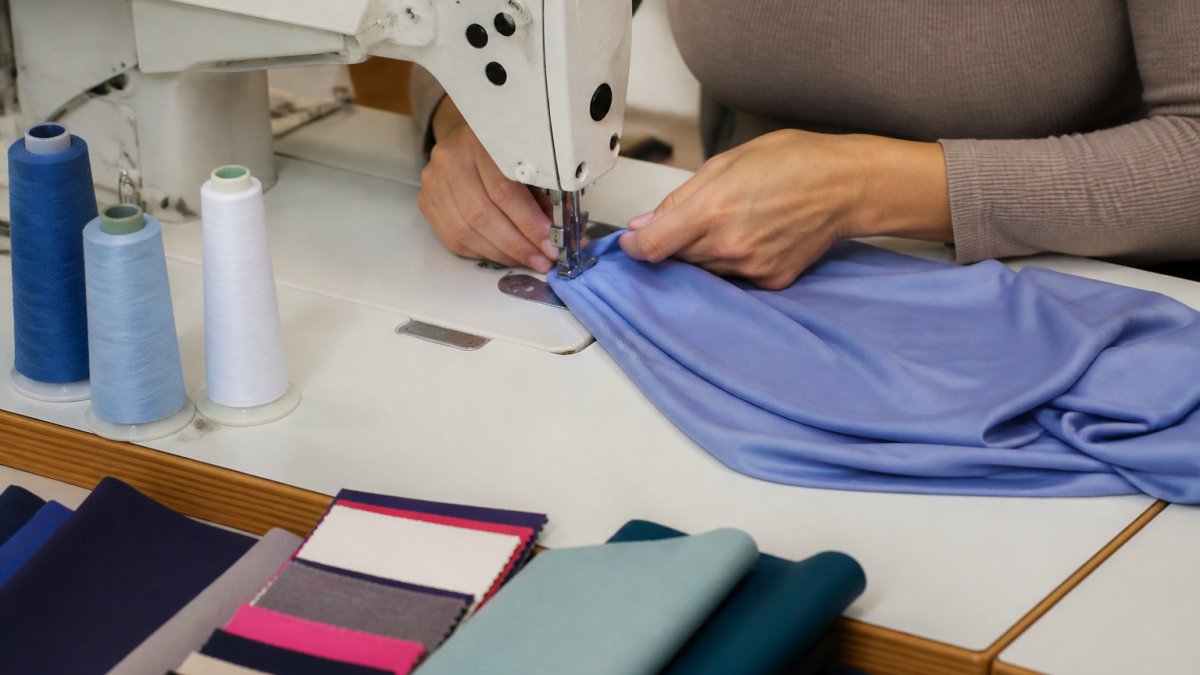
Our ITY Knit Jersey Spandex is a 95% polyester, 5% spandex blend with 40% vertical stretch. That stretch calls for a stretch needle, usually 75/11 or 80/12. Our Scuba Double Knit is 100% polyester with light vertical stretch, so a ballpoint or stretch needle in 90/14 works well. For thicker Neoprene Scuba, step up to a 100/16 stretch needle.


Sewing Machine Needle Size Chart
Most needle charts sort fabric by weight alone. Synthetics need a second axis: fiber content, weave structure, and stretch percentage. Two fabrics can weigh the same and still need different needles. Use the chart below as a starting point, then confirm with a scrap test.
| Synthetic fabric | Fiber / construction | Needle type | Needle size | Why |
|---|---|---|---|---|
| Polyester poplin | 100% polyester, plain woven | Universal/sharp | 80/12 | Stable woven, low stretch; sharp point prevents fiber snagging |
| Polyester taffeta | 100% polyester, tight woven | Universal/sharp | 70/10 or 80/12 | Fine, dense weave; oversized needle leaves permanent holes |
| Slippery lining (acetate or polyester) | Woven, smooth finish | Universal/sharp | 60/8 or 70/10 | Thin and prone to runs; small needle reduces puncture marks |
| Microfiber | Polyester or nylon, densely woven | Universal/sharp or microtex | 70/10 or 80/12 | Tight weave dulls needles fast; microtex point gives cleaner penetration |
| ITY knit jersey | Polyester/spandex, 40% vertical stretch | Stretch | 75/11 or 80/12 | High stretch; stretch scarf prevents skipped stitches |
| Athletic knit (spandex blend) | Nylon/spandex or polyester/spandex | Stretch | 75/11 | Four-way stretch; ballpoint can still skip on high-recovery knits |
| Fleece (polyester) | Knitted, brushed | Ballpoint or stretch | 90/14 | Loft and nap hide stitches; ballpoint separates loops without cutting |
| Scuba double knit | 100% polyester, double knit | Ballpoint or stretch | 90/14 | Medium weight, light stretch; ballpoint protects knit structure |
| Neoprene scuba (2mm) | Polyester/spandex with coating | Stretch | 100/16 | Thick and spongy; larger needle clears the material |
| Coated synthetic (PU or acrylic) | Woven base with polymer coating | Universal/sharp or stretch | 80/12 or 90/14 | Coating grabs the needle; sharp point reduces drag, stretch point if base is knit |
Two rules override the chart. First, if the fabric stretches more than 20% in any direction, use a stretch needle regardless of weight. Second, if you see skipped stitches with the recommended size, go up one size before changing needle type. Replace needles every 6-8 hours of sewing, or sooner if you feel drag; a dull needle on dense synthetics causes more damage than a wrong size.
Test Before You Sew: Setup, Thread Pairing, and Troubleshooting
Test seams prevent most synthetic-fabric problems. Set up your machine with a fresh needle, the right thread, and a scrap of your fabric before you touch the garment.
Pair polyester thread with polyester fabric. It stretches with the fabric and holds up to washing. Cotton thread on a stretchy synthetic can break under tension.
Check these before you sew:
- New needle, correct type and size
- Polyester thread matched to fabric weight
- Stitch length set to 2.5-3 mm for knits
- Tension tested on a scrap
- Presser foot pressure adjusted for stretch
Common Problems and Fixes
- Skipped stitches: Wrong needle type or a dull point. Switch to a stretch or ballpoint needle.
- Thread breakage: Needle too small or thread too weak. Size up and use polyester thread.
- Puckering: Tension too tight or needle too large. Loosen tension and test again.
- Snagging: Sharp needle on a knit. Change to a ballpoint.
- Holes along the seam: Needle too large or blunt. Drop one size and replace the needle.
Conclusion
Synthetic fabrics reward a careful needle choice. Match the point type to the fabric structure, match the size to the weight, and test before you sew. That routine prevents the skipped stitches, snags, and holes that ruin a project.
At New Creations Fabric & Foam Inc, we stock polyester poplin, ITY knit, scuba, and neoprene so you can test the right needle on the exact fabric you plan to use. Our collections offer the consistency and refined finishes that production teams depend on.
Explore our fabrics and match your next project to the right material from the start.
Frequently Asked Questions
What needle should I use on 100% polyester fabric?
It depends on the weave. For woven polyester like poplin, use a universal or sharp needle in size 70/10 to 80/12, which suits lightweight to medium-weight fabric. For knit polyester or stretchy blends with spandex, switch to a ballpoint or stretch needle in the same size range. A 90/14 works for heavier polyester like 2mm neoprene scuba. Always test on a scrap first, because the wrong point can cause skipped stitches or snagging.
Should I use a ballpoint or universal needle on synthetic fabric?
Use a ballpoint needle on knits and stretchy synthetics such as ITY knit jersey or scuba, because its rounded point pushes between yarns instead of cutting them, which prevents runs and skipped stitches. A universal needle suits woven synthetics like polyester poplin. The ballpoint vs universal sewing needle choice comes down to fabric structure: knits get ballpoint, wovens get universal or sharp.
What sewing machine needle works best for stretchy polyester?
A stretch needle in size 75/11 or 90/14 handles most stretchy polyester, including spandex blends. The stretch needle has a deeper scarf and a slightly rounded point that helps the hook catch the thread and reduces skipped stitches on elastic fabric. For very stretchy knits, a ballpoint also works. Pair the needle with a polyester or stretch thread and a slightly longer stitch length for clean stitch formation.
How can I prevent skipped stitches when sewing synthetic fabric?
Skipped stitches on synthetics usually come from a needle that is too sharp for a knit, a dull needle, or the wrong size for the fabric weight. Switch to a ballpoint or stretch needle, replace a worn needle, and match size to weight (70/10 for lightweight, 90/14 for heavier). Also check that the needle is inserted fully and the thread matches the fabric. Test on a scrap of the same fabric before starting your project.