

Last Updated: October 22, 2026
Quick Summary
Choose a dense, low-pile velvet fabric with enough body to hold a seam, ideally cotton velvet in the 230-320 GSM range with pile under about 1.5 mm. Test a swatch for crush recovery, pressing, and fusible bonding before buying a roll, since silk crushes and rayon lacks backbone.
- Cotton velvet is matte and firm, making it the tailor's choice for structured blazers.
- Below roughly 200 GSM velvet droops at the lapel and collapses at the shoulder.
- Cut every pattern piece with the nap running the same direction to avoid mismatched panels.
- Press velvet from the back on a needle board, never face-down on a hard board.
- Match interfacing weight to velvet weight; over-fusing turns velvet board-stiff.
Table of Contents
- Start With the Blazer, Not the Bolt
- Velvet Fabric Types and Uses: Which One Belongs on a Blazer
- Velvet vs Velour vs Velveteen: Telling Them Apart Before You Buy
- Velvet Fabric Weight for Jackets: The Number That Decides Structure
- Swatch Tests Before You Commit to a Roll
- Interfacing, Lining, and Tailoring Compatibility
- Sewing Velvet Blazer Tips: Cutting, Seams, and Pressing
- Conclusion
- Frequently Asked Questions
Start With the Blazer, Not the Bolt
Most people shop for velvet backwards. They fall for a color, order the roll, and then discover the fabric won't hold a lapel.
A blazer is a tailored object. It needs a crisp edge, a clean shoulder, and a body that keeps its shape. Velvet fights all three if you pick the wrong one.
So here's the throughline for this guide. Structure comes first, sheen second. Get that order right and the rest falls into place.
Velvet Fabric Types and Uses: Which One Belongs on a Blazer
The best velvet for a structured blazer is a dense, low-pile cloth with enough body to hold a seam. Loose, drapey velvet belongs on gowns and curtains, not lapels.
Velvet fabric types and uses vary widely. Some are built for movement, others for shape. Here's the short version:
- Cotton velvet: matte, firm, holds structure well. Good for tailoring.
- Silk velvet: luxurious, fluid, prone to crushing. Better for eveningwear.
- Rayon velvet: soft drape, deep color, less body. Suits dresses.
- Synthetic velvet: durable, affordable, variable quality. Check the weight.
Cotton, Silk, Rayon, and Synthetic Velvet Compared
Cotton velvet is the tailor's friend. It has a shorter pile and a firmer hand, so it presses into a crisp edge and keeps a lapel roll.
Silk velvet looks incredible and behaves terribly in a jacket. Heat and pressure crush the pile, especially at the collar and shoulders.
Rayon velvet sits in the middle. It drapes beautifully but lacks the backbone a blazer needs. Synthetic velvet, usually polyester, can work if the weight is right.
| Velvet Type | Structure | Best For | Watch Out For |
|---|---|---|---|
| Cotton | Firm, matte | Blazers, tailoring | Less sheen |
| Silk | Fluid, lustrous | Eveningwear | Crushes under heat |
| Rayon | Soft drape | Dresses | Weak body |
| Synthetic | Variable | Budget tailoring | Quality swings |
Velvet vs Velour vs Velveteen: Telling Them Apart Before You Buy
Velvet is a woven pile fabric with a dense, short nap. Velour is a knit with a thicker, stretchier pile.
The confusion costs people money. Velour stretches, so it sags at the shoulder. Velveteen is closer to velvet but firmer and less lustrous.
For a blazer, velveteen is a legitimate choice. Velour is not, unless you want a soft, casual jacket.
Check the label and the hand. If it stretches easily, it's velour. If it feels dense and matte, it's velveteen.
Velvet Fabric Weight for Jackets: The Number That Decides Structure
Velvet fabric weight for jackets should land in the medium-to-heavy range, but "medium-to-heavy" is useless without numbers and a map to the garment.
As a working range for structured blazers, most tailoring practitioners look for roughly 230-320 GSM (about 6.8-9.4 oz per linear yard at standard 54-60 inch widths).
Our Stretch Crushed Velvet, for example, runs 234 GSM at 0.60 mm thick.

Matching Weight and Pile to Blazer Features
Weight alone doesn't decide structure. Pile height, fiber, and weave density all change how a given GSM behaves. Use this matrix to translate a spec sheet into tailoring decisions:
| Blazer feature | What to look for | Why it matters |
|---|---|---|
| Crisp lapel roll | 260-320 GSM, short pile (under ~1.5 mm), cotton or cotton-blend | Firm hand holds the roll; tall pile flattens under the collar |
| Soft/unstructured shoulder | 230-270 GSM, low-to-medium pile | Enough body to skim the shoulder without a pad |
| Built-up shoulder with pad | 280-320 GSM, dense weave | Supports pad and sleeve head without collapsing |
| Slim, close fit | 230-260 GSM, some mechanical stretch | Lets the jacket move with the body at armhole and waist |
| Relaxed, boxy fit | 260-320 GSM, low stretch | Holds a straight line instead of clinging |
| Two-way stretch comfort | 240-300 GSM with 2-10% spandex | Give at the elbow and back without losing the lapel |
A heavy cloth with a tall pile still crushes, so read the two numbers together. A 300 GSM velvet with a 2 mm pile will mark at the collar faster than a 260 GSM velvet with a 1 mm pile.
Pile Height, Nap, and Sheen in Plain Terms
Pile is the raised surface fibers. Nap is the direction those fibers lean. Sheen is how the light hits them.
Stretch Velvet 58" Wide| Apparel Costumes| New Creations Fabric & Foam Inc. →
Short pile (roughly 1 mm or less) reads crisp and tailored. Medium pile (about 1-2 mm) reads plush but still tailored.
Nap direction changes the color depth: run your hand one way and the velvet looks rich, the other way and it looks flat.
Swatch Tests Before You Commit to a Roll
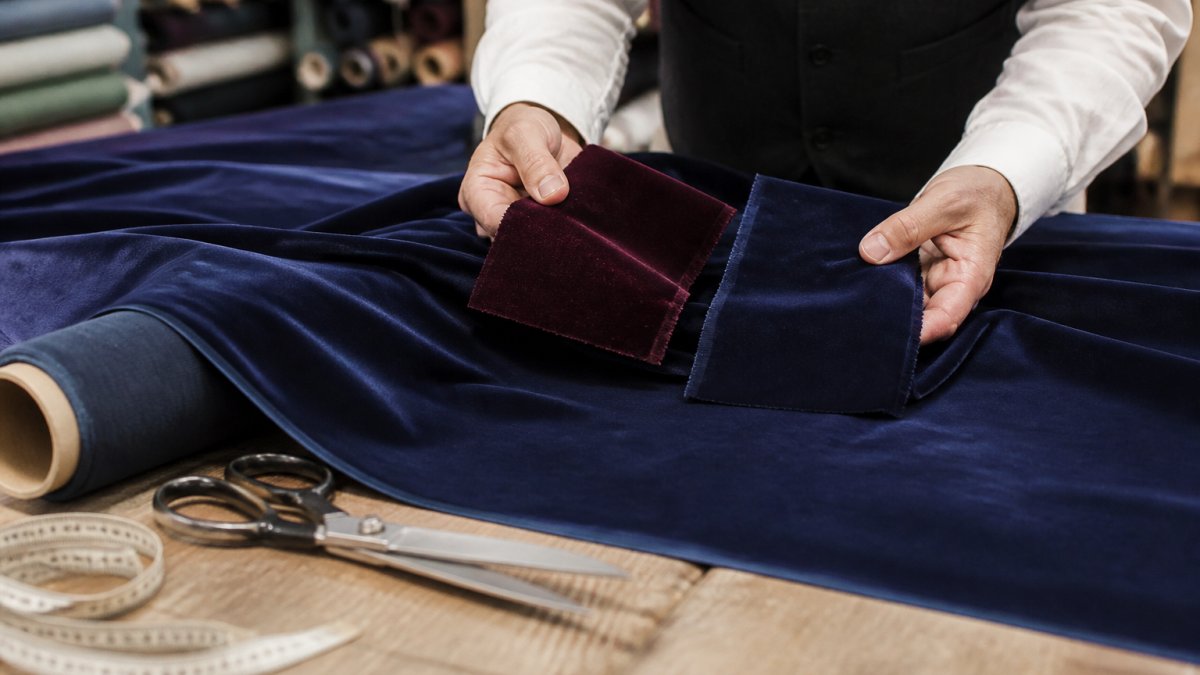
Order a swatch before you order a roll. A swatch tells you more in five minutes than a product photo ever will, but only if you test it the way the finished blazer will stress it.
The Five Tests and How to Read the Results
- Crush test: squeeze the swatch in your fist for ten seconds, release, and wait one minute. Pass: pile springs back with only faint shading. Fail: a visible crease or flattened patch remains. A fail here predicts crushed lapels and collar within a season.
- Drape and body test: hold the swatch over your finger and let it hang. Pass for a structured blazer: it folds in a defined line rather than flopping. Fail: it collapses like a jersey. If it drapes too softly, plan on heavier interfacing or choose a firmer cloth.
- Nap and shading test: tilt the swatch under daylight and under a warm lamp. Pass: color shifts smoothly and evenly across the surface. Fail: blotchy or patchy shading, which signals inconsistent pile and will show as mismatched panels once cut.
- Press test: press a corner with a warm iron (wool/silk setting, no steam) over a needle board or scrap of velvet. Pass: pile recovers after cooling. Fail: a permanent shine or flattened patch. If it fails, the fabric cannot take a pressed lapel edge or seam opening.
- Seam test: sew a 6-inch seam with a ballpoint needle and slightly longer stitch length, then press it open from the back. Pass: seam lies flat without puckering or bulk. Fail: puckering, tunneling, or a stiff ridge. A fail means you'll need to reduce seam bulk (trim, grade, or use a bound finish) or pick a lighter cloth.
Two Extra Tests for Structured Jackets
- Stretch and recovery: cut a 4-inch strip, stretch it gently across the width, and release. Pass for a woven velvet: little to no stretch. If it stretches more than about 10% and doesn't snap back, treat it as a knit (velour-like) and expect sag at the shoulder.
- Fusible bond test: bond a small piece of your intended low-temperature fusible interfacing to the back of the swatch. Pass: smooth bond with no strike-through or pile distortion on the face. Fail: bubbles, shine, or a stiff, boardy hand. This single test prevents the most common velvet-blazer failure: over-fused, rock-hard fronts.
Turning Swatch Results Into a Buying Decision
Score each test pass/fail and weigh them against your pattern. A crisp, padded-shoulder blazer needs passes on crush, press, and fusible bond. A soft, unlined jacket can tolerate a softer drape and a slightly taller pile. If the swatch fails crush or press, walk away: that fabric will not survive a blazer, no matter how good the color looks on a screen.
Interfacing, Lining, and Tailoring Compatibility
Velvet needs the right support system underneath. Interfacing adds body to the lapel and front.
Use a fusible interfacing that bonds at low heat. High heat crushes velvet. Test the bond on a scrap first.
For lining, choose a smooth, lightweight fabric. Bemberg and polyester linings both work.
A common mistake is over-fusing. Too much interfacing turns velvet board-stiff and kills the drape. Match the interfacing weight to the velvet weight.
Sewing Velvet Blazer Tips: Cutting, Seams, and Pressing
Sewing velvet blazer tips start with one rule: work with the nap, never against it. Cut all pattern pieces in the same direction.
Use a walking foot or a light touch. Velvet layers slip. Pin inside the seam allowance only, because pin marks show.
- Use a ballpoint or stretch needle to avoid skipped stitches
- Sew with a slightly longer stitch length
- Press on a needle board or a scrap of velvet, never directly
- Press from the back, never the pile side
- Clip curves carefully to keep seams flat
Our Royal Velvet is 100% polyester. Always pre-wash before sewing, and use a ballpoint needle to prevent skipped stitches.

For stretch velvet, our Stretch Velvet brings 4-way stretch at 90% polyester and 10% spandex. It suits costumes and dancewear more than firm tailoring, so weigh it against your structure needs.
Here's the selection matrix we'd use before buying:
| Priority | Choose | Why |
|---|---|---|
| Crisp lapel | Cotton velvet | Firm, matte, holds shape |
| Deep sheen | Silk or rayon | Rich color, soft drape |
| Budget build | Synthetic velvet | Affordable, check weight |
| Stretch comfort | Stretch velvet | 4-way give, casual fit |
Conclusion
Picking velvet for a tailored blazer comes down to one decision: structure over shine. Get the weight, pile, and fiber right, and the jacket holds its shape for years.
We stock velvet built for real garment work, from firm Royal Velvet to stretch options for softer projects. Every roll ships in continuous yard lengths, so your panels match.
Explore Fabrics at New Creations Fabric & Foam Inc and start with a swatch. Your lapels will thank you.
Frequently Asked Questions
What weight of velvet is best for a structured blazer?
Look for a medium to heavyweight velvet, roughly 230 GSM and up, with a short pile. Heavier velvet gives the blazer body and helps the lapel hold a crisp edge, while very light velvet collapses at the shoulder and roll line. When you compare swatches, drape each one over your hand: if it flops without shape, it will not tailor well. Ask suppliers for the GSM and ounces per linear yard before ordering, and test a sample on your actual pattern piece.
Is stretch velvet suitable for a tailored blazer?
Stretch velvet can work, but it changes how you sew. A 90% polyester, 10% spandex stretch velvet, like the 58-inch Stretch Velvet at $14.95 per yard, moves with the body and suits softer, less constructed blazers. For a sharply tailored jacket, the stretch makes it harder to control the roll line and lapel. If you use it, stabilize the fronts and lapels with fusible interfacing and sew with a stretch stitch so seams do not break under movement.
How do you keep velvet from crushing while sewing a blazer?
Heat and pressure crush the pile, so press from the back only, using a needle board or a scrap of the same velvet as a pressing cloth. Never iron directly on the face of the fabric. Use a low setting and lift-and-press rather than dragging the iron. When cutting, keep the pile running the same direction on every piece so the color reads evenly. Store the finished blazer on a padded hanger, not folded, to protect the nap.
Should velvet blazers be lined?
Yes, lining a velvet blazer is standard practice. Velvet has more friction than smooth fabrics, so a lining helps the jacket slide on and off over other garments. A lining also hides the interfacing and seam allowances, which are bulky in heavier velvet. Choose a smooth lining such as polyester or cupro, and cut it slightly larger than the shell to allow for movement. This keeps the velvet from straining at the seams during wear.