

Table of Contents
- What You'll Need Before You Measure
- Measuring Table Dimensions for Accurate Fabric Yardage
- Standard Tablecloth Drop Length for Every Event Style
- Calculating Fabric Yardage for Rectangular Tables
- Calculating Fabric for Circular Tables
- Calculating Fabric for Table Skirts
- Using a Fabric Yardage Calculator for Tables
- Fabric Width, Shrinkage, and Seam Allowance: Pro Tips
- Frequently Asked Questions
Last Updated: September 19, 2026
What You'll Need Before You Measure
Fabric yardage is the total length of fabric, measured in linear yards, needed to complete a project. Getting it right for event tables starts with the right tools and a few decisions made before you ever touch a tape measure.
Gather these first:
- A retractable tape measure, at least 120 inches
- The actual table you'll be covering, not an assumed size
- Your chosen fabric bolt and its listed width
- A notebook or phone for recording numbers
- Painter's tape to mark layout on the floor
Banquet tables vary more than most event planners expect, and a wrong measurement means a second order, a second dye lot, and a mismatched set.
Know your drop length, your fabric's usable width, and your hem allowance before you calculate anything.
Measuring Table Dimensions for Accurate Fabric Yardage
Accurate fabric yardage depends on three numbers: table length, table width, and table height. Measure all three, then write them down in inches.
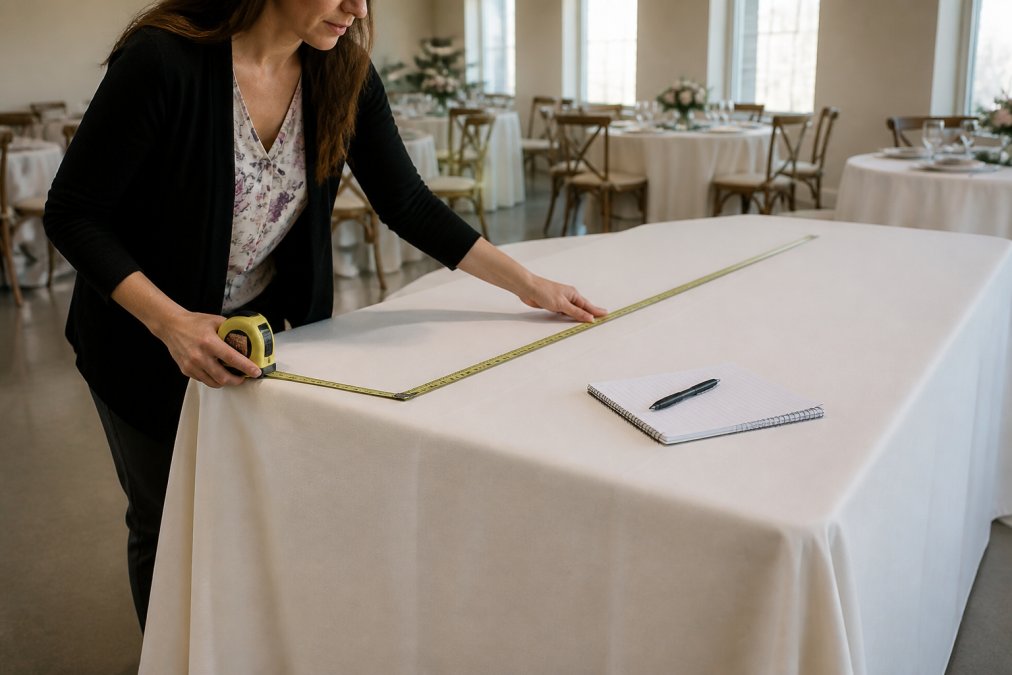
Run the tape along the full length, edge to edge. Do the same across the width. For height, measure from the floor to the tabletop surface, not to the apron or frame.
A common mistake is measuring only the top. The tabletop surface tells you nothing about how far the fabric needs to fall.
Rectangular and Square Tables
Measure length, width, and height in inches. Square tables need only one top measurement since all sides match.
Round and Oval Tables
For round tables, measure straight across the center for the diameter. For oval tables, measure the longest point and the widest point separately. Record both.
Standard Tablecloth Drop Length for Every Event Style
Drop length is the distance fabric hangs from the table edge toward the floor. It sets the entire look of your table setting, so choose it before you calculate.
| Event Style | Drop Length | Look |
|---|---|---|
| Casual / picnic | 8-12 inches | Relaxed, practical |
| Cocktail / high-top | 15-24 inches | Modern, mid-length |
| Banquet / wedding | 30 inches (floor length) | Formal, full drape |
| Puddle / draped | 30 inches plus extra | Romantic, pooled fabric |
A standard table height is 30 inches, so a floor-length drop equals the table height. Add extra length if you want fabric to pool on the floor.
Calculating Fabric Yardage for Rectangular Tables
The formula for a rectangular table is straightforward once you have your measurements.
Length of fabric needed = table length + (2 × drop length) + hem allowance
Width of fabric needed = table width + (2 × drop length) + hem allowance
Then divide total inches by 36 to convert to linear yards.
Step-by-Step Formula and Example
Say you have a 96-inch by 30-inch banquet table with a 30-inch floor-length drop and a 2-inch hem allowance on each side.
- Length: 96 + (2 × 30) + 4 = 160 inches
- Width: 30 + (2 × 30) + 4 = 94 inches
- Convert length to yards: 160 ÷ 36 = 4.45 yards
If your fabric bolt is 90 inches wide, the 94-inch width requirement means you need a seam or a wider bolt. This is where seam allowance and panel joining come in, and it's the step most guides skip entirely.
Calculating Fabric for Circular Tables
Circular tables need a different approach because the fabric must cover a round surface plus the drop.
Diameter of finished cloth = table diameter + (2 × drop length) + hem allowance
A 60-inch round table with a 30-inch drop and 2-inch hems needs a finished diameter of 124 inches. That's wider than most fabric bolts, so you'll join panels.
36"x36" SQUARE POLY POPLIN TABLECLOTH →
For a round cloth, cut a square of fabric equal to the finished diameter, then trim the corners into a circle. You'll need at least two panels joined down the center for a table this size.
- Measure the diameter across the center
- Add drop length twice
- Add hem allowance
- Round up to the nearest half yard when ordering
Calculating Fabric for Table Skirts
A table skirt covers the sides of the table only, so the math is simpler than a full cloth.
Skirt fabric = table perimeter + seam allowance, divided by usable fabric width
For a rectangular table, perimeter is (2 × length) + (2 × width). For a round table, multiply the diameter by 3.14.
Add 1 inch of seam allowance per panel joint. If your fabric is 54 inches wide and your table is 30 inches tall, one width covers the height with room for a hem. Divide the perimeter by the usable width to find how many panels you need, then multiply by the height plus hem.
Using a Fabric Yardage Calculator for Tables
A fabric yardage calculator for tables removes the arithmetic and reduces ordering errors. Most work the same way: enter table dimensions, drop length, fabric width, and hem allowance, and the tool returns linear yards.
Here's what to check before trusting any calculator:
- Does it account for seam allowance on joined panels?
- Does it round up to the nearest half yard?
- Does it let you enter your actual fabric width?
- Does it separate rectangular and circular formulas?
An online calculator is only as good as its inputs. If it assumes a standard 60-inch fabric width and you're working with a 90-inch bolt, the output will overshoot. Always confirm the width of fabric on your specific bolt.
For a quick manual check, remember the core rule: total inches divided by 36 equals linear yards, and you always round up.
Fabric Width, Shrinkage, and Seam Allowance: Pro Tips
The difference between a clean result and a short one comes down to three details most people overlook.
Pre-wash your fabric. Many natural and blended fabrics shrink after the first wash. If you cut to exact size and then wash the finished cloth, the drop shortens and the hem pulls. Pre-wash and dry before cutting so shrinkage happens first.
Match your seam allowance to your join. When you join two panels, you lose width to the seam. A half-inch seam on each side removes a full inch from your usable width. Add that back into your calculation.
Watch the selvage and grainline. The selvage is the finished edge of the fabric bolt. Cut parallel to the grainline so panels drape evenly and don't twist. Panels cut against the grain hang differently and show in photos.
For event-grade linens that hold up to repeated use, the Textile Exchange's materials guidance offers useful context on fiber durability. Our own 90" x 108" rectangular polyester poplin tablecloth covers a standard 8-foot banquet table with a full floor-length drape, made in the USA from 100% spun polyester poplin. For longer tables, the 90" x 132" version handles the extra length without a seam.


If you're building a coordinated set, our 36" x 36" square poly poplin overlay adds a layered look over a base cloth.

Getting fabric yardage wrong on an event order costs more than money. It costs a second dye lot, a mismatched set, and a deadline you can't move. New Creations Fabric & Foam Inc stocks fabrics built for event work, with color-fast, stain-resistant polyester poplin that holds its elegant look through repeated wash cycles. Our seamless tablecloths come in standard banquet sizes with serged edges and rounded corners for a clean fall. Explore Fabrics and order your full set at once for consistent color across every table.
Frequently Asked Questions
How many yards of fabric do I need for a 6 ft table?
For a 6-foot rectangular table (30 inches wide, 30 inches high) with a floor-length drop, you need about 4 yards of 60-inch-wide fabric. The tablecloth dimensions would be 72 inches long by 90 inches wide. If using 45-inch fabric, you'll need to join panels, increasing yardage to approximately 6 yards. Always add 1/2 inch per side for hem allowance. For a standard 8-inch drop, you need about 2.5 yards of 60-inch fabric.
How do I calculate fabric yardage for a round table?
Measure the table's diameter and add twice the drop length. For a 60-inch round table with a 30-inch drop, the total diameter is 120 inches. Since fabric comes in 60-inch widths, you'll need to piece two panels. Cut two 120-inch lengths, join them with a seam, then cut the circle. Add 1 inch for hem allowance. This requires about 7 yards of 60-inch fabric. For a 30-inch drop on a 48-inch table, you need approximately 5 yards.
What is the standard tablecloth drop length for a formal event?
For formal events, the standard tablecloth drop length is 30 inches, which reaches the floor. This is common for weddings, galas, and corporate banquets. For semi-formal events, a 15-inch drop is typical, falling halfway down the table. Casual settings often use an 8-inch drop. The standard tablecloth drop length you choose affects fabric yardage: a 30-inch drop requires significantly more fabric than an 8-inch drop, so plan accordingly.
Does fabric width affect how many yards I need to purchase?
Yes, fabric width directly impacts yardage. Wider fabric (60 inches) often eliminates the need for joining panels, reducing total yardage. Narrower fabric (45 inches) may require seaming two panels for wide tables, increasing fabric consumption. For a 90-inch-wide tablecloth, 60-inch fabric requires two panels, while 120-inch-wide fabric (if available) needs only one. Always check the usable fabric width before calculating, and account for seam allowance if joining panels.