

Table of Contents
- Silk Velvet vs Rayon Velvet for Evening Gowns: A Quick Comparison
- Drape, Luster, and Hand-Feel: How the Two Velvets Differ
- Durability, Crushing, and Long-Term Wear
- Dye Payoff, Breathability, and Skin Sensitivity
- How to Sew Velvet Fabric for Evening Gowns
- Velvet Fabric Care Instructions for Evening Wear
- Choosing the Right Velvet for Your Gown Silhouette
- Frequently Asked Questions
Last Updated: September 20, 2026
Silk Velvet vs Rayon Velvet for Evening Gowns: A Quick Comparison
Choosing between silk velvet and rayon velvet for evening gowns comes down to budget, drape, and how the fabric ages. Silk velvet is the traditional luxury choice, while rayon velvet delivers much of the same depth and luster at a fraction of the cost. This guide from New Creations Fabric & Foam Inc breaks down fiber content, hand-feel, durability, and construction so you can pick the right bolt with confidence.
The short answer: silk velvet wins on heritage and natural fiber prestige, but rayon velvet wins on price, color range, and forgiving construction for most modern evening wear.
| Feature | Silk Velvet | Rayon Velvet |
|---|---|---|
| Fiber content | Natural protein fiber | Regenerated cellulose |
| Drape | Fluid, weighty | Fluid, slightly lighter |
| Luster | Deep, subtle sheen | Bright, even sheen |
| Cost | High | Moderate |
| Crushing | Marks easily | Marks easily |
| Best for | Heirloom gowns | Production and bridal |
Fiber Content and What It Means for Your Gown
Silk velvet is woven from natural protein fiber produced by silkworms. Rayon velvet is made from regenerated cellulose, often labeled viscose, spun from wood pulp. That difference drives price, dye behavior, breathability, and skin feel.
Silk's natural fiber structure gives it a subtle, shifting luster many designers consider unmatched. Rayon takes dye more evenly and holds brighter, more saturated color across a production run, an advantage when color consistency between rolls matters.
Both are pile fabrics, meaning the surface is built from upright yarns that create the nap. How that pile is constructed and finished determines the hand-feel you'll notice the moment you unroll the bolt.
Drape, Luster, and Hand-Feel: How the Two Velvets Differ
Drape, luster, and hand-feel decide whether a velvet gown reads as couture or costume, and they all trace back to the fiber. Silk velvet's pile is built from continuous filament protein fiber, long, smooth, slightly irregular yarns, so its sheen shifts as the wearer moves, catching light at different angles. Rayon velvet's pile is spun from more uniform regenerated cellulose filament, so its sheen reads brighter and more even. Under warm evening lighting, silk velvet absorbs light and gives it back slowly; rayon velvet reflects it directly.
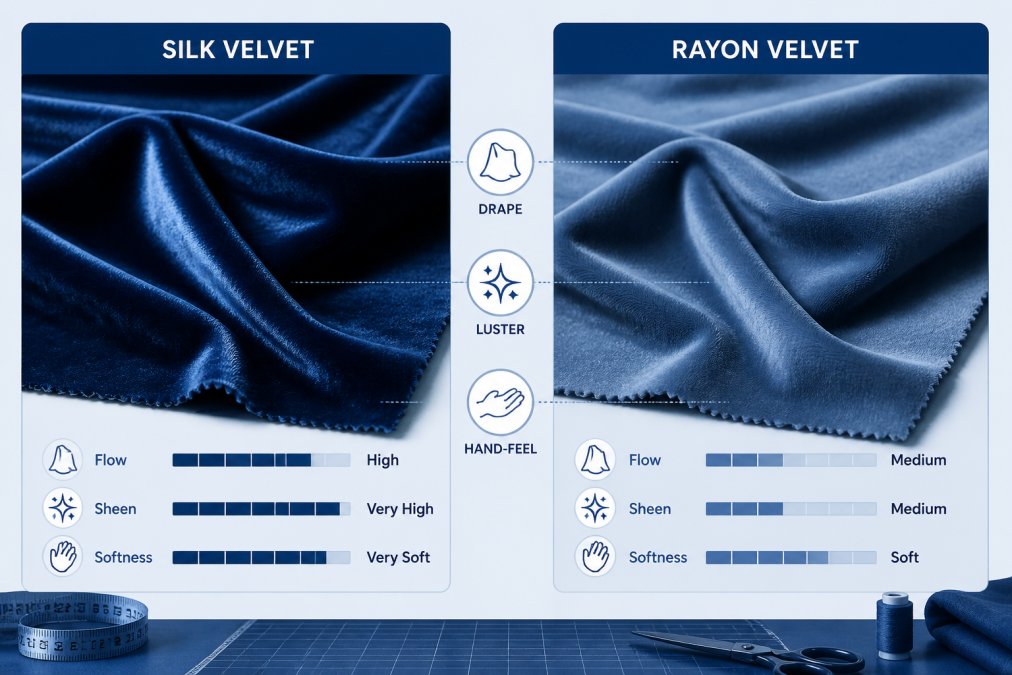
Drape follows the same logic. Silk velvet typically runs heavier per yard than rayon velvet of the same pile height, and that weight makes a bias-cut or column gown skim the body instead of clinging. Rayon velvet drapes fluidly too, but with less mass, so it follows the body's contours more closely. Neither is a defect, they suit different gown shapes.
Hand-feel is where the two diverge most.
Here is how that translates to specific silhouettes:
- Bias-cut slip gowns and column gowns: Silk velvet's weight helps the fabric fall in long, unbroken lines and resist clinging at the hip. Rayon velvet can work here, but it often needs a lining or a slightly heavier underlayer to keep the same line.
- Structured bodices and corseted mermaid gowns: Rayon velvet's lighter hand and faster pile recovery make it easier to manipulate over boning and interfacing. Silk velvet's weight can pull against a structured bodice unless the internal support is built to carry it.
- Ball gowns and full skirts: Both work, but silk velvet's mass gives the skirt more presence and a slower, more deliberate movement. Rayon velvet gives a lighter, more buoyant skirt that moves faster with the wearer.
- Fitted and stretch-dependent designs: Neither silk nor standard rayon velvet stretches. For close-fitting evening silhouettes, a stretch velvet blend is usually the practical answer.
Many dressmakers keep both fabrics on hand for the same project: silk velvet for the overskirt or train where movement and luster matter most, rayon velvet for the bodice lining or a secondary panel where weight would fight the structure.

Durability, Crushing, and Long-Term Wear
A few concrete durability factors worth knowing:
Stretch Velvet 58" Wide| Apparel →
- Pile height and density. A denser, shorter pile resists crushing better than a tall, loose pile. This matters more than fiber type for everyday wear.
- Backing construction. A tightly woven or knit backing holds the pile upright longer. A loose backing lets pile yarns shift and mat.
- Sunlight exposure. Silk is more vulnerable to UV degradation over years of display or storage near a window; rayon velvet holds up better to light exposure but can yellow with age under certain conditions.
- Humidity. Silk tolerates normal indoor humidity well but can develop mildew if stored damp. Rayon velvet is more resistant to biological damage but can lose strength when wet for extended periods.
- Cleaning chemistry. Silk velvet generally requires dry cleaning with a solvent safe for protein fibers. Many rayon and polyester velvets can be hand-washed or machine-washed on gentle, which extends their practical lifespan for gowns worn more than once.
On the environmental side, the two fibers trade off differently. Silk's production footprint depends heavily on farming and processing methods. Rayon (viscose) is made from wood pulp, and conventional viscose production has historically been associated with high water and chemical use, though many mills now offer closed-loop or responsibly sourced viscose. Neither fiber is automatically the greener choice; the more useful question is which one will be worn and cared for long enough to justify its footprint.
Dye Payoff, Breathability, and Skin Sensitivity
Rayon velvet absorbs dye deeply and evenly, which is why it's available in a wider range of saturated, fashion-forward colors. Silk velvet takes dye beautifully too, but the natural fiber can produce subtle tonal variation between dye lots, something to plan for on multi-yard orders.
How to Sew Velvet Fabric for Evening Gowns
Sewing velvet fabric for evening gowns requires one guiding rule: work with the nap, never against it. Every pattern piece must be cut with the pile running the same way or panels will reflect light differently.

Here's a practical workflow:
- Cut in a single layer. Velvet shifts, so cut each piece flat rather than on the fold.
- Mark the nap direction on every pattern piece with an arrow before cutting.
- Use a walking foot to feed the pile evenly and prevent one layer from sliding.
- Pin inside the seam allowance only, so pin marks don't crush the surface.
- Baste before you sew. A hand basting stitch holds velvet far better than pins.
- Press on a needle board or a scrap of velvet, face down, with low steam.
Velvet Fabric Care Instructions for Evening Wear
Velvet fabric care instructions for evening wear come down to three rules: steam instead of iron, clean gently, and store with space. Velvet is a pile fabric, and heat plus pressure destroys it.
- Steam to release crush marks. Hold the steamer an inch from the surface and let the pile lift.
- Never press directly. If you must press, use a needle board and press from the back.
- Dry clean structured gowns. For washable polyester velvets, machine wash gentle and hang to dry.
- Store on a padded hanger with the skirt hanging free, never folded in a bag.
- Keep away from direct sunlight to slow fading, especially on silk.
Choosing the Right Velvet for Your Gown Silhouette
The right velvet for your gown depends on the silhouette. A bias-cut slip gown wants silk's weight and fluidity. A structured ball gown or mermaid silhouette can carry rayon velvet's lighter drape and brighter sheen beautifully.
Frequently Asked Questions
Is silk velvet better than rayon velvet for evening gowns?
Neither is universally better. Silk velvet has a deeper, more complex luster and a lighter, more fluid drape that suits bias-cut gowns and structured silhouettes. Rayon velvet, also called viscose velvet, offers a similar look at a lower cost and takes dye more deeply, giving richer color saturation. For a gown worn once or twice, rayon velvet performs well. For heirloom pieces or gowns where drape and sheen are the priority, silk velvet justifies the higher price.
Does rayon velvet drape as well as silk velvet?
Rayon velvet drapes well but has a slightly heavier hand-feel than silk velvet. Silk velvet's natural fiber structure gives it more fluidity and movement, which matters for bias-cut and column silhouettes. Rayon velvet holds its shape better, making it a strong choice for structured bodices and fuller skirts. If your gown design depends on soft, flowing movement, silk velvet has the edge. If you need body and structure, rayon velvet works in your favor.
Is rayon velvet easier to sew than silk velvet?
Rayon velvet is generally easier to handle because it has slightly more body and resists shifting during cutting. Silk velvet is lighter and more slippery, so it requires more pinning and careful grainline alignment. Both fabrics need a walking foot, a fine needle, and minimal pressing. Always test on a scrap first, and use a needle board when pressing to avoid crushing the pile. New Creations Fabric & Foam Inc's stretch velvet options, such as their 58-inch Stretch Velvet, offer a forgiving alternative for sewers who want velvet drape with added stretch.
Which velvet is more durable for long-term evening wear?
Silk velvet is strong but sensitive to moisture and sunlight, which can weaken the fibers over time. Rayon velvet resists abrasion slightly better in dry conditions but can lose strength when wet. Both fabrics crush and develop pressure marks at folds and seat areas. Proper storage on padded hangers and steam rather than iron will extend the life of either fabric. For gowns worn frequently, rayon velvet's resilience may give it a practical edge, while silk velvet rewards careful handling with lasting beauty.