

Table of Contents
- The Financial Case for Small Batch Fabric Sourcing
- How Small Batch Production Reduces Deadstock and Waste
- Fabric Sourcing for Fashion Startups: Testing Designs and Validating Markets
- Finding Low Minimum Order Quantity Fabric Suppliers
- A Small Batch Clothing Manufacturing Guide: From Tech Pack to Production Run
- Legal and Contract Considerations for Small Batch Fabric Buyers
- Conclusion: Building a Scalable Brand with Small Batch Fabric
- Frequently Asked Questions
Last Updated: September 21, 2026
The Financial Case for Small Batch Fabric Sourcing
Why small batch fabric is better for startups comes down to one uncomfortable truth: most first-time brands die from unsold inventory, not from weak designs. This guide from New Creations Fabric & Foam Inc breaks down the numbers, the sourcing tactics, and the contract terms that keep a young label solvent. Small batch fabric sourcing means ordering limited yardage from low minimum order quantity fabric suppliers so you can test a design, read real demand, and reorder only what sells.
Upfront Capital and Cash Flow Management
Cash flow management is the single biggest constraint on a new apparel brand. A small opening order from a supplier like New Creations Fabric & Foam Inc, where there is no minimum purchase requirement, lets you buy a few yards for sampling and scale up only after a design proves itself. That keeps upfront capital low, which matters when you are also paying for photography, a website, and ads.
Unit Cost vs. Inventory Risk: A Side-by-Side Comparison
Lower unit cost per yard is not automatically the better deal. Bulk pricing only wins when you sell through the whole run. Here is how the two approaches compare on the factors that decide whether a young brand survives its first year.
| Factor | Small Batch | Bulk Production |
|---|---|---|
| Upfront capital | Low per style | High per style |
| Unit cost per yard | Higher | Lower |
| Inventory risk | Minimal | Significant |
| Deadstock exposure | Low | High |
| Design flexibility | High | Low |
| Reorder speed | Fast | Slow |
| Best for | Testing demand | Proven sellers |
How to Run the Break-Even Math Before You Order
Most articles tell you small batch is lower risk. Fewer show you how to prove it for your own numbers. Use this framework, it is the same logic a unit-economics calculator applies, and you can run it in a spreadsheet in ten minutes.
- Set your sell-through assumption. Pick a conservative figure, such as 60% of units selling at full price. If you cannot defend that number, lower it.
- Calculate revenue at full price. Units × retail price × sell-through percentage.
- Add markdown revenue. Assume the unsold units sell at a discount, commonly 40-50% off, and add that back in.
- Subtract landed cost. Fabric cost per unit × total units, plus cutting, sewing, trims, and freight.
- Subtract fixed costs. Photography, website, ads, and any sampling you already paid for.
- Compare the two scenarios. Run the same six steps once at your small-batch quantity and once at a bulk quantity with a lower per-yard price.
The Reorder Option Has Value
Small batch also buys you an option you cannot price on a quote sheet: the right to reorder a winner. If a style sells out in three weeks, you can go back to a low minimum order quantity supplier and buy more yardage. A bulk buyer who guessed wrong has no such move, the fabric is already cut. Treat reorder speed as part of your unit economics, not a separate logistics topic.
How Small Batch Production Reduces Deadstock and Waste
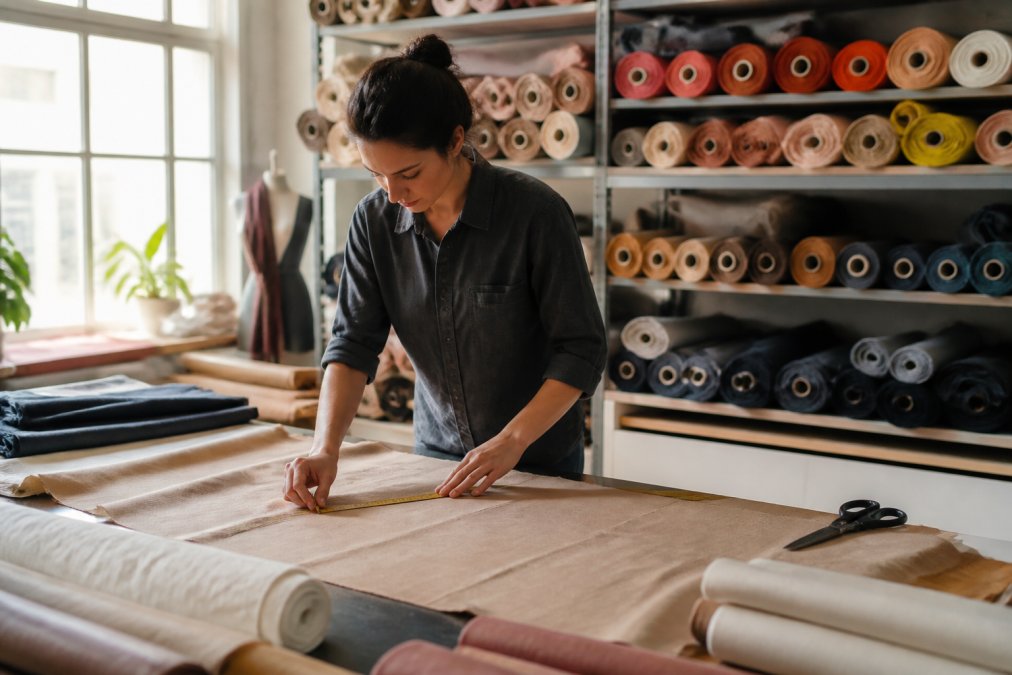
Deadstock is the quiet killer of small labels. Unsold inventory absorbs cash, occupies storage, and often gets liquidated below cost. Producing in smaller runs means you only commit fabric to colorways and silhouettes that have already shown demand, which cuts waste and improves sustainability metrics at the same time.
Fabric Sourcing for Fashion Startups: Testing Designs and Validating Markets
Market validation beats guesswork every time. Small batch fabric lets you produce a limited edition drop, watch how fast it sells, and let customer feedback drive the next order. A pre-order model pushes this further: you collect orders before you cut fabric, so demand is confirmed before cash leaves your account.
The Pre-Order Model and Customer Feedback Loop
A pre-order model turns your customers into your forecasting team. You list a design, take orders, and only then commit to a production run sized to actual demand. The customer feedback loop closes when you use those orders and comments to decide which colorways and silhouettes to repeat.
Finding Low Minimum Order Quantity Fabric Suppliers
Low minimum order quantity fabric suppliers let you buy by the yard instead of by the roll. When you evaluate a manufacturing partner, look past the price list and check whether they will sell you a few yards, ship continuous cuts, and hold consistent quality across reorders. New Creations Fabric & Foam Inc stocks a range of fabrics for apparel and events, including sequins, velvet, and faux fur, and sells by the yard with no minimum purchase required.
What to Look for in a Manufacturing Partner
A reliable manufacturing partner should offer:
- No or low minimum order quantity so you can sample first
- Continuous cuts when you order multiple yards
- Consistent dye lots and finishes across reorders
- Clear lead times stated up front
- Fabric specifications you can verify before ordering
A Small Batch Clothing Manufacturing Guide: From Tech Pack to Production Run
A small batch clothing manufacturing guide starts with documentation, not fabric. The tech pack is the document that tells your supplier exactly what to make, and a vague tech pack is the most common reason a first production run goes wrong. The good news for startups: a small-batch tech pack can be leaner than a mass-production one, because you are specifying one style at a time rather than a full seasonal line.
Cotton Polyester Broadcloth Fabric 58" →
Technical Specification Requirements and Quality Assurance
Your tech pack should specify the fabric content, weight, width, and color, plus construction details and finishing. For example, a cotton polyester broadcloth at 58 inches wide and 86 GSM gives a supplier the exact specification to match. Quality assurance depends on those numbers being written down, because you cannot inspect against a standard that was never stated.

A working small-batch tech pack typically includes:
- Fabric spec: fiber content, weight (GSM or oz/yd²), width, weave or knit, and finish
- Color: Pantone or lab-dip reference, plus a note on acceptable dye-lot variation
- Construction: seam types, stitch density, hem and edge finishes, and any interfacing
- Measurements: a graded size chart with tolerance ranges (for example, ±¼ inch on a chest measurement)
- Trims and hardware: zippers, buttons, labels, and care tags with placement notes
- Packaging: folding, hangtag, and poly-bag requirements
- Approval gates: what must be signed off before cutting begins
Quantifying the Waste and Carbon Advantage
Most articles claim small batch is more sustainable without putting a number on it. You can, and it is worth doing because eco-conscious customers and retail partners increasingly ask.
- Estimate the units you would produce in a bulk run versus a small-batch run.
- Estimate the share of each run you expect to sell at full price.
- Multiply the unsold units by the embodied carbon per unit (your supplier can often provide a figure per yard or per garment).
- The difference is the waste you avoided by producing to demand.
From Approved Spec to Production Run
Once the tech pack is approved, the small-batch production run follows a short sequence: confirm the fabric order and continuous-cut request, approve the pre-production sample, set the cut date, and schedule a final inspection against the written spec. Because the run is small, problems surface cheaply, a seam issue caught on 50 units costs far less to fix than the same issue caught on 5,000.
Legal and Contract Considerations for Small Batch Fabric Buyers
Contract terms protect you when a supplier falls short. Before you place a production order, confirm the order in writing with the fabric specification, quantity, price per yard, and delivery date. Ask how the supplier handles dye lot variation, since colors ordered at different times may not match exactly. Under the FTC's business guidance on advertising and labeling, apparel claims about fiber content must be accurate, so keep supplier documentation on file.
Conclusion: Building a Scalable Brand with Small Batch Fabric
Small batch fabric gives a startup room to be wrong cheaply. You test designs, validate demand, and reorder only what sells, which keeps cash flow healthy and deadstock low. As orders grow, the same suppliers scale with you.
Frequently Asked Questions
What are the primary financial benefits of small batch fabric sourcing?
Small batch fabric sourcing reduces upfront capital requirements and minimizes inventory risk. Instead of tying up cash in thousands of yards of fabric, you buy only what you need for a limited production run. This improves cash flow management and lets you reinvest in marketing or product iteration. It also lowers overhead costs for storage and reduces the chance of deadstock. With less capital at risk, startups can test multiple designs and respond faster to customer feedback.
How does small batch production help startups manage inventory risk?
Small batch production limits the amount of finished goods you hold. If a design does not sell as expected, you are not stuck with thousands of unsold units. This directly reduces inventory risk and deadstock. You can also use a pre-order model to gauge demand before committing to a larger production run. By keeping inventory lean, you free up cash for other parts of the business and avoid the costs of storing and discounting excess stock.
What are the main disadvantages of bulk fabric purchasing for new brands?
Bulk fabric purchasing requires a large upfront capital investment and often comes with high minimum order quantities. If your designs do not sell, you are left with deadstock and tied-up cash. You also face higher storage costs and the risk of fabric becoming outdated as fashion trends change. Additionally, bulk orders reduce flexibility for product iteration, making it harder to respond to customer feedback or test new colorways and silhouettes.
How do you find reliable suppliers for small batch fabric orders?
Look for suppliers that specialize in low minimum order quantity fabric and cater to startups. Check for clear technical specifications, consistent quality assurance, and transparent pricing. Request samples before committing to a production run. A reliable manufacturing partner will offer quantity discounts as you scale. Reading reviews and asking for references from other small brands can also help you avoid supply chain disruptions.