

Table of Contents
- What High Density Foam Actually Means (and Why Density Ratings Matter)
- Sofa Foam Density Chart: Matching Foam Grade to Real Life
- The Firmness vs. Density Paradox: Why Your Sofa Feels Hard but Still Sags
- How to Test Sofa Foam Quality Before You Buy
- High Resilience Foam vs High Density Foam: Which One Belongs in Your Sofa?
- DIY Cushion Replacement: When Replacing Foam Beats Buying a New Sofa
- Environmental and Health Considerations for High Density Foam
- Conclusion: Is High Density Foam Worth the Investment?
- Frequently Asked Questions
Last Updated: September 25, 2026
What High Density Foam Actually Means (and Why Density Ratings Matter)
High density foam is polyurethane foam with a density of at least 1.8 pounds per cubic foot, the weight of the foam material in a one-foot cube. That rating governs how long your sofa cushions hold their shape under daily wear.
Density is not the same as firmness. It measures mass and material longevity, not how hard the cushion feels when you sit down, a distinction where most buying decisions go wrong.
The foam core is what you actually sit on every day. Lower-density foam compresses faster, loses its cell structure, and develops the sagging that makes a solid sofa feel tired. Higher-density foam resists that compression set, so the cushion recovers instead of permanently flattening.
The U.S. Consumer Product Safety Commission guidance on upholstered furniture and industry testing standards treat foam performance as a durability question, not a comfort question. That framing matters when you are comparing sofas side by side.
Sofa Foam Density Chart: Matching Foam Grade to Real Life
The right foam grade depends on how the sofa gets used, not on a single "best" number. A guest-room sofa and a family-room couch that seats four every night have different demands.
| Density (lb per cubic foot) | Typical Use | Durability Outlook |
|---|---|---|
| 1.0 - 1.5 | Decorative or occasional seating | Compresses quickly, sags within months |
| 1.6 - 1.8 | Light residential use | Moderate life, best for low-traffic rooms |
| 1.9 - 2.5 | Daily residential seating | Good sag resistance, holds shape for years |
| 2.6 and above | Heavy use, commercial seating | Long-term performance under constant load |
Below 1.5, you are buying a look, not a seat. Between 1.9 and 2.5 is the sweet spot for a family couch. Above 2.6 suits sofas used constantly or by heavier sitters.
Weight-Based Recommendations: What Density Fits Your Body Type
Your body weight changes how much stress the foam takes every time you sit down, so the same cushion behaves differently for different people.
- Under 150 lb: 1.8 lb per cubic foot holds up well for daily use
- 150-200 lb: aim for 2.0 to 2.2 lb per cubic foot
- 200-250 lb: 2.3 to 2.5 lb per cubic foot gives reliable support
- Over 250 lb: 2.6 lb per cubic foot and above, especially in high-use seats
A 2.0-density cushion that feels firm to a lighter sitter can bottom out under a heavier one within a year. Matching density to weight is the most overlooked step in choosing a sofa.
The Firmness vs. Density Paradox: Why Your Sofa Feels Hard but Still Sags
A sofa can feel rock-hard on day one and still sag deeply within a year. That contradiction comes down to two separate foam properties.
Firmness is measured by indentation load deflection, or ILD, how much force it takes to compress the foam a set amount. Density describes how much material is in the foam. A manufacturer can make low-density foam feel firm with stiffening agents, but that does nothing to stop it breaking down under repeated compression.
This is the firmness vs. density paradox: the hard showroom sofa is not automatically the durable one. A firm low-density cushion is often the worst long-term performer because it hides its weakness behind an uncomfortable surface.
Support factor adds a third variable: how the foam behaves under light versus deep compression. A higher support factor means the cushion gives gently at first, then firms up as you sink in, what most people actually want from a seat.
How to Test Sofa Foam Quality Before You Buy
You can assess foam quality in about thirty seconds with your hands. The press-and-release test reveals more about durability than the showroom label usually does.
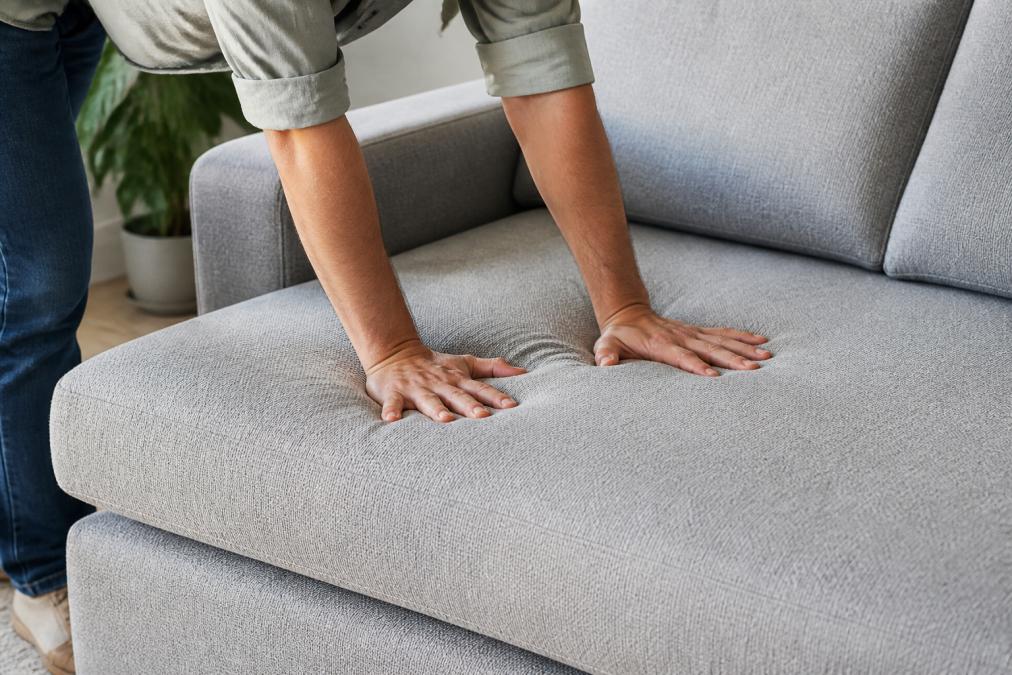
Press your palm flat into the center of the seat cushion, hold a few seconds, then release and watch what happens.
The Press-and-Release Test: What Your Hands Can Tell You
A quality cushion springs back almost immediately. One that stays compressed, or recovers slowly and leaves a faint handprint, has a cell structure that is already weakening.
Bonded Dacron Upholstery Grade →
Three things to check while you are there:
- Recovery speed: fast rebound signals good resiliency and a healthy foam grade
- Resistance: steady pushback through the whole press suggests a higher support factor
- Edges: press the front edge too. If it collapses easily, the foam core is thin or low-density
Ask the seller for the density rating directly. If nobody can tell you the number, treat that as your answer.
The American Society for Testing and Materials standards for flexible cellular materials cover the formal lab methods for measuring these properties, but your hands catch most of the problems in the store.
High Resilience Foam vs High Density Foam: Which One Belongs in Your Sofa?
High resilience foam and high density foam are two different things, and the best sofas use both. High resilience foam is engineered for fast recovery and a springy feel; high density foam for mass and long-term durability.
| Property | High Resilience Foam | High Density Foam |
|---|---|---|
| What it measures | Recovery speed and bounce | Material weight per volume |
| Feel | Springy, responsive | Supportive, substantial |
| Best for | Seat cushions that need to bounce back | Foam cores that must resist sagging |
| Weakness alone | Can still be low density | Can feel flat without resilience |
A cushion with both high density and high resilience gives you the durability of one and the comfort of the other.
DIY Cushion Replacement: When Replacing Foam Beats Buying a New Sofa
Replacing the foam is almost always cheaper than replacing the sofa. If the frame is solid and the upholstery intact, the foam core is the only part that has actually failed.
Here is when replacement makes sense:
- The sofa frame is sturdy with no cracks or wobble
- The fabric is in good condition, or you plan to re-cover it
- The cushions sag but the springs and decking underneath are sound
And here is when it does not:
- The frame flexes or creaks under weight
- The springs have broken through the decking
- The upholstery is torn beyond repair
Environmental and Health Considerations for High Density Foam
Denser foam uses more polyurethane per cushion, so the material footprint per sofa is higher. The counterweight is lifespan: a 2.2 lb per cubic foot core that holds its shape for a decade replaces two or three lower-density cores that fail in three to four years each. Over the life of the sofa, the denser option usually wins on total material consumed.
What Certifications Actually Tell You
A few practical points to weigh:
- Denser foam generally means fewer replacements over the life of a sofa, which lowers total material use even though each cushion uses more
- Ventilating new foam for several days before installation reduces the intensity of the initial off-gassing period
- CertiPUR-US covers the foam; GREENGUARD Gold covers the finished product, they answer different questions
- Natural alternatives like latex and soy-based polyols exist, but "natural" is not a regulated term and does not automatically mean lower emissions
There is no perfect answer, only trade-offs. A denser, certified cushion that lasts a decade uses more material once; a low-density cushion that fails in two years uses less per unit but gets replaced repeatedly, and may carry no emissions testing at all.
Conclusion: Is High Density Foam Worth the Investment?
For a sofa you sit on every day, high density foam is worth it, but the value case is more specific than "it lasts longer." Here is the math most buyers never run.
Frequently Asked Questions
What are the disadvantages of high density foam?
High density foam costs more upfront than low density alternatives, and it feels firmer until it breaks in. Some people expect a plush sink-in feel and find the initial firmness uncomfortable. It also weighs more, which matters if you rearrange furniture often. The trade-off is longevity: high density foam resists compression set and sagging far longer than low density foam, so you replace cushions less often.
What density foam does standard furniture manufacturing use?
Many mass-market sofas use foam in the 1.5 to 1.8 lb per cubic foot range for seat cushions. That density keeps manufacturing costs low but tends to break down faster under daily wear and tear. Higher-quality manufacturers typically use 2.0 to 2.5 lb per cubic foot or higher. If a sofa listing does not state foam density, that omission often signals a lower grade. Ask before you buy.
How can you tell if sofa foam is high quality?
Press the cushion firmly and release. Quality foam springs back quickly with no lingering indentation. Check the foam grade or density rating in the product specs, ideally 2.0 lb per cubic foot or above for seat cushions. Look for high-resilience foam or a support factor above 2.4, which indicates good load-bearing capacity. Also inspect the cell structure at any exposed edge for a uniform, tight appearance.
Does high density foam feel harder than low density foam?
Not necessarily. Density and firmness are different properties. Density measures how much foam material is packed into a cubic foot. Firmness, measured by indentation load deflection (ILD), determines how soft or hard the foam feels. You can find high density foam that feels plush and low density foam that feels firm. The confusion between the two is the most common mistake sofa buyers make when comparing foam options.