

Table of Contents
- Satin vs Velvet for Luxury Event Decor: The Quick Comparison
- How Satin and Velvet Perform Under Event Lighting
- The Best Fabric for Luxury Wedding Tablecloths
- Velvet vs Satin Durability for Events
- How to Style Velvet Backdrops and Draping
- Color, Budget, and Reuse: What Buyers Often Overlook
- Satin vs Velvet by Event Type: Formal, Casual, and Seasonal
- Frequently Asked Questions
Last Updated: September 24, 2026
Satin vs Velvet for Luxury Event Decor: The Quick Comparison
Choosing between satin vs velvet for luxury event decor comes down to one question: do you want light to bounce off your surfaces or sink into them? Satin returns light with a glossy sheen and holds a crisp shape. Velvet absorbs light, creating rich depth and a plush pile guests want to touch. This guide from New Creations Fabric & Foam Inc breaks down sheen, drape, weight, durability, and budget so you can specify the right fabric the first time.
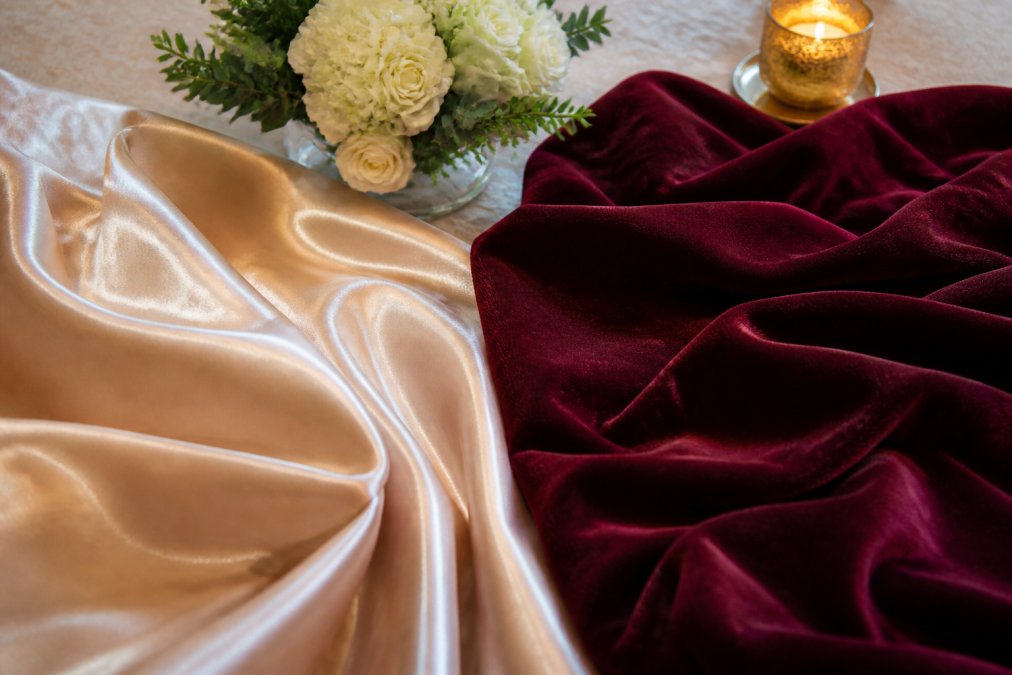
How Satin and Velvet Differ in Sheen, Drape, and Weight
Satin is a weave structure, not a fiber. Its floating warp threads create a smooth, reflective surface that catches light from every angle. Velvet is a pile fabric: thousands of cut threads stand upright, absorbing light and creating deep shadow.
The practical differences show up fast:
- Sheen: Satin reflects; velvet absorbs. A glassy finish versus a soft glow.
- Drape: Satin flows and holds structure. Velvet hangs heavy and full.
- Weight: Most satins sit in the medium range; velvets run heavier per yard.
At-a-Glance Comparison Table
| Factor | Satin | Velvet |
|---|---|---|
| Light behavior | Reflective surface, high sheen | Light absorption, alluring shadows |
| Drape | Fluid, structured folds | Full, heavy drape |
| Weight | Medium | Medium to heavy |
| Best for | Tablecloths, sashes, aisle runners | Backdrops, draping, lounge corners |
| Care | Machine wash cold, tumble dry low | Machine wash cold, tumble dry low |
| Reuse | Excellent with careful handling | Excellent; pile hides creases |
| Budget signal | Lower cost per yard | Higher cost per yard |
How Satin and Velvet Perform Under Event Lighting
Lighting decides which fabric wins, and the reason is physics, not taste. Satin's smooth surface produces specular reflection, light bounces off at a predictable angle, throwing a bright highlight back toward the camera or the guest's eye. Velvet's cut pile produces diffuse reflection: each upright fiber scatters light in a hundred directions, so the fabric reads as a soft, even glow rather than a hotspot.
That single difference drives every practical decision on site:
- Beam angle matters more on satin. A hard pin spot at a shallow angle across a satin runner creates a visible streak; the same fixture on velvet disappears into the pile.
- Color temperature shifts the read. Warm 2700K-3000K washes deepen velvet's jewel tones and make satin look creamy. Cool 4000K+ washes make satin look icy and can flatten velvet into gray.
- Uplights amplify the gap. A wall wash on a velvet backdrop reveals texture as the light rakes across the pile; on satin it turns the wall into a mirror that reflects the fixture itself.
A Quick Lighting-to-Fabric Cheat Sheet
| Lighting Setup | Satin Behavior | Velvet Behavior |
|---|---|---|
| Hard pin spot, shallow angle | Visible streak, doubled wrinkles | Texture glow, creases hidden |
| Soft wash, 2700K-3000K | Creamy sheen, warm highlights | Deep saturated color, plush read |
| Cool wash, 4000K+ | Icy, can look synthetic | Can flatten to gray |
| Candlelight only | Dim, low contrast | Rich, atmospheric, forgiving |
| Bright daylight ballroom | Crisp, formal, palette stays light | Heavy, can look dark in photos |
The Photographer Variable
Most event photographers expose for skin tones, not fabric. A satin surface that looks balanced to the eye can blow out to pure white, and a velvet backdrop that looks rich in person can read as a black hole behind the couple. The fix is placement: satin works best as a mid-ground accent (runners, sashes, chair bands) where it catches light at an angle, while velvet works best as the background plane, where its light absorption keeps the subject from competing with the decor.
The Best Fabric for Luxury Wedding Tablecloths
The best fabric for luxury wedding tablecloths depends on the mood you're building. Satin gives a polished, formal table with crisp folds. Velvet gives warmth, color saturation, and a surface guests instinctively reach out to touch.
Satin Tablecloths: Sheen and Structure
Satin tablecloths deliver formality fast. A dull satin like Dull Satin (Peau de Soie) 58" Wide at $14.95 per yard gives the body and stiffness that keeps a floor-length drop looking sharp, without the high-gloss glare of traditional satin. It's 100% polyester, 60 inches wide, and comes in 35 colors, which matters when matching a bridal palette across dozens of tables.

Velvet Tablecloths: Depth and Warmth
Velvet tablecloths change the entire temperature of a room. Stretch Velvet 58" Wide at $14.95 per yard is a 90% polyester, 10% spandex blend with a silky, plush texture and 4-way stretch that pulls smoothly over large tables. Its selling point is color saturation: deep jewel tones read richer on velvet than on any reflective fabric.

Velvet vs Satin Durability for Events
Velvet vs satin durability for events favors velvet in most high-traffic settings. Velvet's pile resists creases, pressure marks, and minor snags, so it holds up across repeated setups. Satin shows every fold line and picks up pulls where the weave floats, especially on corners and edges.
How to Style Velvet Backdrops and Draping
Styling velvet backdrops starts with weight. Velvet's full drape falls in deep, heavy folds without extra lining, so a single panel can carry a photo wall on its own. Hang it from a pipe and drape kit, gather it at intervals, and let the pile do the work.
- Steam, don't iron. Direct heat crushes the pile and leaves shiny patches.
- Gather generously. Velvet needs roughly double the width of the opening for full folds.
- Layer for depth. Pair a velvet backdrop with satin table linens so the reflective and absorbent surfaces play against each other.
- Light from the side. Angled uplights rake across the pile and reveal the texture.
Color, Budget, and Reuse: What Buyers Often Overlook
Three factors decide most fabric purchases, and they rarely get discussed together: color, budget, and reuse.
Dull Satin (Peau de Soie) 58" Wide| New →
Color Palette Compatibility: Which Colors Pop Where
Satin and velvet do not treat color the same way. Satin's reflective surface adds a white highlight to every color, which lifts and brightens it. Velvet's pile absorbs light, which deepens and saturates it. The same dye lot can look like two different colors across the two fabrics.
A practical guide to how common event colors behave:
| Color | On Satin | On Velvet |
|---|---|---|
| Ivory / champagne | Bright, bridal, can look yellow under warm light | Creamy, warm, reads as luxury |
| Blush / dusty rose | Fresh, light, can look washed out | Rich, romantic, holds depth in photos |
| Emerald / forest green | Bright, can look synthetic | Deep, jewel-like, the classic velvet win |
| Navy | Crisp, formal, can look flat | Near-black in low light, dramatic |
| Burgundy / wine | Can look pinkish under bright light | Deep, moody, the strongest velvet color |
| Black | Glossy, can look like vinyl | Matte, absorbs light, elegant |
| White | Brilliant, can blow out in photos | Rare and risky, shows every mark |
Budget-to-Impact Ratio: Cost Per Event, Not Cost Per Yard
The per-yard price is the wrong number to shop on. What matters is cost per event, which depends on three variables: yards needed, events survived, and labor to prep.
A simple framework:
- Large-scale events (200+ guests, many tables). Satin wins on coverage. A lower cost per yard multiplied across 30 tablecloths and 200 chair sashes is a meaningful line item. Velvet at the same scale gets expensive fast, so most planners use velvet only on the focal wall and satin everywhere else.
- Intimate events (under 80 guests, one statement moment). Velvet wins on impact per yard. A single velvet backdrop or a velvet-draped sweetheart table delivers more visual weight than the same yardage in satin, because velvet's light absorption makes it read as a designed element rather than a surface.
- Rental and reuse businesses. The math shifts again. A fabric that survives ten events costs less per event than a cheaper fabric that survives three. Both satins and velvets in this guide are machine washable and built for repeat use, so the real question is how well your team handles and stores them between bookings.
Sustainability and Reusability: The Rental Lifecycle
Event planners face growing pressure to reduce single-use decor, and fabric choice is one of the few places where the sustainable option is also the cost-effective one. The lifecycle:
- Purchase. Buy continuous yardage in a color you can reorder, so you're not stuck with a dye-lot mismatch on the next event.
- Use. Velvet's pile resists creasing and pressure marks, so it needs less steaming between events. Satin needs more prep time but takes up less storage space per yard.
- Clean. Both fabrics here are machine washable in cold water and tumble dryable on low. Velvet should be washed with similar colors only, since darker dyes can bleed onto lighter loads.
- Store. Roll velvet on a tube rather than folding it, folds in the pile can leave permanent crush lines. Hang or roll satin to avoid sharp creases.
- Retire. When a piece finally fails, both polyester satin and polyester velvet are recyclable through textile take-back programs in many markets, though availability varies by region.
Satin vs Velvet by Event Type: Formal, Casual, and Seasonal
Match the fabric to the occasion and the calendar. Formal receptions and evening events favor velvet for depth and warmth. Daytime formal events and modern minimalist designs favor satin for its clean sheen and structure. Casual celebrations can use either, though satin's lower cost makes it the practical default for high table counts.
| Event Type | Recommended Fabric | Why |
|---|---|---|
| Black-tie evening reception | Velvet | Light absorption, warmth, formality |
| Daytime formal wedding | Satin | Sheen, structure, bright palette |
| Casual celebration | Satin | Lower cost across many tables |
| Fall or winter gala | Velvet | Seasonal weight and richness |
| Spring or summer event | Satin | Light, reflective, airy feel |
| Photo backdrop | Velvet | Full drape, hides creases |
Frequently Asked Questions
Is velvet or satin more flattering for event drapery?
It depends on the look you want. Velvet's plush pile absorbs light and creates depth and alluring shadows, which flatters tall backdrops and evening events. Satin's reflective surface bounces light and reads brighter and more formal in photos. For draping that photographs well under warm uplighting, velvet usually wins. For a crisp, high-shine look in a bright ballroom, satin is the stronger choice.
What are the primary differences between satin and velvet for tablecloths?
Satin has a smooth, glassy finish with a stiff body that holds pleats and folds, so it drapes cleanly over a table. Velvet has a raised pile that gives it weight and a soft, matte surface that shows fewer creases but attracts lint. Satin tablecloths suit sleek, modern receptions; velvet tablecloths suit moody, textured designs. Both are available by the yard or in bulk.
How do satin and velvet perform under event lighting?
Satin's reflective surface captures and bounces light, which makes it read bright and glamorous but can also show wrinkles and uneven folds. Velvet absorbs light instead, producing rich color saturation and soft shadows. Under uplighting or candlelight, velvet tends to look deeper and more luxurious; under bright white light, satin looks cleaner and more formal. Test both under your venue's actual lighting before committing.
Which fabric holds up better across multiple events, satin or velvet?
Velvet's pile weave resists wrinkles and hides minor snags, so it often survives repeated use with less visible wear. Satin shows creases, pulls, and water marks more readily because of its smooth reflective surface. Both can be machine washed cold and tumble dried low, but velvet should be washed with similar colors to prevent bleeding. For high-turnover rental inventories, velvet usually needs less touch-up between events.
Is velvet considered a classy choice for modern event decor?
Yes. Velvet has long been associated with formal reception design, and its plush pile, weight, and light absorption give it a high-end feel that photographs well. Modern event design often pairs velvet backdrops with satin accents, using velvet for depth and satin for sheen. The combination creates visual contrast and works for both evening events and seasonal styling.