

Table of Contents
- What Is Premium Velvet Fabric and Why It Matters for Luxury Garments
- Types of Premium Velvet Fabric: Fiber Content Compared
- Velvet Fabric Weight, GSM, and Choosing the Right Grade
- Silk Velvet Fabric for Evening Wear: Drapability and Garment Structure
- How to Sew with Luxury Velvet: Techniques for Clean Results
- Velvet Fabric Care and Maintenance: Keeping the Pile Pristine
- Which Premium Velvet Fabric Should You Choose?
- Conclusion
Last Updated: August 12, 2026
What Is Premium Velvet Fabric and Why It Matters for Luxury Garments
Premium velvet fabric is a cut-pile textile with a dense, evenly sheared pile surface that creates a distinctive lustrous finish, soft hand-feel, and rich color depth. Thousands of tiny fiber loops are woven into the base, then cut to produce the signature plush texture and light-catching sheen.
At New Creations Fabric & Foam Inc, we work with designers and production teams who need velvet that performs as well as it looks. The difference between a genuinely luxurious garment and one that merely approximates it often comes down to fiber content, pile density, and construction method.
How Velvet Is Constructed: Warp-Pile vs. Weft-Pile
Warp-pile velvet is woven on a double-cloth loom with connecting pile yarns between two fabric layers, then sliced apart to create two pieces simultaneously. This produces an even, dense pile typical of silk and high-grade viscose velvets.
Weft-pile velvet (velveteen when made from cotton) uses extra weft threads that are later cut and brushed upright. The result has slightly lower pile height and is more common in cotton constructions. Warp-pile velvets drape with greater fluidity, while weft-pile constructions offer more body and structure.
A Brief History of Velvet in Luxury Fashion
Velvet's association with wealth is deliberate. According to the Textile Research Journal's historical fiber studies, velvet production originated in the Far East and reached Europe through medieval trade routes, becoming the fabric of choice for European nobility and the Catholic Church. Labor-intensive production made it extraordinarily expensive, and sumptuary laws restricted its use to the aristocracy. That heritage shapes how clients perceive velvet garments today.
Types of Premium Velvet Fabric: Fiber Content Compared
Fiber content is the single most consequential decision when sourcing premium velvet. Each fiber produces a different balance of drape, durability, sheen, and care requirements.
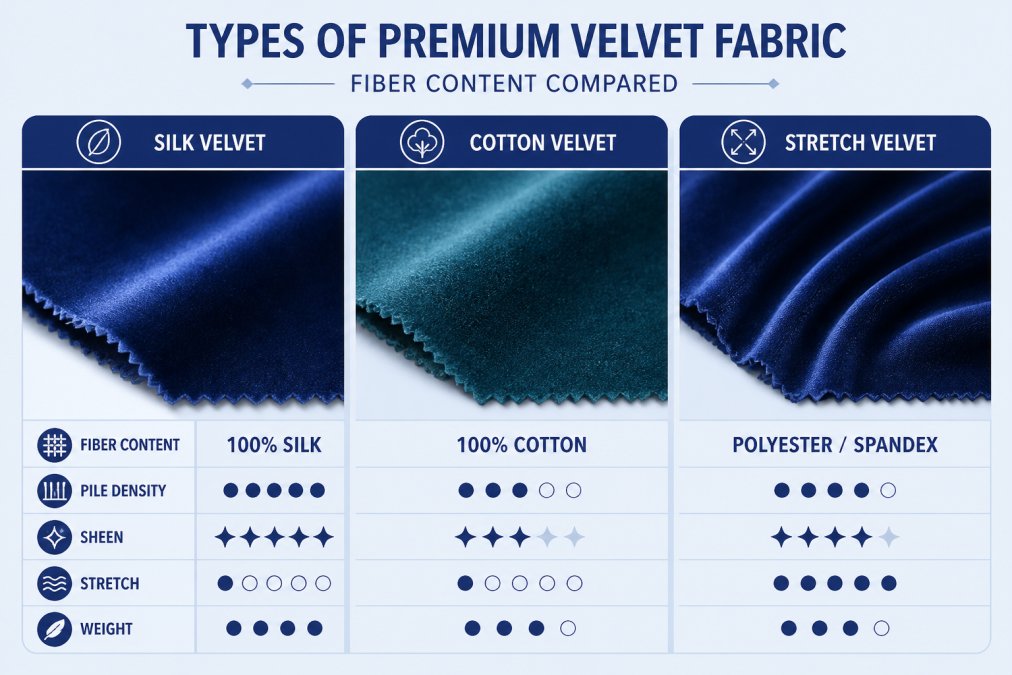
| Velvet Type | Pile Character | Drape | Typical Use | Care |
|---|---|---|---|---|
| Silk Velvet | Ultra-fine, luminous | Fluid, bias-cut friendly | Evening gowns, couture | Dry clean only |
| Cotton Velveteen | Dense, matte | Structured | Tailored jackets, vintage wear | Gentle machine wash |
| Viscose/Rayon Velvet | Soft, luminous | Fluid to moderate | Eveningwear, holiday fashion | Dry clean preferred |
| Stretch Velvet (Poly/Lycra) | Plush, resilient | Form-fitting | Dancewear, costumes, fitted dresses | Machine washable |
1. Silk Velvet: The Original Luxury Standard
Silk velvet sits at the top of the category. The silk pile produces a sheen that shifts with light and movement, and the fiber's natural protein structure gives an almost liquid hand-feel. For evening wear and couture pieces, silk velvet is the benchmark.
The trade-off is cost and fragility. Silk velvet requires dry cleaning, resists pinning and recutting, and shows every handling mark during construction. A silk-and-rayon blend (20% silk, 80% rayon) delivers much of the same visual effect at a more manageable price with slightly more forgiving sewing behavior.
2. Cotton and Cotton Velveteen: Breathable and Durable
Cotton velvet offers a denser, more matte pile than silk with refined, understated sheen. The natural fiber makes it breathable and resilient, performing well in structured garments: tailored blazers, riding jackets, and vintage-inspired separates.
Cotton velveteen, technically a weft-pile fabric, is the more accessible end of this category. For designers building pieces that need to hold their shape through repeated wear, cotton constructions are the practical choice.
3. Viscose and Rayon Velvet: Accessible Drape and Sheen
Viscose and rayon velvet occupies the middle ground between silk and synthetic. The fiber produces luminous sheen and graceful drape that reads as genuinely luxurious, with exceptional color depth in jewel tones. Many designers use rayon velvet in eveningwear and holiday fashion because it delivers the visual impact of silk at a fraction of the cost.
The limitation is durability. Rayon velvet requires careful handling during construction and dry cleaning in use, and does not tolerate moisture well.
4. Stretch Velvet (Polyester/Lycra Blend): Form-Fitting Performance
Stretch velvet is the practical workhorse of the category. A polyester and Lycra blend produces a plush, resilient pile with four-way stretch, making it the standard for dancewear, costumes, fitted dresses, and activewear.
New Creations Fabric & Foam Inc carries Stretch Velvet at $14.95 per yard, available 58 inches wide. For added visual interest, the All-Over 5mm Shiny Sequins Stretch Velvet at $24.95 per yard combines velvet's plush texture with sequin embellishment at 360 GSM.


Velvet Fabric Weight, GSM, and Choosing the Right Grade
GSM (grams per square meter) is the most reliable specification for comparing velvet weights. Lower GSM produces lighter, more fluid fabric suited to bias-cut and draped silhouettes. Higher GSM indicates denser pile and heavier base construction, appropriate for structured garments.
Fashion-grade velvets for evening wear typically run between 180 and 280 GSM. Upholstery-weight velvets commonly exceed 400 GSM and are less suitable for garment construction due to reduced drape. The sequin stretch velvet from New Creations Fabric & Foam Inc is specified at 360 GSM, appropriate for structured costume work rather than fluid eveningwear.
Fabric width matters for production efficiency. Standard fashion velvet runs 54 to 60 inches wide, reducing seam placement constraints and minimizing nap-matching waste.
Silk Velvet Fabric for Evening Wear: Drapability and Garment Structure
Silk velvet for evening wear demands a specific approach because the fabric's exceptional drape works against conventional construction. Silk velvet cut on the bias will flow with extraordinary elegance, but it will also shift and distort if the underlying structure does not account for that movement.

The key principle: silk velvet garments should be fully lined, with the lining carrying the structural load. Boning, if used, should be housed in the lining layer rather than stitched directly to the velvet, preserving the fabric's surface integrity.
Drapability is also directional. The nap direction affects how the fabric catches light and drapes. Cutting all pattern pieces with the nap running in the same direction is non-negotiable for professional results. Mismatched nap directions will show obvious tonal variation that no pressing can correct.
According to the Fashion Institute of Technology's textile resource library, the interplay between pile direction and light reflection gives velvet its characteristic depth of color and the appearance of changing color as the wearer moves.
How to Sew with Luxury Velvet: Techniques for Clean Results
Sewing with luxury velvet requires deliberate technique adjustments. The pile creates friction between layers, the fabric shifts during cutting, and conventional pressing will crush the pile permanently.
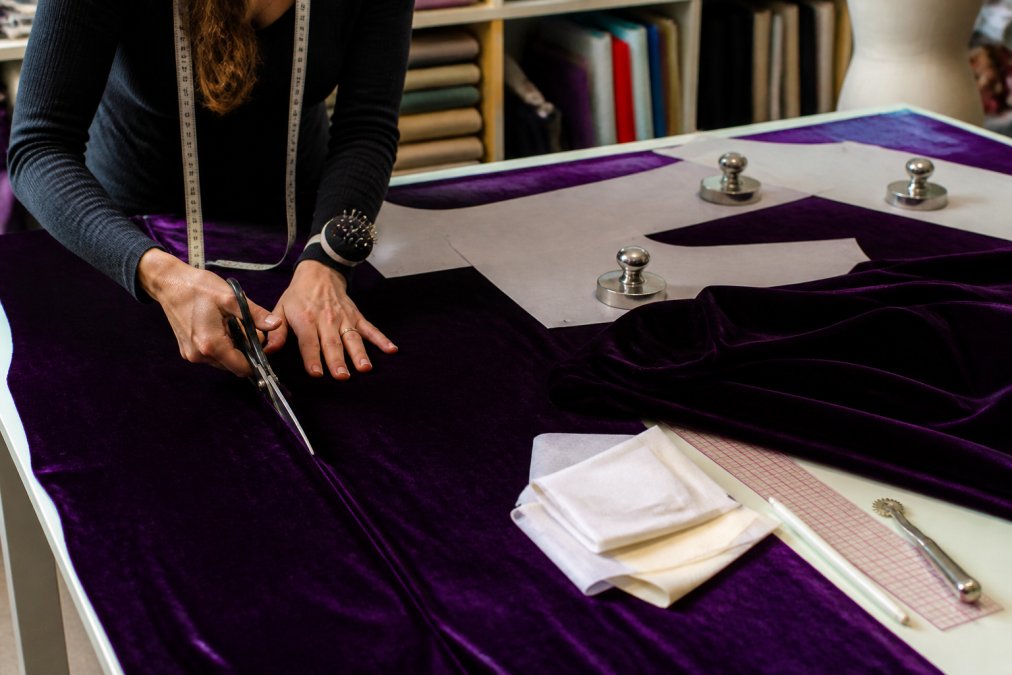
Cutting Along the Fabric Grain and Nap Direction
Establish nap direction and mark it on every piece before cutting. Run your hand along the pile in both directions; smooth-direction cutting is the conventional standard.
Use pattern weights rather than pins to hold pattern pieces in place. Pins create distortions in velvet pile that can be visible in the finished garment. Cut with sharp shears in single layers wherever possible.
Seam Allowances, Interfacing, and Pressing Without Crushing the Pile
Use a walking foot or roller foot when machine sewing velvet to prevent the top layer from creeping forward. Increase seam allowances to at least 5/8 inch.
Interfacing should be sew-in rather than fusible. Fusible interfacing requires heat and pressure that will flatten the pile. Position sew-in interfacing on the wrong side and attach it with a catch stitch around the perimeter.
Never press velvet face-down on a standard pressing surface. Use a velvet board or press seams open from the wrong side using a seam roller and minimal steam. As documented in the American Sewing Guild's technique guides, pile fabrics require a needle board or terry cloth pressing surface to prevent permanent pile compression.
Velvet Fabric Care and Maintenance: Keeping the Pile Pristine
Velvet fabric care varies by fiber content, but all velvet shares vulnerability to crushing, matting, and permanent distortion from heat, moisture, and compression.
For silk and rayon velvet, dry cleaning is standard. These fibers are sensitive to water, which can cause shrinkage, pile distortion, and color migration. Specify that garments should be hung rather than folded during cleaning, with no pressing applied to the pile surface.
Cotton velvet is more forgiving. Many can be hand-washed or machine-washed on a gentle cycle in cold water, though this should be tested on a sample first. Lay flat to dry rather than machine-drying.
Stretch velvet in polyester-Lycra blends is the most care-friendly. Most can be machine-washed on a gentle cycle and air-dried.
For storage, hang velvet garments where possible rather than folding. If folding is unavoidable, use acid-free tissue paper to pad the folds and prevent permanent crease marks.
To revive crushed pile, hang the garment in a steamy bathroom and allow steam to penetrate the pile without direct contact. Gently brush the pile in the correct nap direction with a soft-bristled brush while the fibers are pliable.
Which Premium Velvet Fabric Should You Choose?
The right premium velvet depends on three factors: the garment's silhouette, end-use context, and the construction skill level of the maker.
For formal evening wear and couture pieces where fluid drape and light response are priorities, silk velvet or a silk-rayon blend is the professional standard.
For structured garments, tailored pieces, and designs that need to maintain their shape through repeated wear, cotton velvet delivers durability and breathability.
For accessible eveningwear, holiday fashion, and designs where color depth and luminous sheen are the goal at a manageable price point, viscose and rayon velvet is the practical choice.
For dancewear, costumes, fitted dresses, and any application requiring four-way stretch, stretch velvet in a polyester-Lycra blend is the only option that performs. The New Creations Fabric & Foam Inc stretch velvet at $14.95 per yard, available in 58-inch width, is a strong starting point for costume designers and apparel makers.
| Garment Type | Best Velvet | Key Reason |
|---|---|---|
| Bias-cut evening gown | Silk or silk-rayon blend | Maximum drape and light response |
| Tailored blazer or jacket | Cotton velvet | Structure, durability, breathability |
| Holiday or cocktail dress | Rayon/viscose velvet | Color depth, accessible price |
| Dancewear or costume | Stretch velvet (Poly/Lycra) | Four-way stretch, pile resilience |
| Statement costume piece | Sequin stretch velvet | Visual impact, medium-heavy body |
According to the Sustainable Apparel Coalition's material impact profiles, fiber choice in velvet production carries meaningful environmental implications. Silk and cotton have different lifecycle profiles than polyester-based constructions, a consideration that increasingly matters to fashion brands positioning themselves in the sustainable textiles space.
A common mistake among designers new to velvet is choosing fiber content based on photographs rather than handling samples in person. The hand-feel, drape behavior, and pile density of velvet are characteristics that images cannot convey accurately. Ordering samples before committing to production yardage is essential when working with premium velvet fabric.
Sourcing premium velvet fabric that performs consistently across production runs is one of the more demanding challenges in garment manufacturing. New Creations Fabric & Foam Inc supplies velvet and specialty fabrics designed for consistent, professional-scale production, with options spanning stretch velvet for costumes and dancewear to sequin velvet for statement pieces. Explore our fabric collections and request samples to verify quality before committing to production quantities.
Frequently Asked Questions
What is the highest quality velvet fabric for clothing?
Silk velvet is widely regarded as the highest quality option for garments. Its dense pile, luminous sheen, and fluid drape make it the preferred choice for couture evening gowns and formal wear. Silk-rayon blends (such as 20% silk, 80% rayon) offer a comparable lustrous finish at a lower price point, making them a practical choice for premium garment construction without the full cost of pure silk velvet.
What does GSM mean when buying velvet fabric?
GSM stands for grams per square meter and measures fabric weight. For velvet, lighter weights (around 200-280 GSM) suit draped garments like evening gowns, while heavier weights (300-400+ GSM) work better for structured pieces or upholstery. Stretch velvet from New Creations Fabric & Foam Inc, for example, is 360 GSM, giving it the body needed for fitted apparel and costumes while retaining four-way stretch.
What is the difference between silk velvet and cotton velvet?
Silk velvet has a high-gloss, luminous sheen with an exceptionally fluid drape, making it ideal for evening wear. Cotton velvet has a denser pile with a more understated, matte finish and greater crease resistance, suiting structured garments and vintage-inspired designs. Cotton velvet is also more breathable and generally easier to handle during garment construction, while silk velvet requires more careful sewing precision and is typically dry clean only.
How do you identify premium velvet fabric quality?
Check the pile density first: premium velvet fabric has a dense, even pile that springs back when pressed. Run your hand against the nap to assess hand-feel; it should feel plush without any thin or bald patches. Examine the light reflection: quality velvet shifts color as the nap direction changes. Also confirm the fiber content label, fabric width (54-60 inches is standard for fashion-grade velvet), and the GSM weight relative to your intended garment construction.
Can stretch velvet be used for luxury garments?
Yes. Stretch velvet made from a polyester and Lycra blend delivers a plush texture and rich sheen while adding four-way stretch, making it excellent for fitted dresses, dancewear, and costumes. New Creations Fabric & Foam Inc offers Stretch Velvet at 58 inches wide for $14.95 per yard, as well as sequin stretch velvet options for embellished garments. The stretch content improves comfort and ease of movement without sacrificing the velvet's lustrous finish.
This article was written using GrandRanker