

Table of Contents
- Why Verifying Fabric Drape Online Is Harder Than It Looks
- Fabric Weight and Drape Guide: Understanding GSM and Fiber Content
- Decoding Online Fabric Descriptions to Assess Drape
- How to Test Fabric Drape at Home Using Swatches
- Using Video Reviews to Verify Fabric Movement Before You Buy
- Best Online Fabric Stores for Swatches and Drape Verification
- Troubleshooting Drape Failure: When the Fabric Doesn't Behave as Expected
- Conclusion
Last Updated: August 12, 2026
Why Verifying Fabric Drape Online Is Harder Than It Looks
Fabric drape, the way a material falls, flows, and moves under its own weight, is nearly impossible to assess from flat product photos. This guide from New Creations Fabric & Foam Inc walks you through the systematic approach professionals use to evaluate drape remotely, so you stop guessing and start sourcing with confidence.
Most online fabric listings prioritize visual appeal over technical accuracy. You see a beautiful satin in a styled photo and expect fluid, cascading movement. What arrives is stiff enough to hold its own shape. That gap is preventable.
Drape isn't a single property, it results from four interacting variables: fiber content, fabric weight, weave structure, and finish. Understanding each one separately is what separates a confident sourcing decision from a costly mistake.
Fabric Weight and Drape Guide: Understanding GSM and Fiber Content
Fabric weight starts with a single number: GSM, or grams per square meter. GSM is the standardized measurement of how much a fabric weighs per unit area, and it is the single most reliable proxy for drape when you cannot touch the material.
Higher GSM generally means more weight, which can either increase fluid drape (in soft wovens) or increase stiffness (in dense structures). The relationship is not linear, fiber content and weave structure modify it significantly.
How GSM Ranges Predict Fabric Flow and Stiffness
| GSM Range | Typical Behavior | Common Fabric Types | Best For |
|---|---|---|---|
| 30-80 GSM | Floaty, minimal structure | Chiffon, organza, tulle | Dresses, overlays, drapery |
| 80-150 GSM | Soft with some body | Crepe, jersey, voile | Blouses, skirts, linings |
| 150-250 GSM | Moderate structure | Ponte, suiting, denim | Trousers, structured tops |
| 250+ GSM | Stiff, holds shape | Canvas, upholstery, brocade | Outerwear, decor, bags |
The Confetti Sequin Knit Dot fabric from New Creations Fabric & Foam Inc sits at 90 GSM, giving it enough body to hold decorative sequins while remaining lightweight enough for apparel and costume work.

Synthetic vs Natural Fibers and Their Drapeability
Natural fibers, silk, rayon, Tencel, and fine wool, tend to have excellent drapeability. Silk has a fluid, weighted fall that synthetics struggle to replicate. Cotton drapes well at lower thread counts but stiffens as density increases.
Synthetic fibers, polyester, nylon, and acrylic, vary widely. A lightweight polyester chiffon drapes beautifully; a polyester canvas does not. The key variable is yarn structure: filament yarns (smooth, continuous) drape better than spun yarns (textured, bulkier). Organza, often 100% polyester, achieves a sheer, flowing quality because of its fine filament construction and low GSM.
Blended fabrics add complexity. A polyester-spandex blend adds elasticity and stretch recovery, changing how the fabric moves. A cotton-linen blend increases stiffness compared to pure cotton.
Decoding Online Fabric Descriptions to Assess Drape
The biggest mistake buyers make is ignoring the technical language in product descriptions. These terms encode the physical properties you need.
Weave Structure, Bias Cut, and Fabric Orientation
Weave structure directly determines how a fabric moves:
- Plain weave (tightest interlacing): produces the most stiffness. Poplin and canvas are plain weave.
- Twill weave (diagonal interlacing): produces softer hand and better drape than plain. Denim and gabardine are twill.
- Satin weave (floating yarns): produces the most fluid drape and sheen. Charmeuse and duchess satin are satin weave.
Knit structures behave differently from wovens entirely. Knits have inherent stretch and elasticity, conforming to body curves rather than falling away from them.
Fabric orientation matters too. Cutting on the bias, at a 45-degree angle to the grain, dramatically increases drape even in fabrics that feel stiff on the straight grain. Many descriptions note "bias-cut recommended" for this reason.
Key Terms: Bending Length, Drape Coefficient, and Fabric Hand
Bending length measures fabric stiffness, how far a fabric extends horizontally before its own weight causes it to bend. Shorter bending length means softer, more drapeable fabric.
Drape coefficient is a standardized measurement expressing the percentage of a fabric sample that falls below a reference plane. Low drape coefficient means high drapeability; high coefficient means low drapeability.
Fabric hand refers to tactile qualities: softness, smoothness, firmness, and resilience. Descriptions like "crisp" correlate with stiffness and low drapeability. "Fluid" or "silky" correlate with high drapeability.
How to Test Fabric Drape at Home Using Swatches
Testing fabric drape at home is straightforward and requires no specialized equipment.
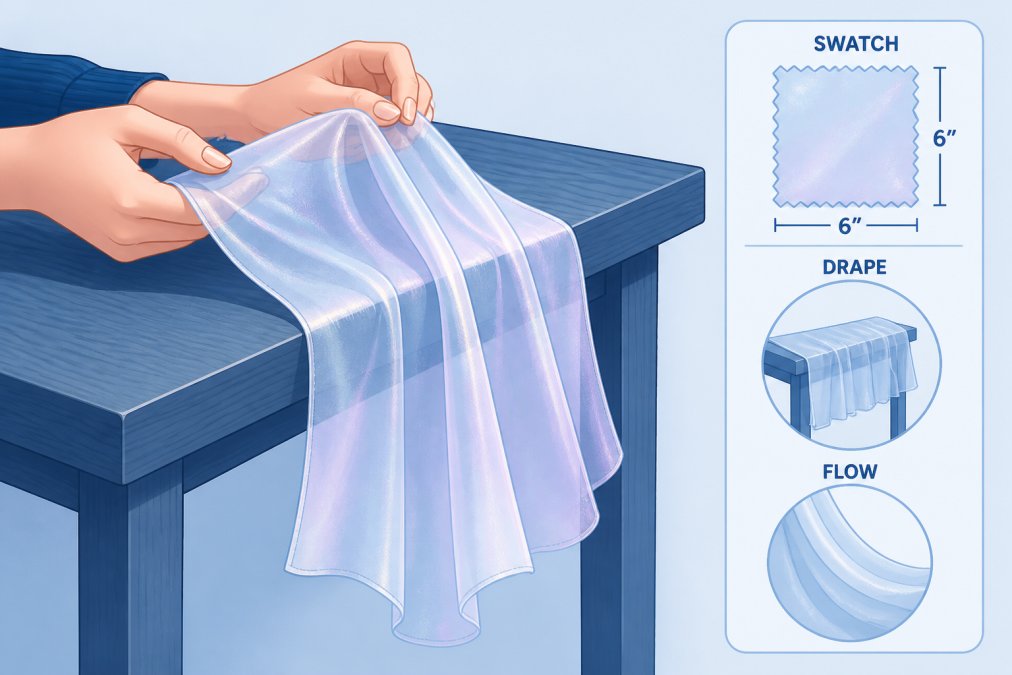
Step-by-Step: The Vertical Fall and Hand-Feel Test
What you'll need:
- A fabric swatch of at least 12" x 12"
- A flat table with a clear edge
- Natural or consistent artificial lighting
Step 1: The vertical fall test Hold the swatch at one corner between your thumb and forefinger. Let it hang freely. A highly drapeable fabric cascades into soft, rounded folds. A stiff fabric holds angular pleats or resists falling.
Step 2: The table-edge drape test Lay the swatch flat on a table and allow half to extend over the edge. A fabric with high drapeability curves smoothly downward. A fabric with significant body extends outward before bending.
Step 3: The hand-feel assessment Bunch the fabric loosely in your hand, then release it. Note how quickly it recovers. Good crease resistance suggests a fabric that will maintain its appearance in use.
Step 4: The bias drape check Rotate the swatch 45 degrees and repeat the vertical fall test. If the fabric drapes noticeably better on the bias, it's a candidate for bias-cut applications.
Using Video Reviews to Verify Fabric Movement Before You Buy
Video content communicates more about drapeability in five seconds than a written description can in five paragraphs.
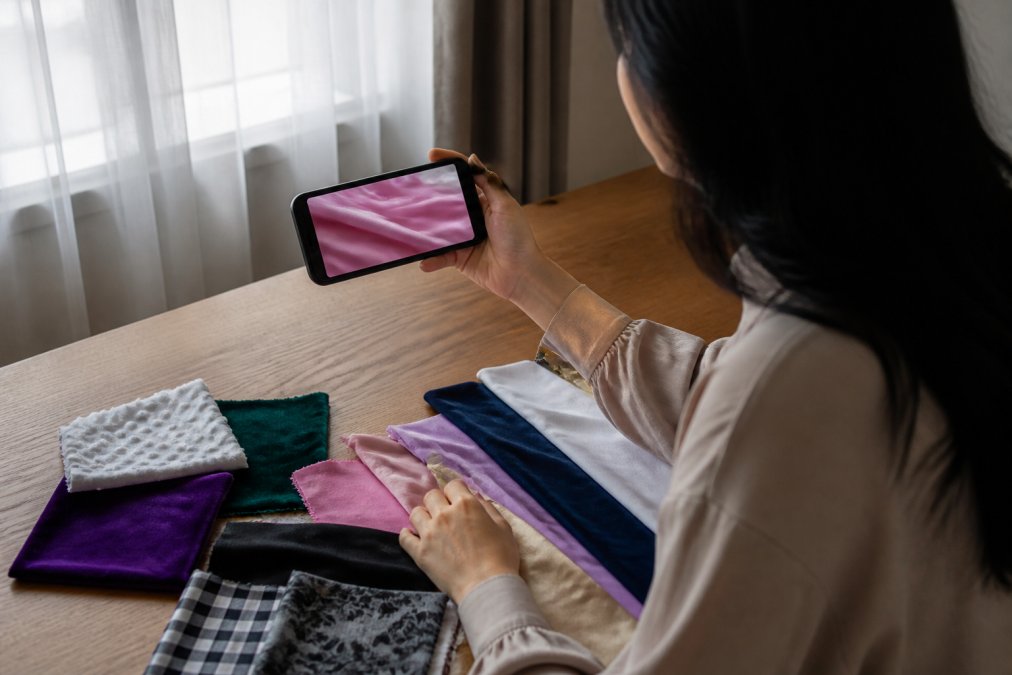
What to look for in fabric videos:
- Shake test: Watch how the fabric moves during the shake and how it settles afterward.
- Drape over hand: Highly drapeable fabrics flow around the hand's contours. Stiff fabrics bridge across them.
- Walking movement: Watch whether fabric swings and flows with movement or moves as a single stiff unit.
- Slow-motion footage: This is the most informative format available remotely.
Search for video reviews on retailer product pages, fabric communities, and video platforms. When a listing has no video, contact the supplier and ask for one.
Best Online Fabric Stores for Swatches and Drape Verification
The best online fabric stores combine detailed technical specifications with a genuine swatch program and video content. Look for these signals:
- GSM listed on every product
- Fiber content confirmed by weight percentage
- Multiple product photos showing fabric draped, not just flat
- Video content showing fabric movement
- Swatch availability before full-yardage orders
- Responsive customer service
New Creations Fabric & Foam Inc stocks curated fabrics with detailed specifications designed for professional sourcing. The Crystal Organza Fabric (60" wide, 100% polyester) has the floaty drape characteristic of low-GSM filament weaves, suitable for wedding drapery and formal gown construction. The Crushed Iridescent Organza offers a distinctive crinkled texture that adds visual movement. For event decor requiring consistent drape, the Bridal Illusion Tulle (108" wide, 50-yard rolls) provides the uniform, lightweight fall that backdrop installations demand.

| Evaluation Criterion | What to Check | Why It Matters |
|---|---|---|
| GSM specification | Listed on product page | Predicts weight and drape behavior |
| Fiber content | Full percentage breakdown | Determines hand-feel and flow |
| Weave/structure type | Plain, twill, satin, knit | Determines stiffness and movement |
| Video content | Shake test or drape demo | Shows actual fabric movement |
| Swatch availability | Offered before bulk order | Confirms real-world behavior |
Troubleshooting Drape Failure: When the Fabric Doesn't Behave as Expected
Problem: Fabric is stiffer than expected Many fabrics receive a stiffening finish during manufacturing that is not disclosed. Before rejecting a fabric, launder a swatch and re-test the drape. The difference can be significant.
Problem: Fabric drapes unevenly or pulls to one side The fabric may have been cut off-grain or have a one-way stretch. Test the fabric's behavior on both the straight grain and cross-grain.
Problem: Fabric loses drape after washing Some natural fibers, particularly rayon and Tencel, shrink and stiffen slightly after washing. Always pre-wash swatches using the same method you intend to use on the finished piece.
Problem: Fabric looks different in person than in product photos A fabric photographed against a light background appears more opaque than it will in real-world use. Request photos against dark backgrounds or look for customer photos in reviews.
Sourcing fabric remotely requires a structured approach to information. New Creations Fabric & Foam Inc offers detailed product specifications, a curated selection spanning lightweight sheers to textured sequin knits, and a range designed for both professional production and individual creative projects. Explore Fabrics at New Creations Fabric & Foam Inc and source with the confidence that comes from knowing exactly what you're getting.
Frequently Asked Questions
What fabric specifications indicate good drape?
Look for a low GSM (grams per square meter) combined with a fluid fiber content such as polyester, rayon, or silk. Fabrics described as 'fluid,' 'lightweight,' or 'sheer' typically have a low bending length and a high drape coefficient, meaning they conform to shape rather than holding it. Weave density also matters: looser weaves generally produce more fabric movement than tight, dense constructions. A fabric hand described as 'soft' or 'silky' is another reliable indicator of good drapeability.
What is the difference between fabric weight and fabric drape?
Fabric weight, measured in GSM, tells you how heavy a fabric is per square meter. Drape describes how the fabric moves and falls under its own weight. The two are related but not the same: a heavy fabric can drape beautifully if its fiber content and weave allow fluid movement, while a lightweight fabric can be stiff if it has a rigid finish or tight weave structure. GSM is one input into drape, but fiber content, weave density, and fabric finish all shape the final drape behavior.
Can I use video reviews to verify fabric movement online?
Yes, and it is one of the most reliable methods available when buying fabric without handling it first. Look for slow-motion or close-up video clips where the fabric is held at one end and allowed to fall freely, or worn and moved by a person. Pay attention to how quickly the fabric settles, whether it forms soft folds or sharp creases, and how it responds to motion. Sheer fabrics like organza and tulle show their drape characteristics most clearly in video format.
How do I distinguish between stiff and fluid fabrics from an online description?
Stiff fabrics are typically described using terms like 'structured,' 'crisp,' 'body,' or 'holds its shape.' Fluid fabrics are described as 'drapey,' 'fluid,' 'soft hand,' 'flowing,' or 'lightweight.' GSM is another clue: fabrics under 100 GSM in polyester or silk blends tend toward fluid drape, while those above 200 GSM in cotton or canvas lean stiff. Fabric finish also plays a role; starched or resin-treated fabrics will feel stiffer regardless of fiber content.
This article was written using GrandRanker