

Table of Contents
- What Small Designers Actually Need From Fabric Suppliers
- Low Minimum Fabric Wholesale: Finding Suppliers That Work at Your Scale
- How to Source Fabric for a Clothing Brand: Step-by-Step
- Top Fabric Types for Apparel Design and Where to Find Them
- Fabric Sourcing Checklist for Designers
- Budgeting for Fabric Procurement: Cost Per Unit Breakdown
- Which Fabric Supplier Is Right for Your Design Business?
- Conclusion
Last Updated: August 13, 2026
Finding reliable fabric suppliers as a small designer is harder than most guides admit. The textile industry was built around bulk purchasing and minimum order quantities that assume factory-scale production, not studio work. At New Creations Fabric & Foam Inc, we work with independent designers who've been burned by suppliers that don't understand small-batch production, and we've put together this guide to help you source smarter.
Quick Picks:
- Best for small designers overall: New Creations Fabric & Foam Inc, no steep MOQs, sold by the yard, broad fabric variety
- Best for natural fiber basics: 100% cotton and muslin options, ideal for pattern-making and everyday garments
- Best for specialty and performance textiles: Stretch velvet, polyester spandex, and satin for apparel and event work
What Small Designers Actually Need From Fabric Suppliers
Small designers need fabric suppliers that sell by the yard, offer consistent dye lots, and don't require warehouse-scale commitments. You're operating in a B2B context, which means you need to think about procurement: lead times, resale certificates, minimum order quantities, and quality control processes.

Wholesale vs. Retail Fabric Sourcing: Which Makes Sense for You
Wholesale fabric sourcing is purchasing textile materials directly from distributors or fabric mills at below-retail pricing, typically requiring a business account and resale documentation.
Retail sourcing works for prototypes. Once you're producing more than a handful of garments per season, wholesale pricing becomes essential to your cost per unit. The spread between retail and wholesale on designer textiles can be significant, often the difference between a profitable collection and one that breaks even.
Wholesale accounts typically require a valid business entity, a state resale certificate, and minimum order commitments that vary by supplier. For small designers not ready for large minimums, suppliers offering wholesale pricing by the yard without bulk purchasing are the most practical entry point.
Understanding Minimum Order Quantities (MOQs)
Minimum order quantity (MOQ) is the smallest amount of fabric a supplier will sell in a single transaction, typically measured in yards or meters.
MOQs exist because fabric mills price for efficiency. Many traditional textile distributors set MOQs at 50 to 100 yards per colorway, a serious barrier for independent designers. The practical workaround: look for suppliers that sell by the yard with no enforced minimums, or those offering wholesale pricing at 25 yards or more.
Low Minimum Fabric Wholesale: Finding Suppliers That Work at Your Scale
Most fabric mills and textile distributors are structured for apparel manufacturers running thousands of units per season. Low minimum fabric wholesale options are genuinely harder to find.
What to look for in a low-minimum wholesale supplier:
- Sold by the yard with continuous yardage (not pre-cut pieces)
- Consistent stock across colorways for repeat orders
- Clear dye lot labeling so you can match future orders
- Published specifications: GSM, width, fiber content, and care instructions
New Creations Fabric & Foam Inc sells fabrics by the yard with no forced bulk commitment, with wholesale pricing available on orders of 25 yards or more for textiles like Stretch Velvet.
Negotiation Tactics for Small-Batch Orders
Most small designers assume listed prices are fixed. They usually aren't. Fabric suppliers, particularly smaller distributors, have more pricing flexibility than they advertise, especially if you demonstrate you're a serious recurring buyer.
Tactics that work in practice:
- Commit to a recurring order schedule. Suppliers value predictability. If you can say "I'll order 20 yards of this colorway every six weeks," you become more attractive than a one-time buyer.
- Ask about roll-end pricing. Fabric mills often have partial rolls they need to clear. These "deadstock" or end-of-roll pieces frequently sell at a discount and are perfectly usable for small-batch production.
- Bundle across SKUs. Ordering multiple fabric types from the same supplier in one transaction often unlocks better per-yard pricing.
- Reference your growth trajectory. If you're scaling, say so. Suppliers want to grow with you, and framing your current small order as the beginning of a larger relationship changes the conversation.
The first order sets the tone. Come in organized, know your specs, and pay on time.
Legal and Licensing Requirements for Sourcing
To purchase fabric at wholesale pricing, most suppliers require proof that you're a legitimate business purchasing for resale or manufacturing. The key document is a state resale certificate (sometimes called a sales tax exemption certificate), which generally requires:
- A valid state-issued seller's permit or business license
- Your business name and EIN (Employer Identification Number)
- A description of what you're purchasing and how it will be used
According to IRS guidance on business structures and EINs, obtaining an EIN is free and can be done online. Most states issue resale certificates through their department of revenue or taxation.
If you're importing custom textiles directly from fabric mills abroad, you'll need to comply with U.S. Customs and Border Protection regulations, including proper HTS code classification for your textile imports. The U.S. Customs and Border Protection textile import guidance outlines the documentation requirements for commercial textile shipments.
How to Source Fabric for a Clothing Brand: Step-by-Step
Sourcing fabric for a clothing brand is a procurement process, not a shopping trip. Designers who do it well treat it as a supply chain discipline: they document specifications, qualify suppliers, and build redundancy into their sourcing strategy.
Step 1: Define your fabric specifications Document exactly what you need: fiber content, weight in GSM, width, stretch percentage, and care requirements.
Step 2: Request swatches from 2-3 suppliers Never qualify a supplier from photos alone. Request physical fabric swatches and evaluate them against your specifications.
Step 3: Evaluate quality against your criteria Assess each swatch for GSM accuracy, drape, hand feel, and color consistency.
Step 4: Place a small test order Order the minimum viable quantity for a sample garment. This tests the supplier's fulfillment process.
Step 5: Evaluate the full order for consistency Check that the delivered yardage matches the swatch in color, weight, and hand feel.
Step 6: Establish a reorder process and document lead times Know your supplier's standard lead time before you need to reorder. Build that lead time into your production calendar.
Evaluating Fabric Quality: GSM, Drape, and Hand Feel
GSM (grams per square meter) is the standard measure of fabric weight in the textile industry. It tells you how dense and heavy a fabric is per unit area, a critical specification for garment construction.
| GSM Range | Weight Category | Typical Use Cases |
|---|---|---|
| 80-120 GSM | Lightweight | Blouses, linings, poplin shirts |
| 130-200 GSM | Medium weight | T-shirts, dresses, jersey knits |
| 200-300 GSM | Medium-heavy | Structured garments, activewear |
| 300+ GSM | Heavyweight | Canvas, outerwear, upholstery |
Drape refers to how a fabric falls and flows when hung or worn. Hand feel is how the fabric feels against your hand. Neither is inherently better; the right drape and hand feel depend on the garment. This is why swatch evaluation is non-negotiable.
Quality Control and Defect Returns
Quality issues in fabric orders fall into predictable categories: color variation between rolls, inconsistent GSM, weave defects, and width inconsistency. Catch these before cutting.
A practical quality control process:
- Inspect the first yard of each roll before cutting
- Check color against your approved swatch in consistent lighting
- Measure width at multiple points along the roll
- Test a small swatch for shrinkage before cutting garment pieces
- Document any defects with photos before contacting the supplier
Most reputable suppliers have a defect return policy, but the window for reporting is often short. Read the return policy before ordering.
Top Fabric Types for Apparel Design and Where to Find Them
Choosing the right textile starts with understanding what each fabric type is built for. The wrong fabric for a garment affects construction, durability, and how the finished piece performs on the body.
Natural Fibers: Cotton, Muslin, and Canvas
Natural fibers remain the backbone of garment production. They breathe, take dye well, and are the standard material for pattern development and toile construction.
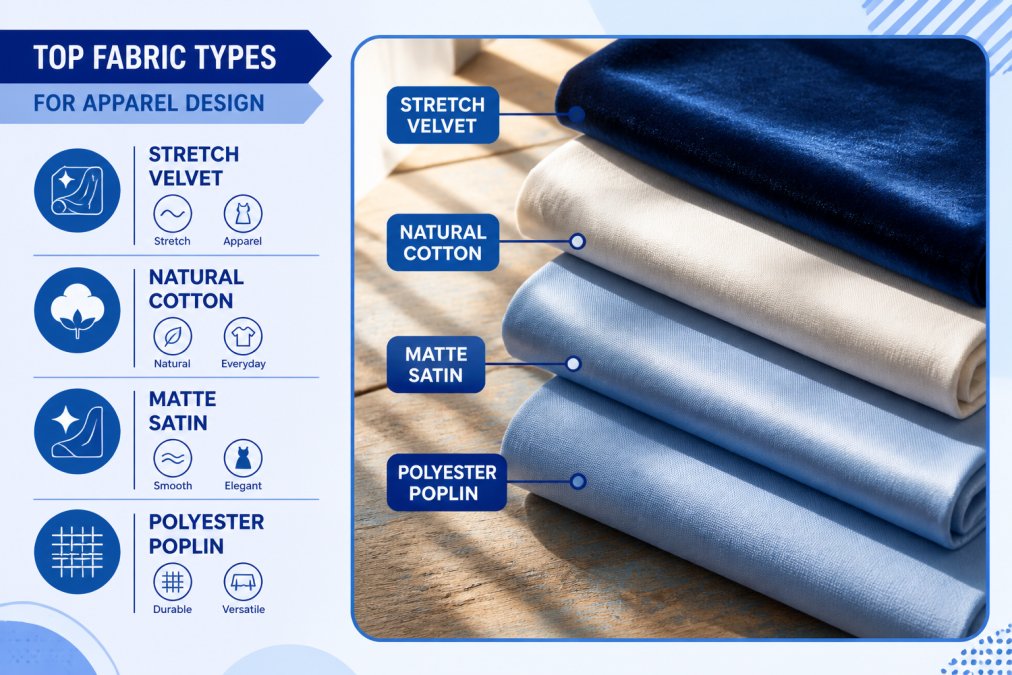
Cotton muslin is the pattern-maker's essential. New Creations Fabric & Foam Inc carries an Ivory Muslin Natural Cotton at $9.99/yard, 100% unbleached cotton at 45-48" wide. It's the right choice for toiles, test garments, and any application where you need a neutral, workable base fabric.
For production-weight cotton, the Solid 100% Cotton Fabric at $12.95/yard offers 58" width and withstands professional cleaning detergents.
Cotton duck canvas is in a different category. The 10 oz Cotton Duck Canvas at $12.95/yard has a 315 GSM, 0.75mm thickness, and a tear strength of 1000 N warp, Oeko-Tex Standard 100 certified. This is the fabric for structured bags, upholstery, and any application requiring serious durability.
Synthetic and Stretch Textiles: Polyester, Spandex, and Velvet
Synthetic textiles dominate performance apparel, event décor, and specialty garment work. They're more dimensionally stable than natural fibers, easier to care for, and often more cost-effective for production runs.
Polyester poplin is the workhorse of the synthetic category. The Polyester Poplin 60" Wide at $7.95/yard is stain and wrinkle resistant, rated for 75+ wash cycles, and made to New Creations' own specifications.

For stretch garments, the Cotton Jersey Spandex Knit at $12.95/yard hits a practical specification: 95% cotton, 5% spandex, 180 GSM, with 50% vertical and 25% horizontal stretch. That stretch ratio works well for fitted dresses, activewear, and maternity garments.

Stretch velvet is the specialty fabric that separates a costume from a garment. The Stretch Velvet 58" Wide at $14.95/yard is 90% polyester, 10% spandex, with 4-way stretch, suitable for dancewear, bridal work, and theatrical costumes. Wholesale pricing is available at 25 yards or more.
For bridal and formal work, the Dull Satin (Peau de Soie) at $14.95/yard offers a matte finish with the body of a traditional satin, 60" wide, 6.1 oz per yard, available in 35 colors.
Sustainable Sourcing and Deadstock Fabric Options
Sustainable sourcing in the textile industry covers two approaches: purchasing from mills that use certified sustainable production methods, and sourcing deadstock fabric, unused textile inventory from larger production runs.
Deadstock fabric is particularly practical for small designers. It's typically first-quality material available at reduced cost because the original buyer over-ordered or canceled. The trade-off is limited availability: once a deadstock lot is gone, it's gone.
For ongoing sustainable sourcing, look for fabrics carrying third-party certifications. The Oeko-Tex Standard 100 certification database allows you to verify whether a specific fabric has been tested for harmful substances.
Fabric Sourcing Checklist for Designers
Use this checklist before every new supplier relationship and at the start of each production season.
Supplier Qualification:
- Confirm supplier sells by the yard (not pre-cut only)
- Request full fabric specifications: GSM, width, fiber content, stretch percentage
- Verify dye lot labeling and consistency policy
- Confirm lead times for standard and rush orders
- Review defect return policy and reporting window
- Obtain supplier's minimum order quantity for wholesale pricing
Order Preparation:
- Document your fabric specifications before contacting supplier
- Request physical swatches before placing production order
- Confirm colorway availability and stock levels
- Calculate yardage with 10-15% overage for cutting waste
- Confirm shipping method and estimated delivery window
Quality Control on Receipt:
- Inspect first yard of each roll before cutting
- Check color against approved swatch in consistent lighting
- Measure fabric width at multiple points
- Test for shrinkage on a pre-cut swatch
- Document any defects with photos immediately
Inventory Management for Small Designers
Poor inventory management is one of the most common reasons small designers run into cash flow problems, either over-ordering and tying up capital in unused fabric, or under-ordering and missing production deadlines.
Track by colorway, not just fabric type. A single fabric in three colors is three inventory line items. Dye lots matter, and a re-order six months later may not match the original.
Set a reorder trigger, not a reorder date. Rather than ordering on a fixed schedule, set a minimum stock level (say, 10 yards of a core fabric) that triggers a reorder. This prevents stockouts without requiring you to predict demand months in advance.
Account for lead times in your production calendar. If a supplier has a two-week lead time and you need fabric for a production run starting in three weeks, your reorder window is now.
Budgeting for Fabric Procurement: Cost Per Unit Breakdown
Budgeting for fabric procurement starts with cost per unit, not cost per yard. The per-yard price is only meaningful in the context of how many yards each garment requires.
| Fabric | Price/Yard | Yards per Garment (est.) | Fabric Cost per Unit |
|---|---|---|---|
| Polyester Poplin | $7.95 | 2.5 yards | ~$19.88 |
| Cotton Polyester Broadcloth | $8.95 | 2.5 yards | ~$22.38 |
| Cotton Muslin (pattern use) | $9.99 | 3 yards | ~$29.97 |
| Solid Cotton 58" Wide | $12.95 | 2.5 yards | ~$32.38 |
| Cotton Jersey Spandex | $12.95 | 2 yards | ~$25.90 |
| Stretch Velvet | $14.95 | 2.5 yards | ~$37.38 |
| Dull Satin (Peau de Soie) | $14.95 | 3 yards | ~$44.85 |
Yards per garment estimates vary significantly by style, size range, and pattern efficiency. Add 10-15% for cutting waste and sampling.
Beyond fabric cost, a complete procurement budget includes shipping costs, swatch and sampling costs, a defect allowance, and storage costs if you're holding inventory. Many small designers calculate profitability based on fabric cost per yard without accounting for yield. A cheaper fabric that requires more yardage due to pattern matching can end up costing more per finished unit than a more expensive fabric that cuts efficiently.
Which Fabric Supplier Is Right for Your Design Business?
The best fabric suppliers for small designers sell by the yard without punishing minimums, provide accurate specifications, and maintain consistent stock for reliable reorders.
For most independent designers and small apparel brands, New Creations Fabric & Foam Inc covers the essential spectrum, from pattern-making muslin and production-weight cotton to specialty textiles like stretch velvet, matte satin, and polyester spandex. The product range is built for professional use: published GSM specs, continuous yardage shipping, and fabrics engineered to withstand professional cleaning and production-scale use.
| Fabric Category | New Creations Option | Price/Yard | Best For |
|---|---|---|---|
| Lightweight synthetic | Polyester Poplin 60" | $7.95 | Shirts, linings, event linens |
| Blended broadcloth | Cotton Polyester Broadcloth | $8.95 | Everyday apparel, uniforms |
| Pattern-making | Ivory Cotton Muslin | $9.99 | Toiles, test garments |
| Production cotton | Solid Cotton 58" | $12.95 | Garments, home décor |
| Stretch knit | Cotton Jersey Spandex | $12.95 | Activewear, fitted dresses |
| Specialty/formal | Stretch Velvet | $14.95 | Costumes, bridal, dancewear |
| Formal/event | Dull Satin (Peau de Soie) | $14.95 | Gowns, table covers, décor |
If your needs fall outside this range, highly technical performance fabrics, certified organic textiles, or custom-woven patterns, you'll likely need to work with specialized fabric mills directly, which typically means higher MOQs and longer lead times. For the majority of small designers working in apparel, event décor, and costume production, a supplier with this breadth of textile options eliminates the need to manage multiple supplier relationships.
The question most designers should ask isn't "which supplier is cheapest?" It's "which supplier can I rely on for consistent quality across repeat orders?" Inconsistent drape, color variation between rolls, and width discrepancies are the problems that kill production timelines, not the per-yard price.
Sourcing fabric consistently at a professional quality level is one of the hardest operational challenges for small designers. New Creations Fabric & Foam Inc offers a textile range built specifically for this challenge: fabrics sold by the yard with published specifications, engineered for production-scale use, and stocked across a range of categories from natural cotton to specialty synthetics. Explore Fabrics at New Creations Fabric & Foam Inc and build a sourcing foundation your production process can depend on.
Frequently Asked Questions
Where do small independent designers source their fabrics?
Independent designers typically source fabric from online wholesale suppliers, textile distributors, fabric trade shows, and direct-to-consumer fabric stores that offer by-the-yard purchasing. The best fabric suppliers for small designers offer low minimum order quantities, detailed fabric specs like GSM and fiber content, and consistent stock across repeat orders. Starting with fabric swatches before committing to bulk purchasing helps avoid costly mismatches in drape, hand feel, or color.
What are realistic minimum order quantities for small fashion brands?
Minimum order quantities vary significantly by supplier type. Fabric mills and large textile distributors often require 50 to 300 yards per colorway, which is impractical for independent designers. Suppliers focused on small-batch and by-the-yard sales typically have no formal MOQ, or set a low threshold of 5 to 25 yards. If you need wholesale pricing at lower volumes, presenting a resale certificate and discussing recurring order potential can sometimes unlock better terms.
Is it better to buy fabric from wholesalers or retail stores?
Wholesale pricing delivers a lower cost per unit, which matters once your garment production reaches even modest volume. Retail fabric stores are convenient for sampling and small projects, but the markup makes them expensive for recurring procurement. The practical middle ground for small designers is an online supplier offering wholesale pricing by the yard with no large MOQ requirement, you get the price advantage without committing to hundreds of yards before validating your design.
How do I evaluate a new fabric supplier before placing a bulk order?
Request fabric swatches first and assess GSM, drape, hand feel, and color accuracy against product photos. Check whether the supplier ships multiple yards as a continuous piece, which matters for cutting efficiency. Ask about their defect and return policy before ordering. Confirm lead times and whether stock levels support recurring orders. For apparel design, also verify fiber content and care instructions match your garment's requirements, and check for certifications like Oeko-Tex Standard 100 where relevant.
How can small designers access wholesale fabric pricing without a large business account?
Many online fabric suppliers offer wholesale pricing by the yard without requiring a formal wholesale account or large minimum order. Obtaining a state resale certificate, issued through your state's department of revenue, establishes your business legitimacy and can unlock trade pricing with suppliers who require it. Buying in slightly larger quantities per order, even 20 to 30 yards, often triggers tiered wholesale pricing. Suppliers that serve independent designers directly frequently list wholesale prices openly without an account requirement.
This article was written using GrandRanker