

Table of Contents
- Why Fabric Samples Matter Before Any Bulk Order
-
The 7 Essential Custom Clothing Fabric Samples to Evaluate
- 1. Polyester Poplin: The Workhorse for Structured Garments
- 2. Cotton Jersey Spandex: Stretch, Breathability, and Drape Combined
- 3. Scuba Double Knit: Wrinkle-Free Structure for Tailored Pieces
- 4. Charmeuse Satin: Glossy Finish for Formalwear and Linings
- 5. Dull Satin (Peau de Soie): Matte Elegance for Event and Bridal Work
- 6. Stretch Velvet: Plush Texture for Apparel, Costumes, and Decor
- 7. Cotton Polyester Broadcloth: Lightweight Versatility at a Lower Price Point
- Fabric Weight and Hand Feel Guide: What the Numbers Actually Tell You
- How to Source Fabric for a Clothing Line Without Costly Mistakes
- Fabric Swatch Organization Tips for Designers and Production Teams
- Cost-Benefit Analysis: Is a Sample Pack Worth It Before Bulk Orders?
- Conclusion
Last Updated: August 14, 2026
Ordering fabric online without testing it first is one of the most expensive mistakes a designer or production team can make. The color looks perfect on screen, then the roll arrives, wrong hand feel, unexpected drape, color three shades off. At New Creations Fabric & Foam Inc, we see this repeatedly. The fix is always the same: test before you commit to bulk.
This guide covers the 7 essential custom clothing fabric samples every designer, brand owner, or production team should evaluate before placing a large order, plus a practical guide to reading GSM specs and a cost-benefit analysis for sample testing.
Quick Picks:
- Best structured woven: Polyester Poplin, the reliable workhorse for uniforms, shirting, and structured garments
- Best stretch knit: Cotton Jersey Spandex, breathable, drapey, and forgiving on the body
- Best for tailored looks: Scuba Double Knit, wrinkle-free and production-friendly
- Best formalwear satin: Charmeuse Satin, high gloss, fluid drape
- Best bridal/event matte: Dull Satin (Peau de Soie), structured body, matte finish
- Best plush texture: Stretch Velvet, 4-way stretch with a luxurious pile
- Best budget workhorse: Cotton Polyester Broadcloth, lightweight, versatile, affordable
Why Fabric Samples Matter Before Any Bulk Order
Fabric samples are physical test swatches that allow designers and production teams to evaluate a textile's true characteristics, weight, texture, drape, colorfastness, and shrinkage, before committing to bulk purchase. The gap between a digital product image and the physical textile is real. Monitor calibration, photography lighting, and color compression all distort how a fabric appears online. A swatch in your hands tells you what no screen can: how the material drapes, how it responds to tension, and whether the hand feel matches your design intent. Testing fabric samples also surfaces issues that specs alone cannot predict. A fabric listed at 180 GSM may feel heavier or lighter depending on fiber composition and weave structure. A sample pack costs a fraction of what a failed bulk order costs in wasted material, production delays, and client relationship damage.

The 7 Essential Custom Clothing Fabric Samples to Evaluate
Seven fabric categories cover the majority of custom clothing production needs, from structured shirting and activewear to formalwear and performance costumes.
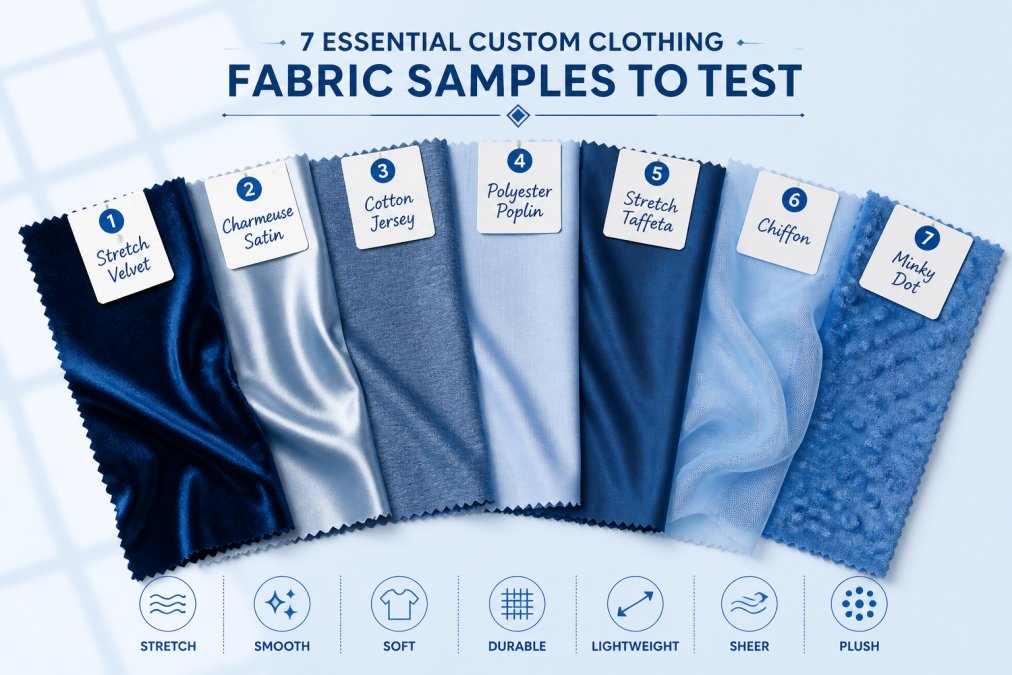
1. Polyester Poplin: The Workhorse for Structured Garments
Polyester Poplin is a 100% polyester, plain-woven textile with a smooth, mini-matte finish that reads professional without being stiff. New Creations Fabric & Foam Inc offers Polyester Poplin at $7.95 per yard, 58 inches wide, with a 7-ounce weight. When evaluating your swatch, run your thumb across the face, the weave should feel tight and even. Hold it up to light; uniform opacity indicates consistent construction.
Best for: Uniforms, shirts, blouses, structured dresses, tablecloths, and event linens.
2. Cotton Jersey Spandex: Stretch, Breathability, and Drape Combined
Cotton Jersey Spandex is a 95% cotton, 5% spandex blend at 180 GSM and 0.45 mm thickness, with 50% vertical stretch and 25% horizontal stretch. At $12.95 per yard, it reflects its natural fiber content. Pull the swatch vertically to its stretch limit and release; it should snap back cleanly with no distortion. Hang the swatch and watch how it falls, the drape should be bouncy and voluminous, that movement is what makes the fabric work for t-shirts, dresses, and activewear.
Best for: T-shirts, dresses, leggings, activewear, maternity wear, and baby garments.
3. Scuba Double Knit: Wrinkle-Free Structure for Tailored Pieces
Scuba Double Knit is 100% polyester at 180 GSM and 0.65 mm thickness, the thickest fabric in this list, with 5% vertical stretch and a wrinkle-free finish. Priced at $9.95 per yard. Scrunch the swatch hard in your fist for ten seconds, release, and observe. Good scuba should recover almost completely within a few seconds.

Best for: Skirts, structured dresses, blazers, costume bases, furniture covers, and linings for sports equipment.
4. Charmeuse Satin: Glossy Finish for Formalwear and Linings
Charmeuse Satin is 100% polyester, 58-60 inches wide, with no stretch and a silky, smooth texture. Priced at $14.95 per yard. Hold the swatch under direct light and tilt it; the sheen should shift and catch light evenly across the entire surface without dull patches. Run the fabric between your fingers, it should feel cool, smooth, and weightless, not stiff or papery.
Best for: Wedding dresses, gowns, skirts, blazer linings, festival wear, and nightwear.
5. Dull Satin (Peau de Soie): Matte Elegance for Event and Bridal Work
Dull Satin, also known as Peau de Soie, is 100% polyester, 60 inches wide, 6.1 oz per yard, with a stiff matte finish and no stretch. Priced at $14.95 per yard. Hold the swatch by one corner and observe how it hangs, it should maintain its form rather than collapsing softly. The matte surface should appear even and consistent, without any sheen variations that would read as quality inconsistencies in finished garments.
Best for: Bridal gowns, prom dresses, event drapery, table covers, sashes, and structured skirts.
6. Stretch Velvet: Plush Texture for Apparel, Costumes, and Decor
Stretch Velvet is 90% polyester and 10% spandex, 58/60 inches wide, with 4-way stretch and a silky soft pile. Priced at $14.95 per yard. When you receive the swatch, stroke it in both directions. The pile should lay flat consistently in one direction and stand up in the other, with no matting or irregular sections.
Best for: Apparel, dancewear, costumes, curtains, drapery, prom wear, and event decor.
7. Cotton Polyester Broadcloth: Lightweight Versatility at a Lower Price Point
Cotton Polyester Broadcloth is an 80% polyester, 20% cotton plain-woven fabric at 100 GSM and 0.20 mm thickness, the lightest in this lineup. Priced at $8.95 per yard. The cotton content adds breathability that 100% polyester cannot match, while the polyester majority improves durability and reduces cost. The swatch should feel crisp and smooth, not limp.
Best for: Shirts, blouses, uniforms, children's clothing, quilts, pillowcases, and table linens.
Fabric Weight and Hand Feel Guide: What the Numbers Actually Tell You
Fabric weight is the single most misunderstood specification in textile sourcing. GSM (grams per square meter) describes how much a fabric weighs per unit area, which directly affects drape, opacity, warmth, and durability, but the number alone does not tell you how a fabric will behave in production.
| Fabric | GSM | Thickness | Stretch | Best Application |
|---|---|---|---|---|
| Cotton Polyester Broadcloth | 100 GSM | 0.20 mm | None | Shirting, quilting, linings |
| Cotton Jersey Spandex | 180 GSM | 0.45 mm | 50% vertical | Activewear, t-shirts, dresses |
| Scuba Double Knit | 180 GSM | 0.65 mm | 5% vertical | Tailored pieces, costumes |
| Polyester Poplin | 7 oz/yd | N/A | None | Uniforms, structured garments |
| Dull Satin (Peau de Soie) | 6.1 oz/yd | N/A | None | Bridal, event drapery |
| Charmeuse Satin | N/A | N/A | None | Formalwear, linings |
| Stretch Velvet | N/A | N/A | 4-way | Apparel, costumes, decor |
Reading GSM and Thickness Specs on a Swatch Card
A swatch card is a labeled fabric sample that includes the textile's key specifications: fiber content, GSM, width, thickness, and care instructions. Two fabrics can share a 180 GSM rating and behave completely differently. Cotton Jersey Spandex at 180 GSM is 0.45 mm thick and stretches 50% vertically. Scuba Double Knit at 180 GSM is 0.65 mm thick with only 5% vertical stretch. Thickness, fiber content, and weave structure all modify how a given GSM translates to hand feel and drape.

Testing Colorfastness, Shrinkage, and Wash Performance
Colorfastness testing determines whether a fabric's dye will bleed, fade, or transfer during washing or wear. Wet the swatch with warm water, press it against a white cloth, and check for color transfer. Then machine wash the swatch on a warm cycle and compare it to an unwashed piece. Significant color shift or bleeding is a reliable warning sign before you commit to a bulk batch.
Measure your swatch before washing, wash and dry it according to care instructions, and measure again. For cotton-content fabrics especially, some shrinkage is expected; the question is whether it falls within acceptable tolerances for your pattern dimensions.
How to Source Fabric for a Clothing Line Without Costly Mistakes
Sourcing fabric for a clothing line requires evaluating suppliers on four criteria beyond price: consistency between dye lots, minimum order quantities, lead times, and sample availability. A supplier who cannot provide physical samples before bulk orders is a supplier who cannot be verified. Dye lot variation is real; colors ordered at different times from the same supplier can differ slightly between rolls.
Build a sample-first protocol into your sourcing workflow:
- Request physical swatches before any purchase decision
- Evaluate swatches against your design specifications and color standards
- Place a small test order (1-5 yards) before committing to bulk
- Test the test order fabric through your full production process, including washing
- Document results and establish a reorder threshold that accounts for dye lot variation
Digital vs. Physical Color Matching: Closing the Gap
The gap between digital and physical color is real and unavoidable. Monitor calibration, ambient lighting, photography settings, and image compression all alter how a textile color renders on screen. Request physical swatches for any color-critical application, use a standardized color reference system (Pantone is most common in apparel), and evaluate swatches under multiple light sources: daylight, fluorescent, and incandescent.
Sustainable Sourcing Verification: Questions to Ask Before You Commit
Sustainable sourcing verification is the process of confirming that a textile supplier's materials and practices meet your environmental and ethical standards before placing an order. Questions to ask any fabric supplier before committing to bulk:
- What is the fiber composition, and where are the raw materials sourced?
- Are the dyes used in your fabrics compliant with OEKO-TEX Standard 100 or equivalent certifications?
- What is your policy on minimum order quantities for ongoing orders?
- Can you provide documentation on colorfastness and shrinkage testing for this fabric?
- What is your lead time consistency across seasons?
The OEKO-TEX Association's certification standards for textile safety provide a useful benchmark for evaluating whether a supplier's dye and finishing processes meet recognized safety and environmental standards.
Fabric Swatch Organization Tips for Designers and Production Teams
Fabric swatch organization is the practice of systematically cataloging physical textile samples so they can be referenced quickly during design, production, and sourcing decisions.
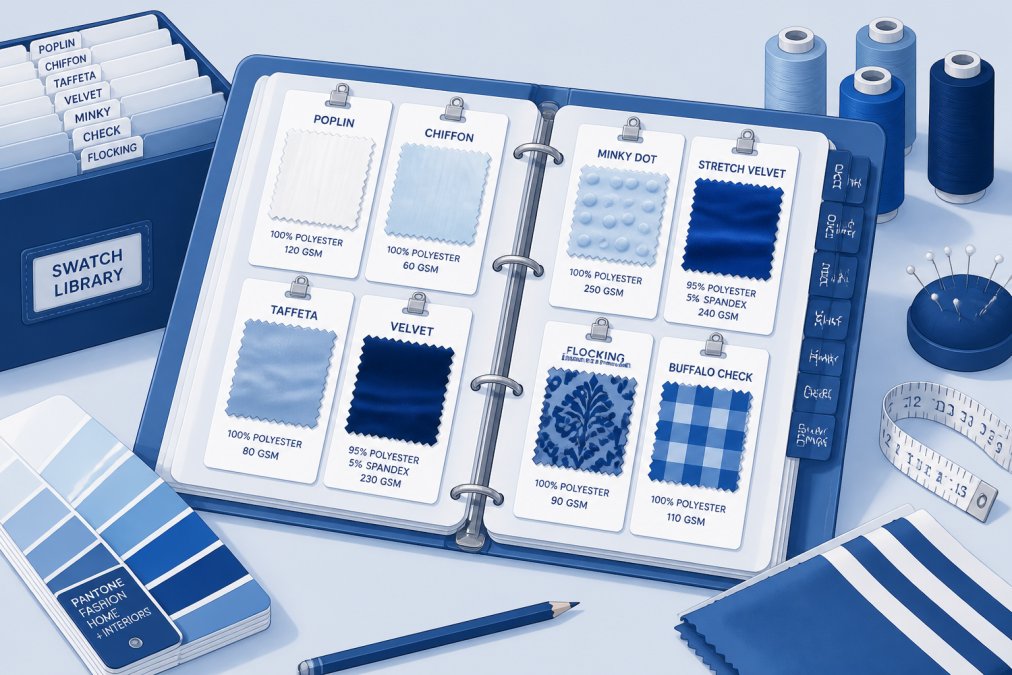
The most functional system is a physical binder organized by fabric category, with each swatch attached to a card that records: fabric name, fiber content, GSM, supplier, price per yard, and date of sample receipt.
Fabric swatch organization tips for designers:
- Label every swatch immediately upon receipt
- Record the supplier, price per yard, and order date on each card
- Organize by fabric type first, then by weight within each category
- Photograph each swatch under controlled lighting for your digital reference file
- Note wash test results directly on the swatch card
- Flag swatches that passed full wash and wear testing with a colored tab
- Archive discontinued fabrics separately for client consultations
For production teams managing multiple collections, a shared digital catalog that mirrors the physical binder keeps remote collaborators aligned.
Cost-Benefit Analysis: Is a Sample Pack Worth It Before Bulk Orders?
A sample pack is worth ordering before any bulk purchase where the fabric's physical characteristics directly affect the finished product's quality, fit, or appearance. That covers nearly every apparel application. The cost of a sample pack is fixed and predictable. The cost of a failed bulk order includes wasted material, lost production time, delayed delivery to clients, and potential reputational damage.
If ordering five fabric samples at $8.95-$14.95 per yard prevents even one rejected bulk order of 50 yards, the sample investment pays for itself many times over. Physical testing at the sample stage is professional practice, not a beginner's precaution.
| Sample Investment | What It Prevents | Net Value |
|---|---|---|
| 1-5 yards per fabric type | Wrong hand feel discovered post-bulk | Saves full bulk order cost |
| Wash and shrinkage test | Pattern grading errors in production | Saves rework and recuts |
| Colorfastness test | Color bleed on finished garments | Saves client relationship |
| Drape evaluation | Garment silhouette failures | Saves design iteration costs |
The hardest part of sourcing fabric online is knowing what you are actually getting before a bulk order ships. Physical sample evaluation closes that gap. New Creations Fabric & Foam Inc offers a full range of production-ready textiles, from Polyester Poplin at $7.95 per yard to Stretch Velvet and Charmeuse Satin at $14.95 per yard, all available by the yard with consistent quality specifications. Explore Fabrics at New Creations Fabric & Foam Inc and build your sample set before your next bulk order.
Frequently Asked Questions
Why is it important to test fabric samples before production?
Ordering fabric samples before a bulk batch protects you from costly surprises. A swatch lets you verify hand feel, drape, colorfastness, and actual fabric weight against the listed GSM, details that product photos simply cannot convey. Testing for shrinkage and wash performance on a small piece first can prevent an entire production run from failing quality checks, saving both money and time on replacements or rework.
How do I request fabric samples from textile manufacturers?
Contact the supplier directly and specify the fabric type, fiber content, weight in GSM, and any color references you need. Ask for a swatch card or a cut of at least 6 by 6 inches so you can assess hand feel and drape properly. Confirm whether the sample comes from the same dye lot as available stock, since colors ordered at different times can vary between rolls. Many suppliers, including New Creations Fabric & Foam Inc, sell fabric by the yard so you can order a single yard as a test print before committing to a bulk order.
What are the most common fabric types for custom apparel?
The most frequently used fabrics for custom clothing include polyester poplin for structured shirts and uniforms, cotton jersey spandex for activewear and casualwear, scuba double knit for tailored dresses and skirts, charmeuse satin and peau de soie for formalwear, and stretch velvet for costumes and eveningwear. Each has distinct material characteristics, fiber content, GSM, stretch, and drape, that make fabric samples essential for confirming the right choice before a bulk order.
How do I organize my fabric swatch library?
Group swatches by fabric type first, wovens, knits, specialty, then sort within each group by weight or end use. Attach a swatch card to each sample noting the supplier, fiber content, GSM, price per yard, and wash instructions. A three-ring binder with zip-lock sleeves works well for flat wovens, while heavier textiles like velvet benefit from hanging tags on a rod system. Date each entry so you can track dye lot availability when reordering.
How can I tell if a fabric's online color matches what I'll actually receive?
Monitor calibration and lighting conditions mean on-screen colors rarely match physical fabric exactly. The safest approach is to order a physical yard before any bulk order, then compare it against your design reference under consistent lighting. When working with a supplier like New Creations Fabric & Foam Inc, note that colors ordered at different times come from different dye lots and may not match exactly, so ordering all yardage for a single project at once reduces color variation risk.
This article was written using GrandRanker