

Last Updated: October 26, 2026
Quick Summary
Use chiffon drapes at twice the frame width for soft fullness or three times for deep gathered folds, then add 12 to 18 inches of length for floor pooling. Anchor the top first, gather every 8 to 12 inches down each upright, and confirm your attachment method with the venue in writing.
- Chiffon is lightweight, sheer and soft, so panels billow gently instead of sagging like canvas or satin.
- For a 7-foot-wide, 8-foot-tall arch, plan roughly 9.5 to 10 feet of panel length per panel.
- Zip ties and fabric clips work on frames, but tape releases in heat and leaves residue.
- Choose hardware rated for at least four times the total weight of fabric plus hardware.
- Keep pooled fabric at least 36 inches back from exits, aisles and emergency egress routes.
Table of Contents
- Why Chiffon Drapes Create an Elegant Wedding Atmosphere
- Chiffon Wedding Backdrop Ideas for Ceremony and Reception
- How to Drape Fabric on a Wedding Arch
- Wedding Backdrop Fabric and Drape Sizes: Getting the Math Right
- How to Hang Chiffon Backdrop Curtains on Frames and Walls
- Layering Chiffon with Flowers, Lighting and Color
- Wrinkle Removal, Transport and Care for Chiffon Drapes
- Ordering Chiffon Drapes for Your Next Wedding
- Frequently Asked Questions
Why Chiffon Drapes Create an Elegant Wedding Atmosphere
Chiffon drapes are the fastest way to turn a plain venue into a soft, romantic setting.
At New Creations Fabric & Foam Inc, we supply chiffon by the yard to decorators and designers.
Three qualities do the work:
- Sheer density softens harsh venue lighting and hides plain walls
- Light weight lets panels billow gently instead of sagging
- Soft drape creates deep, flowing folds with very little fabric
Tulle reads flat and matte; organza holds a crisper shape.
Watch out: chiffon shows every crease and every hard edge behind it.
Chiffon Wedding Backdrop Ideas for Ceremony and Reception
Chiffon wedding backdrop ideas split into two jobs: ceremony pieces that frame the couple and reception pieces that soften a large room. Plan both at once so fabric, color, and fullness match.
Altar and Ceremony Backdrops
The ceremony backdrop is the most photographed surface of the day. You can buy sheer chiffon curtain panels in a height suited to ceremony arch backdrops. Keep it simple and let the fabric carry the drama.
Three setups work reliably:
- Full arch drape with a single gathered panel swept to one side
- Freestanding pipe frame with two panels meeting at the center
- Cross-back or grid frame with layered panels behind the officiant
Reception and Ceiling Treatments
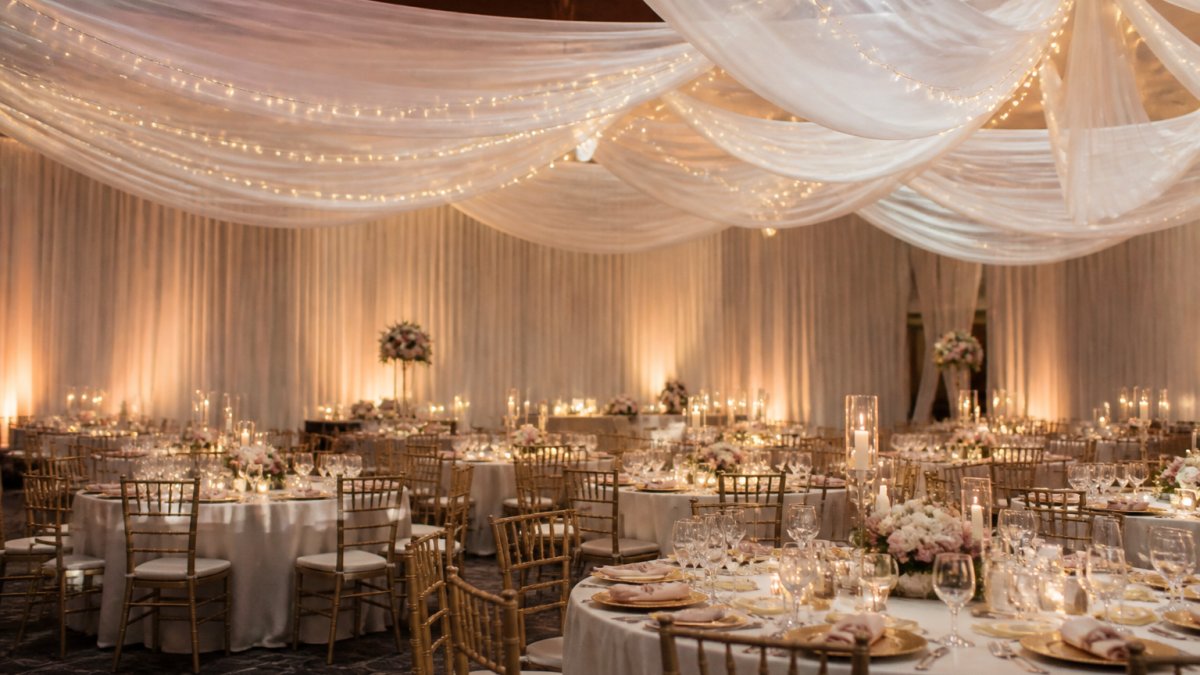
Ceilings are where chiffon earns its keep. You can shop sheer chiffon panels to hang for reception and ceiling draping.
How to Drape Fabric on a Wedding Arch
Most arch-draping guides stop at "attach, gather, secure." The steps below add the measurements, anchor points, and safety checks that separate a backdrop that photographs well from one that sags or slips.
Step 1: Measure before you touch fabric
Measure three numbers on the arch itself:
- Inside width between the two uprights at the widest point
- Height from the floor to the top of the arch
- Upright diameter (or width, for square frames) so you know what your clips and ties have to grip
Step 2: Calculate the fabric you need
Use the same fullness rule you would use for any backdrop:
Panel width = arch inside width × 2 for soft fullness, × 2.5 to 3 for deep gathered folds.
Panel length = arch height + 12 to 18 inches for floor pooling, plus 6 inches of tail for the top anchor.
Worked example for a common 7-foot-wide, 8-foot-tall arch:
- Soft fullness: 7 × 2 = 14 feet of fabric width
- Deep gathers: 7 × 3 = 21 feet of fabric width
- Panel length: 8 feet + 12 to 18 inches pooling + 6 inches anchor tail = roughly 9.5 to 10 feet per panel
If your chiffon is 58 inches wide (about 4.8 feet), a 14-foot run needs three panels overlapped or seamed; a 21-foot run needs five. You can check the fabric's width and yardage specs before ordering.

Step 3: Set and stabilize the arch
An arch that shifts under fabric weight will pull your gathers out of place. Before draping:
- Push the feet as wide as the frame allows and weight each foot with a sandbag or concealed weight
- On grass or gravel, stake the feet if the venue permits
- On a hard floor, use rubber-footed bases and check that the arch does not rock
Step 4: Anchor the top first
Attach the top of the panel to the highest point of the arch first. Zip ties, fabric clips, or a hidden staple into the back face of a wooden arch all work. Tape does not, it releases in heat and leaves residue. Leave a 6-inch tail above the anchor point so the fabric hangs without pulling tight against the frame.
Step 5: Gather as you descend
Pinch the fabric into loose folds every 8 to 12 inches down each upright. Do not stretch, stretched chiffon reads thin and flat in photos, while gathered chiffon reads deep and soft. Secure each gather with a clear zip tie or fabric clip on the back of the upright so hardware stays out of view.
Step 6: Choose a sweep or a cross
Two layouts cover most ceremonies:
- Single sweep: both panels anchored at one top corner and swept to the opposite base. Best for asymmetrical floral arrangements.
- Soft cross: one panel anchored at each top corner, crossed at the center, and tied at the opposite base. Best for a formal, symmetrical altar.
Step 7: Finish the base and fluff
Let 12 to 18 inches of fabric pool on the floor at each upright. Pooling hides the feet and softens the transition to the ground. Then step back to the aisle, not next to the arch, and check the folds from the angle guests and the photographer will actually see.
Wedding Backdrop Fabric and Drape Sizes: Getting the Math Right
Wedding backdrop fabric and drape sizes come down to one rule: buy for fullness, not coverage. A flat panel that just covers the frame looks thin.
Use this formula:
Panel width = frame width × 2 to 2.5 for soft fullness, × 3 for deep gathered folds.
Wool Dobby Chiffon Fabric 58” Wide by the Yard – Sheer Textured Chiffon Fabric →
Panel length = frame height + 12 to 18 inches for floor pooling.
A quick reference:
| Frame Width | Soft Fullness (×2) | Deep Gathers (×3) |
|---|---|---|
| 6 ft | 12 ft | 18 ft |
| 8 ft | 16 ft | 24 ft |
| 10 ft | 20 ft | 30 ft |
Dye lots vary between orders, and a slight color shift between two panels is very visible in photos.
How to Hang Chiffon Backdrop Curtains on Frames and Walls
Hanging chiffon is not hard. Hanging it safely, legally, and without damaging the venue is where most DIY backdrops go wrong. Here are the anchor options, load math, and venue rules to check before you buy a zip tie.
Match the anchor to the surface
| Surface | Best anchor | Avoid |
|---|---|---|
| Pipe and drape frame | Zip ties at the top bar, gathered ties at each upright | Tape, which slips on smooth pipe |
| Wooden arch or frame | Fabric clips or staples into the back face | Staples into the front face, which show in photos |
| Painted venue wall | Freestanding frame; if the venue allows, tension rods or removable adhesive hooks rated for the load | Nails, screws, or any permanent fastener |
| Exposed ceiling beams | Screw eyes into the beam, then wire or cable to carry the panels | Anything into a drop-ceiling grid or a sprinkler pipe |
| Drop ceiling or sprinkler pipe | Freestanding frame only | Hanging anything from the grid or the pipe |
Do the load math before you hang
Chiffon itself is light, most sheer polyester chiffon runs roughly 2 to 4 ounces per square yard, but hardware, gathered weight, and the pull of a long run add up. A 20-foot-wide, 10-foot-tall backdrop is 200 square feet of fabric: at 3 ounces per square yard, roughly 1.25 pounds. That sounds trivial, but a tension rod rated for 5 pounds is already at a quarter of its capacity before you add clips, ties, and pull from air movement.
Rule of thumb: choose hardware rated for at least four times the total weight of the fabric plus hardware. For a 1.25-pound panel set, that means hardware rated for 5 pounds or more per anchor point, and more if the backdrop is outdoors or near a doorway.
Get venue approval in writing
Ask the venue coordinator these questions before you finalize your plan:
- Are freestanding frames required, or are wall and ceiling attachments allowed?
- Are adhesives permitted on painted surfaces, and which removables are approved?
- Are there fire-retardancy requirements for fabric used indoors?
- What is the clearance required around exits, aisles, and fire equipment?
- Is there a load limit for ceiling beams or rigging points?
Get the answers in writing, email is fine. A verbal "sure" from a banquet captain is not the same as approval from the facility manager.
Outdoor and wind considerations
Chiffon catches wind like a sail. Outdoors, a 10-foot panel in a 10 mph breeze can generate meaningful pull on its anchors. If the ceremony is outdoors:
- Weight every frame foot with sandbags
- Stake frames into grass or gravel where the venue permits
- Keep panels shorter than the frame so they cannot whip over the top
Keep exits and walkways clear
Pooled fabric is beautiful and also a trip hazard. Keep it at least 36 inches back from any exit path, aisle, or emergency egress route, and never narrow a defined aisle with drape tails.
Fire and fabric
Many venues require documentation that indoor fabric is flame-retardant or treated. Ask before you buy and keep the manufacturer's documentation with your event kit. Untreated chiffon may be allowed only on freestanding frames away from ignition sources, confirm rather than assume.
A note on ready-made panels
For tall frames and high walls, ready-made extra-long sheer panels skip the sewing step and arrive with a finished rod pocket or top hem that attaches cleanly to a top bar. Measure frame height plus pooling plus anchor tail before ordering, and confirm finished width so panel count matches your fullness target.
Layering Chiffon with Flowers, Lighting and Color
Layering separates a nice backdrop from a memorable one. Chiffon alone is soft; chiffon plus flowers, light, and a second fabric becomes a designed piece.
Then layer:
- Fabric layers: chiffon over organza or voile for depth
- Floral arrangement: a cluster at one shoulder of the arch, not both
- Lighting: uplights behind the fabric to make it glow
The lighting point matters more than people expect. A panel lit from the front looks flat.
For the fabric itself, a textured weave adds depth that plain chiffon cannot. Our wool dobby chiffon, 58 inches wide, has a subtle texture.

Wrinkle Removal, Transport and Care for Chiffon Drapes
Steaming beats ironing. Hold a handheld steamer a few inches from the fabric and let the steam relax the fibers. Never press chiffon directly with a hot iron.
For transport:
- Roll panels around a wide cardboard tube instead of folding
- Pack each panel in its own breathable bag
- Label bags by panel length so setup is fast
Ordering Chiffon Drapes for Your Next Wedding
Ordering comes down to three numbers: total width, total length, and panel count. Get those right and the install is easy.
Run this checklist before you buy:
- Measure every frame: width, height, and floor clearance
- Multiply width by 2 to 3 for fullness
- Add 12 to 18 inches of length for pooling
At New Creations Fabric & Foam Inc, we sell chiffon by the yard, and multiple yards are shipped in one continuous piece.
Planning a wedding backdrop means juggling fabric width, fullness, color, and install hardware all at once.
Frequently Asked Questions
How much chiffon do you need for a wedding backdrop?
Measure the backdrop height, then multiply by 2.5 to 3 for a soft gathered look. A standard 7-foot arch usually takes 18 to 21 feet of 58-inch-wide chiffon per panel. For a full backdrop wall, plan on three to four panels across a 10-foot span.
How do you keep chiffon drapes in place?
Anchor the top edge first with zip ties, clamps or clear fishing line, then let the fabric fall naturally. Pin the bottom loosely to the floor or a base weight so wind does not lift it. For outdoor setups, use weighted bases on the frame and avoid stretching the fabric tight, since tension makes chiffon pull out of its fastenings.
What are the downsides of chiffon fabric?
Chiffon wrinkles easily in transit, frays at cut edges and is sheer enough that seams and frames show through. It also shifts in wind, so outdoor use needs weights. None of these are dealbreakers: steam before the event, use pinking shears or a rolled hem, double the layers for opacity, and anchor the base. Wool dobby chiffon adds texture that hides minor creases.
What fabric is best for wedding drapery?
Liquid chiffon has a fluid drape; textured dobby chiffon has a subtle textured weave.
