

Last Updated: October 25, 2026
Quick Summary
To interpret fabric hand feel descriptions, read descriptors in pairs as scales rather than single labels, so soft versus hard or stiff versus flexible tells you where a fabric sits. Attach numbers to each scale by asking for GSM, fiber content, and stretch percentage, then map the pair to your application. Always confirm with a swatch, because fabric hand adjectives are ordinal and two suppliers may mean different things.
- Read descriptors in pairs like warm vs. cool and stiff vs. flexible, since each pair is a scale.
- Ask for GSM, fiber content, and stretch percentage to attach a number to each scale.
- Run a five-minute swatch test: rub, squeeze, fold, drape, stretch, and weigh each sample.
- Score each swatch line from one to five and rank swatches against each other.
- Compare swatches from the same supplier side by side, since hand-feel adjectives are ordinal, not interval.
Table of Contents
- Start With the Descriptor Pairs Buyers Actually Use
- How to Describe Fabric Texture Without Guessing
- Fabric Drape and Hand: Why Weight Changes the Story
- Textile Hand Evaluation Methods Buyers Can Borrow
- Fabric Sample Evaluation: A Five-Minute Test
- Translate Supplier Language Into a Buying Decision
- Order a Swatch and Test the Hand Yourself
- Frequently Asked Questions
Start With the Descriptor Pairs Buyers Actually Use
Reading a fabric hand feel description gets easier the moment you stop hunting for one perfect word. Fabric hand is the total tactile impression a textile gives when you touch, squeeze, and fold it, and it rarely reduces to a single adjective. This guide from New Creations Fabric & Foam Inc breaks down how to interpret fabric hand feel descriptions the way a sourcing professional does.
The most useful descriptions come in pairs, not single words. The Textile Protection and Comfort Center's guide to subjective hand evaluation lists the paired descriptors panelists use when they touch, rub, and squeeze swatches:
- Warm vs. cool
- Damp vs. dry
- Hard vs. soft
- Stiff vs. flexible
- Rough vs. smooth
- Thick vs. thin
- Heavy vs. light
- Loose vs. dense
- Non-stretchy vs. very stretchy
Each pair is a scale, not a label. "Soft" tells you almost nothing on its own. "Soft with a heavy hand" tells you the fabric drapes close to the body and holds shape.
Watch out: treating a single adjective as the whole story is the most common reading mistake. Suppliers know "soft" sells, so nearly every listing claims it.
How to Describe Fabric Texture Without Guessing
Texture words describe surface feel, and surface feel has its own vocabulary. Smoothness, roughness, grain, and nap all sit under the texture umbrella, and each one points to a different construction. The problem is that listings use these words loosely, so the fastest fix is a working glossary that ties each adjective to a plain-language definition and a likely cause.
Use this glossary when a description uses a word you cannot picture:
| Descriptor | What it actually means in the hand | Likely cause |
|---|---|---|
| Dry | No slick or waxy residue; the surface absorbs rather than glides | Matte finish, spun yarns, little or no calendering |
| Slick | Low friction; fingers slide across the surface | Filament yarns, satin weave, calendered or coated finish |
| Lofty | Thick and airy; compresses under the thumb and springs back | High-loft yarns, brushed or napped surface, loose sett |
| Papery | Thin, flat, and slightly stiff, with a faint rustle | Tight plain weave, low GSM, crisp finishing |
| Spongy | Yields under pressure and recovers slowly, like foam | Knit construction, cellular or foam-backed structure |
| Drapey | Falls in soft folds under its own weight | Lower weight relative to stiffness, fluid fiber |
| Crisp | Holds a fold and releases it sharply | Sizing, tight weave, stiff fiber |
| Buttery | Smooth with a soft, almost powdery glide | Fine gauge, brushed or peached finish |
Here is how to describe fabric texture from a listing without guessing:
- Smooth usually signals a flat weave or a satin construction.
- Rough or crisp points to a plain weave with visible yarn texture.
- Napped means a brushed or raised surface, like suede or velvet.
- Slippery suggests filament yarns and a tight, glossy finish.
A sheer crystal organza, for example, reads as light, see-through, and softly textured, which matches a plain, lightweight woven construction.
The trap is mixing up texture with weight. A fabric can be smooth and heavy, or rough and light. Read those two dimensions separately.
Fabric Drape and Hand: Why Weight Changes the Story
Fabric drape and hand move together, and weight is the hinge between them. Drape is how a fabric hangs under its own weight. Hand is how it feels in your fingers. The same word can mean opposite things depending on the grams per square meter behind it.
A heavy fabric with a soft hand tends to fall in long, fluid folds. A light fabric with a crisp hand holds its own shape and stands away from the body.
Charmeuse satin is a clean example. Our charmeuse satin listing shows a real fabric where those descriptors apply, so you can compare the words against a known product before you commit to a roll.

Read drape and hand as a pair, every time. One without the other is half the story.
Textile Hand Evaluation Methods Buyers Can Borrow
Textile hand evaluation methods range from trained sensory panels to lab instruments, and buyers can borrow the simple parts. The formal version uses panelists who rank swatches against reference fabrics. The practical version is a short, repeatable comparison you run yourself.
Here is how the main methods compare:
| Method | What It Measures | Effort | Best For |
|---|---|---|---|
| Subjective panel test | Human touch, rub, squeeze | Moderate | Judging perceived comfort |
| Paired-descriptor ranking | Relative feel on scales | Low | Comparing two swatches |
| Instrumental testing | Mechanical and surface properties | High | Spec sheets and QC |
| Reference-fabric matching | Feel against a known standard | Low | Repeat orders |
Researchers publishing in Applied Sciences in 2022 described a faster way to train a hand-feel panel, noting that time and personnel are real constraints. That matters for buyers: the panel approach works, but it needs discipline.
Faux Suede Polyester Fabric 58" Wide| New Creations Fabric & Foam Inc. →
A medium-weight cotton twill is a good fabric to practice on, because its weight and weave give you clear signals.
Watch out: instrumental numbers and human feel do not always agree. A fabric can score stiff on a machine and still feel comfortable against skin.
Fabric Sample Evaluation: A Five-Minute Test
Fabric sample evaluation works best as a short, fixed routine you repeat the same way every time. Five minutes per swatch is enough to rank a shortlist.
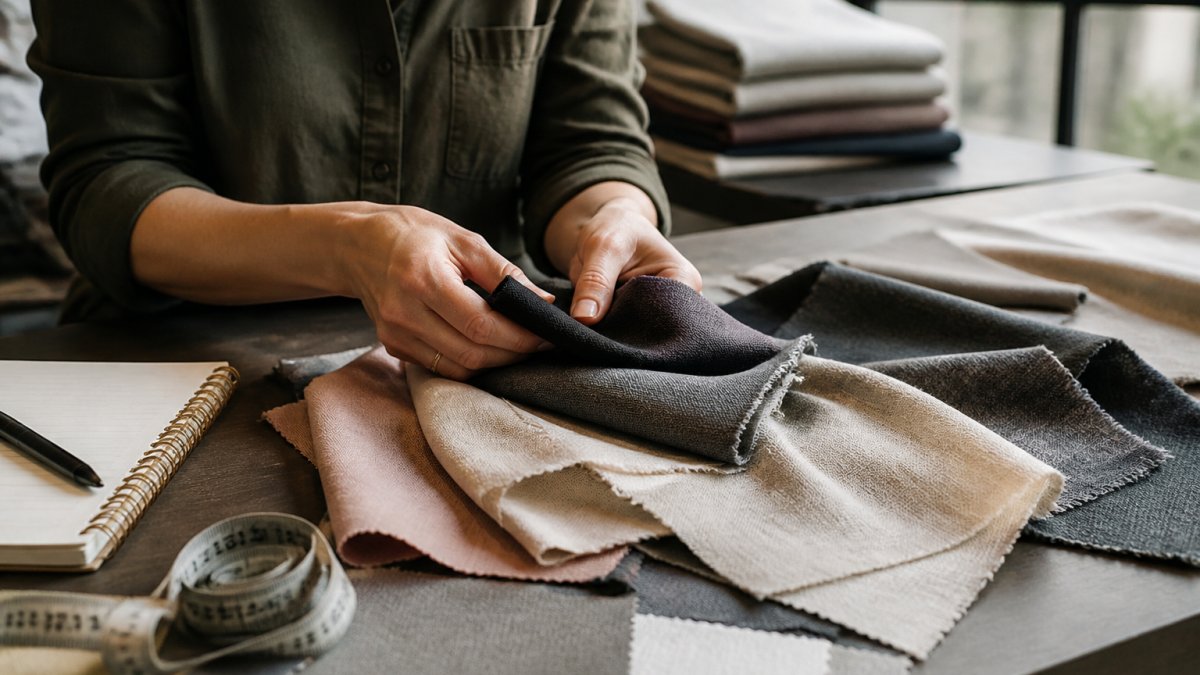
Run this checklist on each swatch:
- Rub the surface with your thumb and note smooth vs. rough
- Squeeze it in your fist and watch how fast it recovers
- Fold it and see whether it creases or springs back
- Hold it up and watch the drape
- Stretch it gently and note the give
- Weigh it in your hand and compare to a known fabric
Score each line from one to five. Total the scores and rank the swatches against each other, not against an abstract ideal. A heavy, stretchy spandex is a useful test case because its stretch and weight are both obvious; our heavy shiny polyester spandex page gives you a real example to score.

Translate Supplier Language Into a Buying Decision
Supplier language is marketing language until you map it to a decision. The job is to convert adjectives into a shortlist, then confirm the shortlist with a swatch. Competitors stop at definitions; the useful move is a repeatable translation step that turns a phrase into an application fit.
Use this translation table on any listing:
| Supplier Says | Ask Instead | What It Decides |
|---|---|---|
| "Soft" | Soft at what weight? | Drape and garment type |
| "Premium" | What is the GSM? | Structure and hand |
| "Stretchy" | How much recovery? | Fit and durability |
| "Crisp" | Stiff or just smooth? | Shape retention |
| "Luxury finish" | What is the surface? | Sheen and care needs |
Then run the description through a three-step interpretation workflow:
- Split the phrase into its descriptor pairs. "Soft, stretchy, matte" becomes soft vs. hard, stretchy vs. non-stretchy, and smooth vs. rough. Each pair is a scale, not a label.
- Attach a number to each scale. Ask for GSM, fiber content, and stretch percentage. A "soft" 95 GSM jersey and a "soft" 225 GSM fleece sit at opposite ends of the same word.
- Map the pair to an application. Structured garments need crisp and dense; lining needs slick and drapey; activewear needs stretchy with recovery; bedding needs smooth and breathable. If the description does not support the application, the fabric is wrong regardless of how pleasant the adjective sounds.
Worked examples make the method concrete:
- "Structured but soft" usually maps to a mid-to-heavy woven with some give, a suiting or bottomweight. It suits jackets and trousers, not fluid dresses.
- "Slick and lightweight" usually maps to a filament lining or satin. It suits linings and eveningwear, not structured bags.
- "Lofty and stretchy" usually maps to a knit fleece or spacer. It suits activewear and outerwear, not tailored pieces.
Cost matters here, and a careful cost analysis helps you weigh a higher price against consistency and finish quality. A fabric that reads well on paper but varies between dye lots will cost you more in rework than the price difference suggests.
Our own approach is to publish the specs that drive hand, so you can read weight and finish before you order. That is the standard we hold ourselves to across our fabric collections.
Order a Swatch and Test the Hand Yourself
No description replaces your own hands on the fabric. Order swatches, run the five-minute test, and score them against each other before you commit to production yardage.
A few final habits separate confident buyers from guessing ones:
- Ask for the GSM and the fiber content on every listing.
- Compare swatches from the same supplier side by side.
- Note dye-lot variation before you scale an order.
- Keep a reference swatch for every fabric you reorder.
At New Creations Fabric & Foam Inc, we stock fabrics built for consistent production runs, with finishes that hold up across batches. Our range covers sequins, velvet, faux fur, and everyday apparel fabrics, all selected for refined finishes and repeatable quality. Get started with New Creations Fabric & Foam Inc and source fabrics whose hand you can trust before the first cut.
Frequently Asked Questions
What does fabric hand mean in a product description?
Fabric hand, also called hand feel, is how a textile feels when you touch, squeeze, and move it. Descriptions usually pair opposite terms: soft or crisp, smooth or rough, stiff or flexible, heavy or light. North Carolina State University's Textile Protection and Comfort Center lists these paired descriptors as the basis of panel testing. Read the pairs together, because a fabric described as soft and heavy behaves very differently from one described as soft and light.
How can you tell whether a fabric will feel soft or crisp from an online listing?
Look for the construction and fiber first, then the adjectives. A 100% polyester faux suede at 225 GSM with a napped finish is listed with a soft but heavy hand feel, which points to a velvety surface and body. A lightweight 70 GSM polyester chiffon is described as extremely soft to the touch with a fluid drape, so it reads soft but airy. Crispness usually appears in taffeta, organza, and heavily finished cottons, where the listing mentions stiffness or structure.
What is the difference between fabric softness and fabric hand?
Softness is one dimension of hand, not the whole thing. Hand covers softness alongside smoothness, stiffness, extensibility, resilience, and weight. A fabric can be soft and still be heavy, dense, or low-stretch. That is why a supplier may call a cloth soft while a buyer finds it too stiff for a bias-cut dress. Judge the full set of descriptors, then confirm with a swatch before committing to production yardage.
How do you evaluate fabric hand from an online product description?
Use a repeatable sequence. Note the fiber content, weight in GSM, width, and finish, then read the hand-feel sentence for paired adjectives. Compare those against a fabric you already know. Request a swatch and run a five-minute test: rub the surface, squeeze and release for recovery, fold for stiffness, and hang a corner for drape. Record your findings beside the listing language so future orders rest on your own notes, not marketing copy.
