

Table of Contents
- Why Fabric Inventory Breaks Fashion Startups
- Build a Fabric Inventory Spreadsheet Template That Works
- How to Run a Fabric Reorder Point Calculation
- Fabric-to-Garment Material Planning by Style
- Low-MOQ Purchasing and Cash Flow Control
- Deadstock Fabric Management and Remnant Recovery
- Fabric Traceability, Dye Lots, and Quality Checks
- Frequently Asked Questions
Last Updated: October 13, 2026
Why Fabric Inventory Breaks Fashion Startups
Fabric inventory is the total yardage a brand owns or has committed to buy, tracked by fabric type, color, and dye lot.
Here's the trap. Fabric is bought in bulk, months ahead, in minimum order quantities.
A common mistake is treating fabric like finished goods. It isn't. Fabric has dye lots, cut waste, and remnant value that finished inventory doesn't.
Build a Fabric Inventory Spreadsheet Template That Works
A fabric inventory spreadsheet template is a simple grid that tracks every roll and remnant you own by fabric type, color, dye lot, width, and remaining yardage.
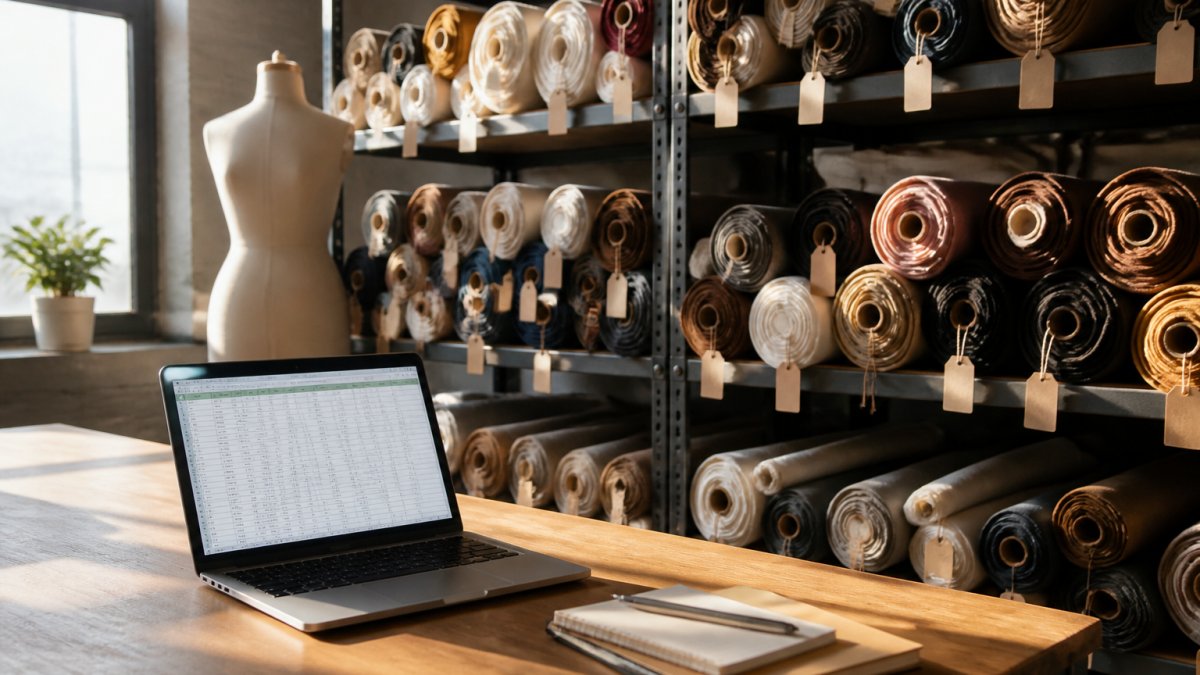
Most general apparel inventory advice stops at "track your SKUs." Fabric is different. A single fabric style can exist in five dye lots, three widths, and two finishes, and each combination behaves like its own item.
Columns Every Fabric Tracker Needs
Every row should represent one roll or lot, not one fabric style. That single decision is what separates a fabric tracker from a finished-goods tracker.
- Fabric name and fiber content (e.g., 100% cotton, 95/5 cotton-spandex)
- Color name and dye lot number
- Cuttable width in inches, the usable width after selvage, not the nominal width on the spec sheet
Add a "committed" column for yardage already promised to a cut ticket. Without it, your "remaining" number lies. A roll can show 60 yards on hand and still be effectively empty because 55 yards are already allocated to a production run.

Usable Yardage, Not Nominal Yardage
The number that matters for planning is usable yardage, not the number on the supplier's packing slip. Usable yardage accounts for:
- Selvage you can't cut through
- Width loss from shrinkage after washing or finishing
- Defects, holes, and shade breaks within a roll
A common pattern is to apply a 3-8% usable-yield haircut on woven cotton and a larger haircut on stretch knits, which tend to shrink and recover unpredictably. Record the haircut as a column so you're not re-estimating it every time you plan a cut.
Bin Labels and Physical Organization
Label each bin with the same ID used in your spreadsheet. Store by fabric family, then by dye lot. Keep remnants in a separate, clearly marked bin so they don't get buried behind full rolls.
A bin label that works has four things on it: the fabric ID, the dye lot, the cuttable width, and the yards remaining as of the last count.
A Low-Cost Workflow for Startups Not Ready for Software
You don't need a dedicated inventory platform to run this. A workable startup workflow looks like:
- One spreadsheet, one tab per fabric family. Wovens, knits, linings, and trims each get their own tab so filters stay fast.
- A receiving row per roll. When a shipment arrives, add a row before the roll hits the shelf.
- A weekly physical count of high-turn fabrics. Count only the fabrics you cut this week; full counts monthly.
- A "committed" update at cut-ticket creation. The moment a cut ticket is written, move those yards from available to committed.
- A monthly reconciliation. Compare spreadsheet remaining to physical remaining and log the variance. Persistent variance usually means cut waste is higher than you assumed.
When you outgrow the spreadsheet, usually somewhere past a few dozen active fabrics or multiple production partners, that's the signal to look at dedicated inventory software. Until then, a disciplined spreadsheet beats a half-configured platform every time.
How to Run a Fabric Reorder Point Calculation
A fabric reorder point calculation is the yardage level that triggers a new purchase order. The formula is simple:
Reorder Point = (Average Daily Usage × Lead Time in Days) + Safety Stock
If you cut 20 yards a day and your supplier takes 14 days, you need 280 yards just to cover production. That's before safety stock.
The formula is easy. The hard part is that fabric reorder points have to be calculated per dye lot, not per fabric style. If you reorder "navy cotton" without specifying the lot, you may get a visually different navy that can't be cut into the same garment run.
Lead Time, Safety Stock, and Usage Rate
- Lead time: days from order to delivery. Add a buffer for customs or restocking delays. Domestic mill lead times often run shorter than import lead times, but both can slip.
- Usage rate: yards consumed per production day, averaged over four weeks. Don't use a single busy week, it will overstate demand and tie up cash.
- Safety stock: extra yardage for demand spikes or late shipments. Many brands use one to two weeks of usage.
Recalculate monthly. Usage changes with every new style.
A Worked Example With Real Numbers
Suppose a startup cuts a basic tee at 1.5 yards per unit and plans to produce 400 units over 20 production days.
- Daily usage = (400 × 1.5) ÷ 20 = 30 yards/day
- Supplier lead time = 21 days (including a week of buffer for a mill that has slipped before)
- Safety stock = one week of usage = 30 × 7 = 210 yards
- Reorder point = (30 × 21) + 210 = 840 yards
That 840-yard trigger is the point at which you place the next PO, not the point at which you run out. If you wait until you're down to 200 yards, you've already missed the window and you'll either pay for expedited freight or push the production date.
Adjusting for Cut Waste and Shrinkage
Raw usage rate understates real consumption. If your cutter plans 12% over the marker and the fabric shrinks 4% after finishing, your effective usage is closer to 1.5 × 1.12 × 1.04 ≈ 1.75 yards per unit. Rebuild the reorder point on the effective number, not the design number. This is the single most common reason startups run short on a best-selling size.
Lot-Level Reorder Logic
A reorder point on the fabric style tells you when to buy. A lot-level reorder point tells you when to stop cutting from the current roll set. Track both:
New Creations Fabric & Foam Inc, Unbleached Muslin Cotton Fabric →
- Style-level reorder point: triggers a new PO to the mill.
- Lot-level reorder point: triggers a switch to the next lot, or a decision to stop the style until the new lot lands.
If the new lot arrives and the shade doesn't match the old one, you have a choice: cut the new lot into a separate production run, sell the old lot as a limited colorway, or absorb the mismatch as deadstock. Planning for that decision in advance is cheaper than discovering it at the cutting table.
The Cash-Flow Trade-Off
A high reorder point protects production but ties up cash. A low reorder point protects cash but risks stockouts and expedited freight. For most startups, the right answer is a moderate reorder point plus a shorter, more frequent order cadence, even at a slightly higher per-yard cost, because the carrying cost of fabric sitting on a shelf for six months usually exceeds the per-yard savings from a bulk order.
When to Recalculate
Recalculate reorder points when any of these change:
- A new style enters or leaves production
- Your cutter changes the marker or yield
- A supplier's lead time shifts by more than a few days
- You switch from domestic to import sourcing, or vice versa
A reorder point is a living number. Treating it as a one-time setup is how startups end up with both stockouts and deadstock in the same quarter.
Fabric-to-Garment Material Planning by Style
Material planning by style means calculating exactly how many yards each garment consumes before you commit to a fabric order.
Cut waste is the fabric lost to pattern layout, flaws, and end-of-roll scraps. Many cutters plan 10 to 15 percent over the marker.
Track consumption per style in the same spreadsheet. When a style repeats next season, you already know the number.
Low-MOQ Purchasing and Cash Flow Control
Minimum order quantity is the smallest amount a supplier will sell. For startups, low-MOQ purchasing is the difference between steady cash flow and a warehouse full of fabric you can't afford to cut. Buy in smaller lots more often, even at a slightly higher per-yard cost.
Three ways to protect cash:
- Buy core fabrics in smaller, repeatable orders instead of one bulk commitment.
- Test new colors with sample yardage before committing to full rolls.
- Time purchase orders to production start dates, not to sales projections.
Our unbleached muslin cotton fabric ships in continuous yards, which lets small brands buy closer to actual need rather than guessing at a large minimum.

Deadstock Fabric Management and Remnant Recovery
Deadstock fabric management is the practice of tracking, using, or reselling leftover yardage before it loses value. Remnants, end-of-roll pieces, and unsold colorways all count. Left alone, they tie up cash and shelf space.
A simple recovery routine:
- Log every remnant over one yard in your tracker
- Tag remnants for samples, linings, or accessories
- Bundle small pieces for craft or quilting resale
- Review deadstock quarterly and write off what won't move
Fabric that sits for a year rarely sells at full value. Move it or accept the loss.
Fabric Traceability, Dye Lots, and Quality Checks
Fabric traceability is the ability to match any finished garment back to its exact roll, dye lot, and supplier. It matters because dye lots vary. Two rolls of the same color can arrive visibly different, and customers notice.
Quality checks to run on arrival:
- Compare the roll against your approved swatch in daylight
- Check for fraying, pulls, and inconsistent drape
- Record the dye lot on the roll tag and in your tracker
- Quarantine anything that fails before it reaches the cutting table
Dye lot consistency is the single most common source of returns for small apparel brands. One mismatched roll can ruin a production run.
Frequently Asked Questions
How should a fashion startup track fabric inventory?
Start with a spreadsheet that logs each roll by fabric type, dye lot, width, yardage on hand, and location. Update it every time fabric is cut or received, and do a physical count monthly. Once you carry more than about 20 active fabrics or run multiple styles at once, move to inventory software with real-time visibility. The goal is inventory accuracy you can trust before you place a purchase order.
What is the best way to organize fabric inventory?
Group fabric by type first, then by dye lot, so you never mix rolls that will not match in a finished garment. Label every roll with a bin number, yardage, and receipt date. Store vertically on shelves to reduce crushing and make counting faster. Keep remnants in a separate labeled bin so leftover yardage does not get counted as full stock during inventory tracking.
How do you calculate how much fabric to order for a clothing line?
Multiply the fabric consumption per garment by the number of units you plan to produce, then add cutting waste, usually 5 to 15 percent depending on the pattern. Add safety stock on top of that. For example, 200 units at 1.5 yards each plus 10 percent waste equals 330 yards. Order in continuous yardage where possible so you avoid seams in the middle of a cut.
How can a small fashion brand avoid fabric overstock?
Tie every purchase order to confirmed sales data or preorders rather than optimism. Set a reorder point for each fabric and resist buying beyond it, even when a supplier offers a discount. Review slow-moving rolls every quarter and move them into deadstock fabric management: sample sales, accessory lines, or remnant bundles. Carrying costs, not the fabric price, are what drain startup cash flow.
Fabric inventory is where fashion startups quietly lose money: cash tied up in yardage, dye lots that don't match, remnants nobody tracks. New Creations Fabric & Foam Inc helps brands avoid that trap with consistent, refined fabrics built for professional-scale manufacturing, including unbleached muslin cotton and solid 100% cotton options that ship in continuous yards. Explore Fabrics and stock your studio with materials you can actually plan around.