

Table of Contents
- Why Foam Density Matters for Cushion Longevity
- Tools You Need to Measure Foam Density at Home
- How to Calculate Foam Density Formula Step by Step
- Foam Density vs ILD: What Each Number Tells You
- Best Foam Density for Sofa Cushions and Seat Cushions
- Common Measurement Errors and How to Troubleshoot Them
- Frequently Asked Questions
Last Updated: October 1, 2026
Why Foam Density Matters for Cushion Longevity
Foam density is the single best predictor of how long a cushion will hold its shape. It measures how much material by weight is packed into a cubic foot of foam. Higher density means more foam cells, more material recovery, and better durability.
Here's the practical takeaway: a cushion that feels firm in the showroom can turn to mush in a year if the foam inside is low density. That's why so many sofa owners end up replacing seat cushions long before the frame wears out.
So how do you check it yourself? You don't need a lab. You need a scale, a tape measure, and about ten minutes. Below, we'll walk through the exact formula, the tools, and the mistakes that throw off your numbers.
Tools You Need to Measure Foam Density at Home
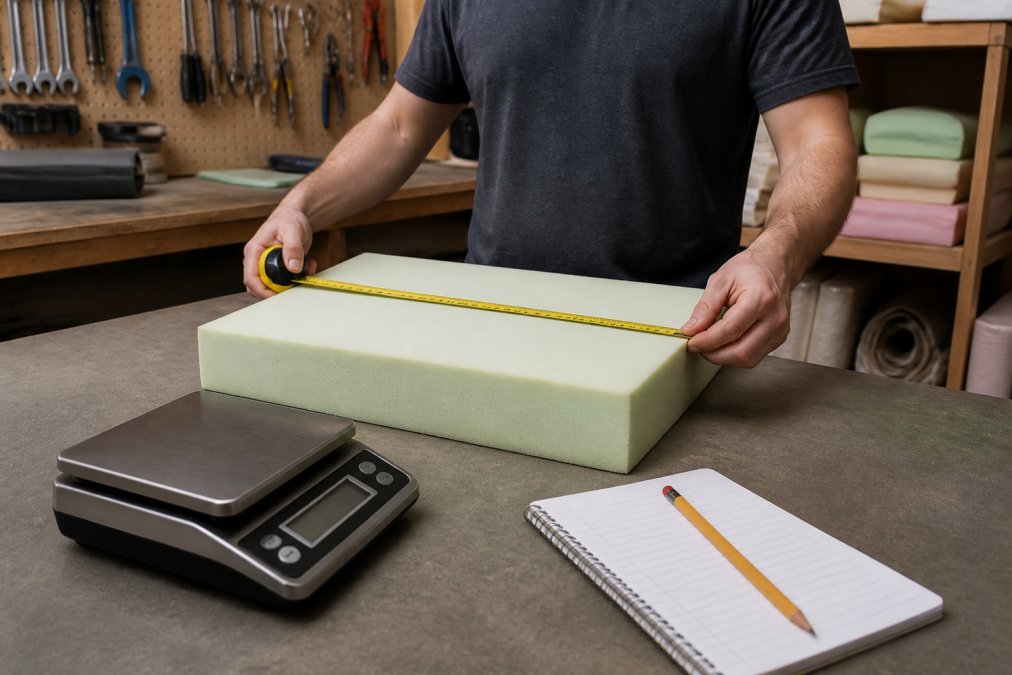
To measure foam density at home, you need three things: a tape measure, a digital scale, and the foam block itself. A kitchen scale works for small cushions. For a full sofa cushion, you'll want a bathroom scale or a luggage scale.
Here's your basic kit:
- Tape measure (inches, for length, width, thickness)
- Digital scale (kitchen or bathroom, in pounds or ounces)
- Notepad or phone for recording numbers
- Calculator (your phone is fine)
- Marker to label each foam block
Matching the Scale to the Cushion
The single biggest tool mistake is using a scale that's too small. A typical 24" × 24" × 6" seat cushion at 2.5 PCF weighs about 5 pounds, which most kitchen scales handle. But a 30" × 30" × 8" cushion at 2.8 PCF can weigh over 14 pounds, past the limit of many kitchen scales and into bathroom-scale territory.
A practical rule: if the cushion is larger than a throw pillow, weigh yourself holding the foam on a bathroom scale, then weigh yourself alone, and subtract. That two-step method works for any size cushion and avoids maxing out a small scale.
DIY Measurement Tools and Accuracy Tips
Accuracy matters more than fancy tools. A few small habits make a big difference:
- Measure in three spots for each dimension, then average them
- Compress the tape gently, don't squeeze the foam
- Weigh the foam by itself, no cover, no batting
- Use a flat surface so the block sits level
- Zero the scale (tare) before placing foam on it
A common mistake is weighing a cushion with its cover still on. That adds fabric weight and throws off your density calculation. Always strip the foam bare before you weigh it.
Estimating Density Without Cutting the Foam
Sometimes you can't remove the foam, it's glued into a cushion, or the cover is sewn shut. In that case, you can estimate. Weigh the whole cushion, then estimate the cover weight (a typical upholstery cover adds 0.5 to 1.5 pounds depending on fabric and size) and subtract it. Measure the cushion's outer dimensions, subtract roughly 1 inch per side for cover thickness, and run the same formula. The result is an estimate, not a lab number, but it's close enough to tell a 1.5 PCF cushion from a 2.5 PCF one.
A squeeze test adds a second data point. Press the foam between your thumb and fingers. High-density foam (2.5 PCF and up) feels dense and heavy for its size and springs back quickly. Low-density foam (under 1.5 PCF) feels light, compresses easily, and recovers slowly. Neither test replaces the math, but together they catch obvious mismatches.
How to Calculate Foam Density Formula Step by Step
The foam density formula is simple: weight divided by volume. Density equals the weight of the foam block in pounds, divided by its volume in cubic feet. The result is pounds per cubic foot (PCF).
Density (PCF) = Weight (lbs) ÷ Volume (cubic feet)
Volume is length × width × thickness, all converted to feet. Most home measurements come out in inches, so you'll divide each by 12 first.
Here's the process:
- Measure length, width, and thickness in inches
- Convert each to feet (divide by 12)
- Multiply the three to get cubic feet
- Weigh the foam block in pounds
- Divide weight by volume
Measuring Length, Width, and Thickness
Measure the foam block at its widest points. Foam can bulge in the middle, so check both ends and the center.
Bonded Dacron Upholstery Grade →
Write down all three numbers. A foam block that's 24 inches long, 24 inches wide, and 6 inches thick gives you clean math later.
Weighing the Foam Block and Running the Numbers
Now weigh the block. Let's run a real example.
A cushion measures 24" × 24" × 6". That's 2 ft × 2 ft × 0.5 ft = 2 cubic feet. If the block weighs 5 pounds, your density is 5 ÷ 2 = 2.5 PCF.
That's a low-density foam.
Foam Density vs ILD: What Each Number Tells You
Foam density and ILD measure two different things. Density tells you how much material is in the foam, which predicts durability. ILD tells you how firm the foam feels, which predicts comfort.
| Property | What It Measures | Unit | Predicts |
|---|---|---|---|
| Density | Material weight per volume | PCF | Durability and longevity |
| ILD | Force to compress 25% | Pounds | Firmness and feel |
| Support factor | Firmness at 65% vs 25% compression | Ratio | Deep support and comfort |
Indentation Load Deflection and Support Factor Explained
Indentation Load Deflection (ILD) is the pounds of force needed to compress a 4-inch-thick foam sample by 25%. Higher ILD means a firmer cushion.
Best Foam Density for Sofa Cushions and Seat Cushions
For sofa seat cushions, aim for a foam density of at least 1.8 PCF, with 2.5 PCF or higher for daily use. Back cushions can go lower, around 1.2 to 1.5 PCF.
Here's a quick guide:
- Decorative pillows: 1.0 to 1.5 PCF
- Sofa back cushions: 1.2 to 1.8 PCF
- Sofa seat cushions (light use): 1.8 to 2.5 PCF
- Sofa seat cushions (daily use): 2.5 PCF and up
- High-traffic seating: 2.8 PCF and up
Matching Density to Body Weight and Use
Density recommendations shift with the person using the cushion. A 2.5 PCF seat cushion holds up well for most adults, but heavier users (over 200 pounds) often get better longevity from 2.8 PCF or higher. The reason is simple: more weight per square inch compresses the foam cells harder, and low-density foam loses its rebound faster under that load.
Foam Density for Mattress Foam
Mattress foam follows a different scale than cushion foam because the load is spread over a larger area and the foam is usually thicker.
- Mattress toppers: 1.5 to 2.5 PCF
- Mattress support cores: 2.5 to 3.5 PCF
- Memory foam layers: 3.0 to 5.0 PCF
- High-end mattress foam: 4.0 PCF and up
Thickness and Density Trade-Offs
Density and thickness work together. A 6-inch cushion at 2.0 PCF can feel firmer and last longer than a 3-inch cushion at 2.5 PCF, because the thicker foam distributes weight over more cells. When you replace foam, don't trade thickness for density or the reverse, match both to the original cushion's dimensions unless you're intentionally changing the feel.
Common Measurement Errors and How to Troubleshoot Them
- Weighing with the cover on: always strip the foam bare first
- Rounding dimensions: a half inch off on a big cushion changes the volume
- Wrong units: inches vs feet trips up almost everyone
- Compressed foam: let the block expand fully before measuring
A quick visual check helps too. High-density foam feels heavier in your hands and springs back fast when you press it. Low-density foam feels light and slow to recover. That's not a substitute for the math, but it's a useful sanity check.
Frequently Asked Questions
What is a good density of foam for seat cushions?
For seat cushions that get daily use, look for foam density between 2.5 and 3 pounds per cubic foot. High-resiliency foam in the 2.8 to 3 lb range offers a good balance of support and cushion longevity. Lower densities around 1.5 lb work for decorative pillows or light-use seating, but they compress faster and lose their supportive properties within a year or two of regular use.
Does higher density foam mean it is firmer?
No. Density and firmness are separate measurements. Density is the weight-to-volume ratio, measured in pounds per cubic foot. Firmness is measured by indentation load deflection, or ILD. A 3 lb density foam can be soft or firm depending on its ILD rating. When shopping, check both numbers: density tells you how long the foam will last, while ILD tells you how it feels when you sit on it.
How do you calculate the density of a foam block?
Use the formula: density equals weight divided by volume. First, measure the foam block's length, width, and thickness in inches. Multiply those three numbers to get cubic inches, then divide by 1,728 to convert to cubic feet. Weigh the block in pounds. Divide the weight by the cubic feet. For example, a block weighing 3 pounds with a volume of 1 cubic foot has a density of 3 pounds per cubic foot.
Which is better, 32 density foam or 40 density foam?
In the U.S., foam density is measured in pounds per cubic foot, not as a two-digit number. If you see 32 or 40, those are likely ILD firmness ratings, not density. A 32 ILD foam is medium-firm; 40 ILD is firm. For sofa cushions, medium-firm around 30 to 35 ILD suits most people. Pair that with a density of at least 2.5 lb per cubic foot for durability.