

Table of Contents
- Why the Right Questions to Ask Potential Fabric Wholesale Partners Decide Your Production Run
- Questions to Ask a Fabric Supplier About Composition, Width, and Weight
- Fabric Minimum Order Quantity: What MOQ Really Means for a Small Brand
- Fabric Supplier Sample Policy: What to Request Before You Commit
- Colorways, Dye Lots, and Repeat Supply Questions
- Bulk and Production Pricing, Payment Terms, and Financial Risk
- Wholesale Fabric Supplier Checklist: Quality, Lead Time, and Continuity
- Conclusion: Turn the Answers Into a Supplier Scorecard
- Frequently Asked Questions
Last Updated: October 15, 2026
Why the Right Questions to Ask Potential Fabric Wholesale Partners Decide Your Production Run
Most production disasters trace back to a conversation that never happened. At New Creations Fabric & Foam Inc, we have watched small brands commit to a fabric wholesale order only to discover weeks later that the dye lot does not match, the width is off, or the roll count was never confirmed.
Rollouts fail for predictable reasons: unclear fiber content, unconfirmed stock, vague lead times, and unwritten payment terms. This guide gives you the questions that surface those risks before money changes hands.
Questions to Ask a Fabric Supplier About Composition, Width, and Weight
Start with the specification sheet, because everything downstream depends on it. A fabric supplier should hand you exact fiber content, width, and weight without hesitation; without those numbers you cannot price the garment or promise a delivery date.
Fabric Composition and Fiber Content
Fiber content is the foundation of how a fabric behaves. Ask for exact percentages, not a general description.
Take our Cotton Jersey Spandex Knit, which is 95% cotton and 5% spandex. That ratio tells you it will stretch about 50% vertically and 25% horizontally, breathe well, and drape softly.
Ask these questions:
- What is the exact fiber content, by percentage?
- Is the cotton combed, carded, or organic?
- Does the fabric carry a safety certification, such as Oeko-Tex Standard 100?
Fabric Width and Fabric Weight
Width and weight decide your yield per yard and your shipping cost. A fabric at 58/60 inches wide gives you more usable area than one at 44 inches.
Weight is measured in GSM, or grams per square meter. Our 10 oz Cotton Duck Canvas runs 315 GSM at 0.75 mm thick, heavy enough for tote bags, upholstery, and slip covers. Our Scuba Double Knit sits at 180 GSM, a lighter choice for dresses and blouses.

| Spec | What to Ask | Why It Matters |
|---|---|---|
| Fiber content | Exact percentages | Predicts stretch, drape, and care |
| Width | Usable width in inches | Sets your cut yield per yard |
| Weight | GSM and ounces per linear yard | Controls hand feel and shipping cost |
| Stretch | Direction and percentage | Determines fit and recovery |
| Certification | Oeko-Tex or equivalent | Confirms safety testing |
Fabric Minimum Order Quantity: What MOQ Really Means for a Small Brand
MOQ is the smallest quantity a supplier will produce or release, and it ends most first conversations. A fabric minimum order quantity tells you whether a supplier is built for your order size.
Many suppliers set wholesale pricing at a specific yard count; ours begins at 25 yards, keeping small runs viable for independent designers.
How MOQ Changes Between By-the-Yard and By-the-Roll
By-the-yard buying lets you test a fabric with minimal risk; by-the-roll buying lowers unit cost but locks up cash and storage. Ask both prices to calculate the break-even.
Questions worth asking:
- What is the MOQ for a first order versus a repeat order?
- Is the MOQ per colorway or across the whole order?
- What is the price per yard at MOQ, and what is the price per roll?
Fabric Supplier Sample Policy: What to Request Before You Commit
A sample policy tells you how a supplier treats risk. Request a swatch before any bulk order, and confirm whether sample costs are credited against your first production order.
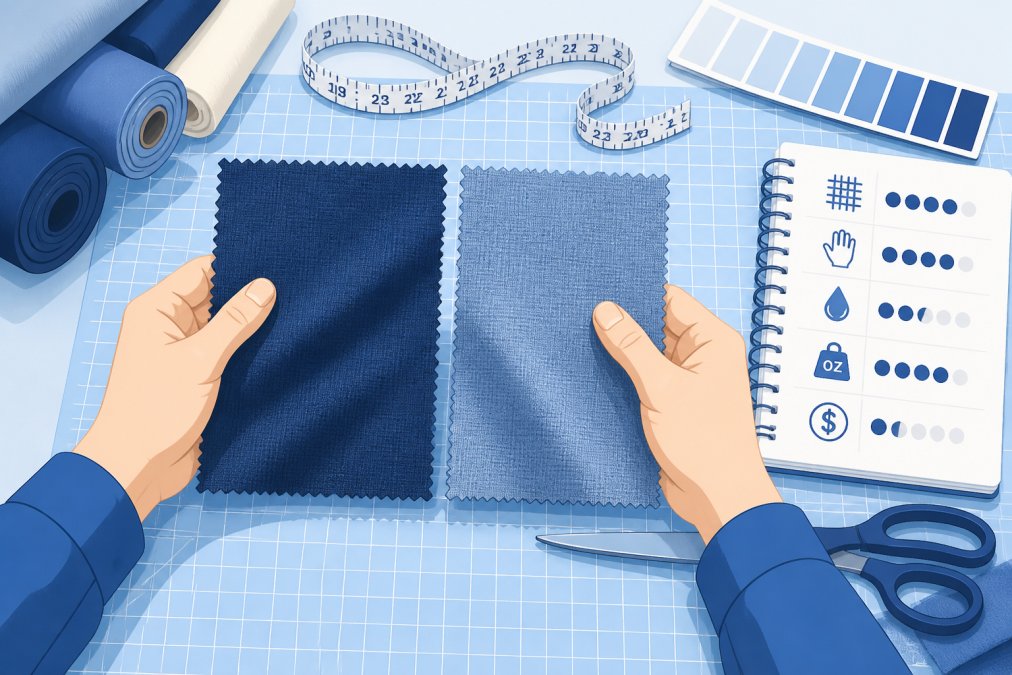
Ask what the sample includes. For specialty materials like our Luxury Feather Damask Beaded Lace, a sample also confirms bead density and edge finish.

Specific questions:
- How large is the swatch, and is it cut from current stock?
- Is the sample free, and is the cost credited on a bulk order?
- How long does a sample take to ship?
Colorways, Dye Lots, and Repeat Supply Questions
Color consistency is where repeat orders quietly fail. Two rolls from different dye lots can look identical online and slightly different in daylight, enough to ruin a matched set of garments or a coordinated event backdrop. The problem is not the first order but the second, third, and fourth, when the fabric you built a product line around is no longer the same shade.
Understanding Dye Lots and Why They Drift
A dye lot is a single batch of fabric dyed together. Within one lot, color is consistent; between lots, variables like dye concentration, water chemistry, temperature, and the base fiber can shift the shade visibly, obvious enough to fail when two pieces sit side by side.
Ask these questions before you commit to a first order:
- How many color options are available in this fabric, and are all of them in stock right now?
- Will a reorder match my first order, or will it come from a new dye lot?
- Can you reserve a single dye lot for my full production run, including any planned reorders?
Reserving a Dye Lot for a Full Run
For any order where pieces must match, a matched set of garments, tablecloths and chair covers for one event, a coordinated upholstery job, lock a single dye lot for the entire job.
If your run is large enough to consume a full dye lot, ask whether the supplier will dye the entire quantity in one batch rather than splitting it across two, splitting is a common cause of color mismatch that only shows up after delivery.
Continuity, Discontinuation, and Restock Notice
A fabric that is in stock today may be discontinued next quarter. Ask how the supplier handles continuity:
- How long has this fabric been in the catalog, and is it a core item or a seasonal one?
- If the fabric is discontinued, how much advance notice do you give?
- Can you notify me before discontinuing a fabric I buy on repeat?
For recurring buyers, ask whether the supplier will hold a standing inventory allocation for your account, a set quantity reserved at a set price for a set period. It is common for established accounts and rare for new ones, itself a useful signal about how the supplier treats long-term relationships.
Building a Color Reference File
Keep a physical swatch from every dye lot you buy, labeled with the lot number, purchase date, and supplier. When a reorder arrives, compare it against your reference swatch under the same lighting, ideally daylight, not a screen. This catches color drift before it reaches production and documents any claim.
10 Oz Fine Arts Unprimed Cotton Canvas Natural Color 58/60" Wide| New Creations →
Bulk and Production Pricing, Payment Terms, and Financial Risk
Production pricing is more than a unit cost. Your quote should separate fabric cost, freight, duties, and handling or cut fees, because a low per-yard number with hidden freight can cost more than a higher bundled quote. Ask for an itemized written quote, then compare suppliers on landed cost per yard.
Deposit Structures and Payment Schedules
Most wholesale fabric transactions follow one of a few patterns. Knowing which one you are offered tells you how much risk you carry:
- Full prepayment. You pay 100% before the order ships. Lowest supplier risk, highest buyer risk. Common on small first orders and sample-yard purchases.
- Deposit plus balance on shipment. A typical split is 30% down and 70% due when the order leaves the supplier's dock. This is the most common structure for mid-size production runs.
- Deposit plus balance on delivery. You pay a deposit up front and the balance after the goods arrive and pass inspection. This shifts more risk to the supplier and is usually reserved for established accounts.
Ask directly: what deposit do you require, is it refundable, and what triggers the balance due date? A non-refundable deposit tied to a confirmed ship date is normal. What matters is that the trigger is written down, not verbal.
Payment Methods and Transaction Fees
Payment method affects both cost and recourse. Wire transfers and ACH carry low or no fees but limited dispute protection once funds leave your account. Credit cards and payment platforms carry processing fees, often 2% to 3%, but give you a chargeback mechanism if the order never arrives or arrives materially different from the confirmed specification.
Refunds, Credits, and Short-Ship Remedies
Get the remedy in writing before you pay. The questions that matter:
- If the order ships late, is there a credit, a discount, or a cancellation right?
- If the order arrives short, do you ship the balance, credit the difference, or refund it?
- If the fabric is defective, do you replace it, credit it, or refund it, and who pays return freight?
A supplier who answers these in specifics has handled disputes before. A supplier who deflects is telling you something.
Protecting Your Cash on Large Orders
Experienced buyers often split a large order into two releases: a deposit-backed first shipment sized to test quality, then a second release after the first passes inspection. This spreads your cash outlay, gives you a real quality read before committing the full balance, and creates a checkpoint to renegotiate. For orders large enough to matter, ask whether the supplier will hold the second release until you confirm the first.
Wholesale Fabric Supplier Checklist: Quality, Lead Time, and Continuity
Run every candidate through the same checklist so your comparison stays objective. This wholesale fabric supplier checklist covers the operational questions that decide whether a partner can support you beyond a single order.
Quality Standards, Quality Control, and Defect Remedies
Ask how the supplier inspects fabric before shipping and what happens when a defect slips through. A serious partner describes a real process, not a promise.
Questions to ask:
- What quality control steps happen before shipping?
- Do you inspect for fraying, pilling, and color variation between rolls?
- What is your defect policy, and do you replace or credit flawed yardage?
Our fabrics are built for consistency: the 10 Oz Fine Arts Unprimed Cotton Canvas is tear resistant, pilling resistant, and color fade resistant, and it carries Oeko-Tex Standard 100 certification.

Lead Time, Shipping Policy, and Stock Availability
Lead time is the clock your whole production calendar runs on. Ask for production lead time separately from shipping time, they are two different waits.
Questions to ask:
- What is the production lead time, and what is the transit time?
- What is your shipping policy and shipping cost structure?
- Is this fabric in stock now, and how much is available?
Continuity planning separates a one-off purchase from a real supplier relationship. If you run recurring event orders, confirm the supplier can restock the same fabric and reserve capacity for your volume.
Conclusion: Turn the Answers Into a Supplier Scorecard
A structured supplier-vetting scorecard turns scattered answers into a clear decision. Score each candidate from 1 to 5 on six criteria: composition clarity, MOQ fit, sample policy, color consistency, payment terms, and lead time reliability.
At New Creations Fabric & Foam Inc, we built our catalog for exactly this kind of scrutiny.
Frequently Asked Questions
What questions should I ask a fabric supplier before placing an order?
Ask for the fiber content breakdown, fabric width, and fabric weight in GSM, then confirm the minimum order quantity and whether wholesale pricing starts at 25 yards. Request a sample so you can check drape, hand feel, and color against your screen. Before you pay, get written answers on lead time, shipping cost, dye lot consistency, and what happens if a roll arrives with defects. Those answers tell you more about a fabric wholesale partner than any showroom tour.
What is the minimum order quantity for wholesale fabric?
MOQ depends on the mill and the fabric. Many wholesale programs start at 25 yards, which is the threshold New Creations Fabric & Foam Inc uses for wholesale pricing on items such as the Flame Sequin Fabric at $24.95 per yard and the Glitter Stretch Velvet at $15.95 per yard. Specialty goods like the Luxury Feather Damask Beaded Lace at $59.95 per yard can carry higher minimums. Confirm MOQ per colorway, not per order, because that is where small brands get caught.
How do I check the quality of wholesale fabric before a bulk order?
Order a sample and test it the way your customer will use it. Wash and dry a swatch to see if it shrinks, pills, or fades. Stretch it to check recovery, and hold it against a light to spot thin spots. Compare the sample to the spec sheet: for example, the 10 oz Cotton Duck Canvas is listed at 315 GSM with a 0.75 mm thickness and Oeko-Tex Standard 100 certification. If the sample does not match the numbers, ask why before you wire a deposit.
How do fabric wholesalers handle stock shortages and delays?
Ask directly what happens when a colorway sells out mid-production. A reliable fabric supplier will tell you the current stock level, offer a substitute lot, or give a restock date in writing. Get the lead time in your quote and confirm whether it is business days or calendar days. If your launch depends on one dye lot, ask about a continuity plan: reserved inventory, a backup colorway, or a partial shipment schedule so a shortage does not stop your garment production.
What should a fabric supplier's sample include?
A useful sample shows the actual production fabric, not a lookalike. Ask for a swatch large enough to drape and sew, plus the spec sheet with fiber content, width, weight, and care instructions. For prints and sequins, request the exact colorway you plan to order. Note that colors ordered at different times come from different dye lots and may not match exactly, so keep your approved sample on file as the reference for every reorder.
Sourcing decisions carry real weight, and a supplier who cannot answer these questions clearly will cost you a production run. If you want fabric partners who treat specifications, samples, and consistency as the starting point, not an afterthought, explore our collections. Get started with New Creations Fabric & Foam Inc and build your next production run on fabrics made for consistency and refined finishes.