

Table of Contents
- What Does Consistent Quality Mean for Fashion Brands?
- Quick Comparison: Top Wholesale Fabric Suppliers for Fashion Brands
- Why Batch Consistency Matters More Than Sample Quality
- Fabric Quality Control Standards to Demand From Any Supplier
- Textile Sourcing Best Practices for Reliable Results
- How New Creations Fabric & Foam Inc Ensures Uniform Quality
- The Verdict: Choosing Your WeaveSource Alternative
- Frequently Asked Questions
Last Updated: September 7, 2026
What Does Consistent Quality Mean for Fashion Brands?
For fashion brands, consistent quality is the measurable uniformity of fabric across every roll, dye lot, and production run you receive. It means the color, drape, hand-feel, and structural integrity of yard 500 match yard 1 from the same order, and that the next order placed in six months aligns with the first. When designers evaluate a weavesource alternative for consistent quality, they are comparing supply chain reliability, not just catalogs.
This guide breaks down what "consistent fabric quality" demands from a supplier and how to evaluate whether a wholesale partner can deliver it at scale, covering quality control standards, sourcing best practices, and what to look for in a true production partner.
Sample quality and batch consistency are entirely different commitments. A supplier can send a flawless swatch and still ship a production run with noticeable shade variation or shrinkage issues. Below, we outline the technical benchmarks and workflow integrations that separate reliable wholesale fabric suppliers from one-off vendors.
Quick Comparison: Top Wholesale Fabric Suppliers for Fashion Brands
Most sourcing guides stop at listing supplier types. What's missing is a technical benchmarking framework, a way to measure a supplier's output consistency the same way you'd benchmark software for stable generation. When you evaluate a weavesource alternative for consistent quality, you need quantifiable criteria, not just catalog breadth.
The Benchmarking Framework: Speed vs. Quality vs. Repeatability
For creative professionals, the core trade-off is always between three variables: lead time (how fast you get material), quality uniformity (how closely roll 10 matches roll 1), and repeatability (whether order #2 matches order #1). No supplier maximizes all three simultaneously. Here's how the major supplier categories actually perform on those axes:
| Supplier Type | Lead Time (Typical) | Quality Uniformity | Repeatability Across Orders | Best Fit |
|---|---|---|---|---|
| Large Volume Mills | 6-10 weeks for custom runs | High, they control raw material from fiber stage | High for staple fabrics; low for specialty items | Mass-market production with predictable SKUs |
| Specialized Converters | 2-4 weeks for finished goods | Variable, depends on their upstream mill relationships | Medium, they may switch mills between orders | Designer collections needing unique finishes |
| Full-Service Fabric Retailers | 1-5 business days for in-stock yardage | Medium-to-high, they inspect incoming lots but don't control production | High for stocked items; depends on reorder frequency | Small to mid-size brands needing flexibility |
Why This Framework Matters for Your Workflow
The most common failure pattern is treating a supplier like a search engine, type in a query, get a result, move on. That works for one-off prototyping but fails for continuous delivery. A technical benchmarking approach forces you to ask: What is this supplier's documented coefficient of variation across dye lots? Most can't answer that. The ones that can are worth your time.
A practical way to benchmark is to order the same SKU three times over a 90-day period at small yardages (5-10 yards each). Measure shade consistency under standardized lighting (use a colorimeter if available), width variance (within ±1 inch of stated width), and shrinkage after one wash cycle (within 1% of the supplier's stated spec) (astm.org). This gives you a repeatability score before committing to a large order.
What the Table Doesn't Tell You
The table above is a starting point, not a verdict. The real differentiator is how each supplier handles exceptions. When a dye lot shifts slightly, and it will, does the supplier proactively notify you, offer a shade-band match, or ship anyway and hope you don't notice? That behavioral benchmark matters more than any catalog promise. Ask for a reference from a brand that has been ordering the same SKU for over a year; if the supplier can't produce one, that's a red flag.
For brands migrating from a platform like WeaveSource, this benchmarking approach is a mindset shift. You're no longer comparing individual product listings but supply chain operating systems. The supplier that documents its quality control checkpoints, provides shade banding data, and commits to width tolerances in writing is the one that will deliver consistent quality at scale.
Why Batch Consistency Matters More Than Sample Quality
A beautiful sample is a marketing asset; a consistent batch is a production asset. When you order 100 yards of a stretch mesh for evening gowns, every yard must perform identically during cutting, sewing, and finishing.

Inconsistency in a batch creates hidden costs that destroy margin. If roll A has a slightly different drape than roll B, your cutters must adjust patterns mid-production, increasing labor time and error rates. If the color shifts between dye lots, you may be forced to reject finished garments or reorder fabric, delaying your go-to-market timeline.
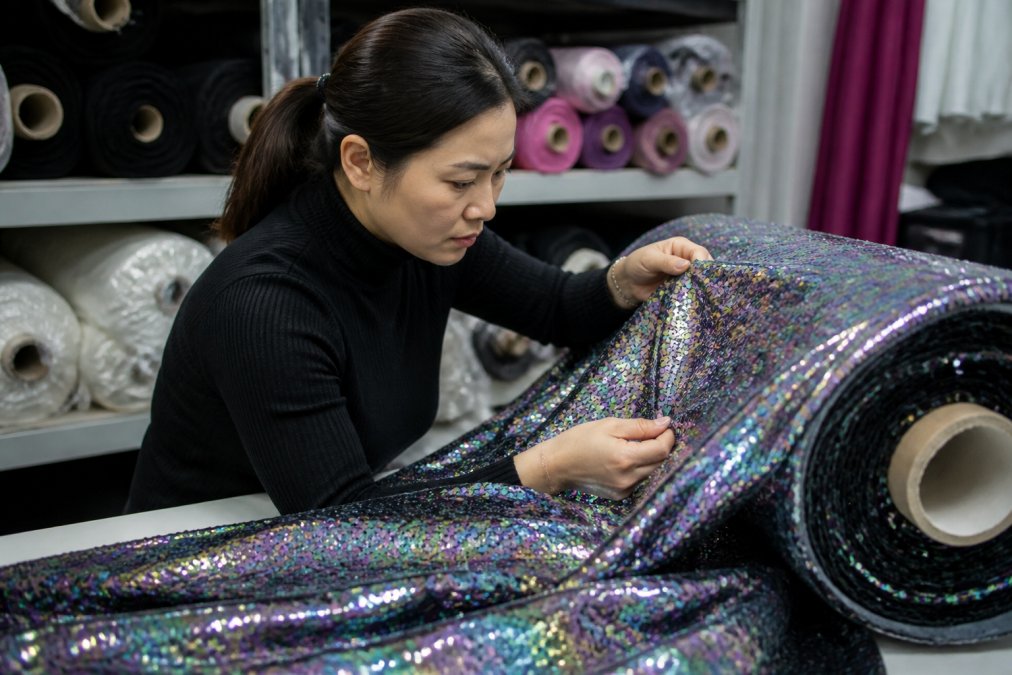
Top-tier brands demand that suppliers document their quality control processes, not just promise them. Look for suppliers who acknowledge the realities of textile production, such as slight color variation due to screen settings or minimal sequin shedding, and who provide clear care instructions. This honesty indicates a supplier who understands the product's limits and manages them proactively, rather than hiding potential issues.
Fabric Quality Control Standards to Demand From Any Supplier
Implementing fabric quality control standards is a non-negotiable part of a professional sourcing strategy. You must verify that your supplier adheres to specific checks that protect your production line.
First, demand shade banding certification to ensure rolls from the same dye lot are grouped correctly, preventing visible color differences in a single garment or across a production run (aatcc.org). Second, verify shrinkage test results, a stretch mesh that shrinks 5% after washing will ruin the fit of a structured gown. Third, check for consistent width; a fabric listed at 54 inches wide that arrives at 50 inches will ruin your marker nesting and yield calculations.

For specialized materials like sequin fabrics, quality control extends to the integrity of the embellishment. A reliable supplier will be transparent about normal characteristics, such as minimal sequin shedding, and will advise on proper handling and care to preserve the finish. According to industry guidelines on textile testing standards, verifying these physical properties before bulk ordering is essential for predictable output in garment manufacturing.
Textile Sourcing Best Practices for Reliable Results
Most sourcing advice reads like a checklist: request samples, check shrinkage, build a buffer. That's necessary but not sufficient. What's missing is a migration workflow, a step-by-step process for moving from one supplier platform to another without losing asset quality mid-production.
Step 1: Audit Your Current Material Specifications
Before contacting any new supplier, document every technical specification for the fabrics you currently use: fiber content percentage, fabric weight (oz/yd² or g/m²), width, stretch percentage (for knits), shrinkage tolerance, and color reference (Pantone or a physical swatch library). Most brands skip this step and then wonder why the "same" fabric from a new supplier behaves differently. The problem isn't the new supplier, it's that you never had a written spec in the first place.
Create a spec sheet for each SKU you order regularly. If you're moving from a platform like WeaveSource, export your order history and identify your top 10 SKUs by volume. For each, document what you actually received, not just what you ordered. This becomes your baseline for evaluating alternatives.
Step 2: Run a Parallel Validation Period
Do not cut over to a new supplier in one production cycle. Instead, run a parallel validation period of 4-6 weeks, ordering small quantities (10-15% of your typical volume) from the new supplier while maintaining your existing source. This lets you compare actual performance under real production conditions.
During this period, track four metrics:
- On-time delivery rate, did the fabric arrive when promised?
- Quality acceptance rate, what percentage of yards passed your incoming inspection?
- Communication response time, how quickly did they answer technical questions?
- Exception handling, when a problem arose, did they offer a solution or an excuse?
Step 3: Define Quality Tolerance in Your Purchase Order
A purchase order is a legal document. Use it. Specify acceptable color variation limits (e.g., ΔE ≤ 1.0 under D65 lighting), shrinkage tolerance (e.g., ≤ 3% after one wash cycle), and width variance (e.g., ±1 inch from stated width). If the supplier can't commit to these numbers in writing, they're not a production partner.
Step 4: Build a Transition Buffer Into Your Timeline
Even a flawless migration takes longer than you expect. Build a 2-week buffer into your production schedule for the first three orders from a new supplier. This absorbs the inevitable learning curve, different packing methods, roll lengths, and labeling conventions, without pushing your launch date.
The Migration Mistake Most Brands Make
The most common error is treating the transition as a one-time event rather than an ongoing relationship. Brands switch suppliers, place one large order, and then go silent for six months. When they return, the supplier has no context, no history, and no incentive to prioritize their quality. Instead, establish a regular ordering cadence, even a small monthly order, to keep your account active and your quality data current.
What This Means for Your Workflow
A reliable sourcing workflow is not about finding the perfect supplier. It's about building a system that catches problems before they reach your production line. That system includes written specifications, parallel validation, contractual quality tolerances, and a transition buffer. When you have those in place, the specific supplier matters less than the process you've built around them.
How New Creations Fabric & Foam Inc Ensures Uniform Quality
New Creations Fabric & Foam Inc addresses the core concern of any fashion brand: achieving a consistent fabric quality that translates directly to a flawless final product. Our approach is built on the foundation that consistency is the result of rigorous sourcing and a deep understanding of textile behavior.
We curate our collections to ensure that each material, from our Damask Sequin Stretch Mesh to our 4-way stretch options, meets professional standards for performance. For example, our Damask Sequin Stretch Mesh Fabric is cut to a consistent 54-inch width and constructed on a 4-way stretch mesh base, ensuring uniform flexibility and comfort across every yard. This specification is critical for designers who need predictable draping and movement in evening wear.

Our commitment to refined finishes means we provide transparent care instructions. Whether you are sourcing for prom dresses, bridal gowns, or luxury fashion pieces, our goal is to provide the stable generation of high-quality materials your production line demands. We offer the variety that creative professionals need, including options like the Iridescent Sequin Stretch Mesh Fabric for costumes and event styling, ensuring your workflow is never disrupted by a lack of available materials.
The Verdict: Choosing Your WeaveSource Alternative
For fashion brands seeking a weavesource alternative for consistent quality, the decision ultimately hinges on the supplier's ability to act as an extension of your production team. The ideal partner offers more than just fabric; they offer predictability, a commitment to uniform quality, transparent communication, and a catalog deep enough to support your evolving creative vision.
Choosing a supplier who understands the nuances of professional manufacturing protects your brand from the costly pitfalls of inconsistent materials. By demanding rigorous fabric quality control standards and adopting sound textile sourcing best practices, you de-risk your supply chain. The best choice is a partner who provides the technical specifications, material variety, and consistent quality necessary to bring your designs to life without compromise.
Finding a fabric supplier that delivers uniform quality batch after batch is the foundation of a scalable fashion business. New Creations Fabric & Foam Inc provides the diverse range of high-quality fabrics, from luxury sequins to versatile velvets, that meet the creative and production demands of modern brands. We ensure consistency and refined finishes at scale, so you can focus on design, not defects. Explore Fabrics and build a partnership built on reliable quality.
Frequently Asked Questions
What should I look for in a WeaveSource alternative for consistent quality?
Look for a supplier that can articulate its fabric quality control standards. Ask about their process for inspecting rolls for color variation, drape consistency, and defects. A reliable partner should be able to explain how they maintain uniform quality across different dye lots and production runs, and they should be willing to stand behind their product with a clear return policy.
How do I ensure fabric consistency when switching suppliers?
Order swatches first, but don't stop there. Request a larger sample yardage to test drape and handling. Ask the supplier how they handle dye lot variations and what their tolerance is for shade differences. Following textile sourcing best practices, you should also ask for references from other fashion brands and inquire about their order fulfillment process to spot potential issues before they impact your production timeline.
Why is fabric consistency critical for fashion manufacturing?
Fabric consistency is critical because it directly impacts your brand's reputation and your bottom line. Inconsistent fabric can lead to color mismatches between garment pieces, unexpected shrinkage, or variations in drape that ruin a design. For scalable production, a stable generation of identical material ensures that every piece you sell meets your quality standards, reducing waste and returns.
What are the signs of a high-quality wholesale fabric supplier for fashion brands?
A high-quality supplier will be transparent about their stock and processes. They can clearly answer questions about fabric content, width, and care instructions. They also have established fabric quality control standards, which they are happy to discuss. Look for a partner that offers continuous delivery capabilities for bulk orders, which shows they can handle your scaling needs without compromising on uniform quality.