

Table of Contents
- Milan Fabrics vs Britex Fabrics: What Designers Need to Know
- Sourcing Luxury Materials: How Fabric Quality Affects Garment Construction
- Britex Fabrics Alternative for Bulk Orders: Why Consistency Matters
- Wholesale Fabric Sourcing for Fashion Designers: Comparing Price and Value
- Digital vs. Physical Swatch Procurement for Design Teams
- Which Supplier Fits Your Production Workflow?
- Conclusion: Aligning Your Fabric Choice with Your Design Process
- Frequently Asked Questions
Last Updated: September 6, 2026
Milan Fabrics vs Britex Fabrics: What Designers Need to Know
Choosing between milanfabrics vs britexfabrics for designers comes down to whether you are prototyping a one-off piece or scaling a production run. This guide from New Creations Fabric & Foam Inc breaks down both suppliers as distinct supply chain options.
One functions as a retail emporium for sampling while the other operates with the consistency demands of wholesale procurement. We show you how to evaluate each channel against your project's yardage requirements and quality control needs.
Quick Comparison: Sourcing Channels for Professional Designers
Milan Fabrics and Britex Fabrics are both physical retail fabric stores, but they serve different primary functions for garment prototyping versus bulk production. Milan Fabrics and Britex Fabrics are both known for their diverse selections. Neither is structured as a traditional wholesale fabric supplier with dedicated trade discount programs for high-volume manufacturing.
| Sourcing Factor | Milan Fabrics | Britex Fabrics | New Creations Fabric & Foam Inc |
|---|---|---|---|
| Primary Strength | Luxury textile selection | Remnant inventory | Consistent production sourcing |
| Bulk Order Focus | Limited | Limited | Continuous yardage shipping |
| Dye Lot Consistency | Varies by roll | Varies by remnant | Managed for repeat orders |
| Trade Discounts | Minimal | Minimal | Volume-oriented |
| Best For | Sampling, special pieces | Small projects, one-offs | Production runs, recurring orders |
If you are a fashion design student buying for a single garment, either store works. If you are sourcing for a seasonal collection, you need a supplier that can hold dye lots across multiple rolls.
Sourcing Luxury Materials: How Fabric Quality Affects Garment Construction
Fabric quality is a set of measurable physical properties that determine whether a garment survives prototyping, production sewing, and repeated wear. The practical question is whether the textile meets the performance demands of your pattern and end-use.
Material Performance Testing: Drape, Weight, and Washability
Professional designers evaluate fabric on four measurable axes before committing yardage to a pattern:
-
Fabric weight (GSM or oz/yd²): A silk charmeuse at 12 mm drapes entirely differently than a 19 mm silk twill. Most retail fabric stores label bolts with fiber content but often omit precise weight; you must train your hand to distinguish different weights by feel alone.
-
Drape coefficient: This is the ratio of how far a fabric folds under its own weight. A high-drape fabric (like rayon challis) is ideal for fluid skirts; a low-drape fabric (like organza) is required for structured evening wear. When you cannot physically test the drape, request a 1-yard sample and hang it to observe the fold pattern.
-
Washability and shrinkage: Cotton can shrink up to 3-5% on the first wash unless pre-shrunk; wool requires cold water and flat drying; silk can water-spot permanently (peer-reviewed research). If your garment will be washed repeatedly, a dry-clean-only luxury fabric is a liability. Run a full wash test on a 1-yard swatch before committing to a bulk order, measuring shrinkage and checking for color bleed.
-
Embellishment integrity: For beaded lace or sequined mesh, test whether embellishments survive construction and wear. Run a fingernail across the surface, pull gently on an embroidered motif, and fold the fabric along a seam line to check for snags, puckering, or cracked beads. These failure modes are invisible in a digital product photo.
Fiber Content and Performance Trade-offs
Natural fibers offer breathability and a luxurious hand-feel but require careful handling. Synthetic blends offer durability, wrinkle resistance, and lower cost, but they can trap heat and may not drape as elegantly. Match the fiber's properties to the garment's intended function:
- Silk habotai (lightweight, 8-12 mm): best for linings, scarves, and soft blouses; prone to wrinkling and water spots.
- Silk dupioni (medium weight, textured): holds structure well for tailored jackets and bridal bodices; the slubs create a unique texture but can catch on needles.
- Wool crepe (medium-heavy): excellent for suiting and skirts; requires lining to prevent stretching at the seams.
- Cotton poplin (crisp, medium weight): ideal for shirts and dresses; easy to sew but wrinkles easily unless blended with polyester.
- Beaded mesh (varies): the base mesh is typically nylon or polyester for strength; the embellishment density determines both the drape and the cost.
The Physical Inspection Advantage
Milan Fabrics and Britex both offer the advantage of physical inspection: you can hold the fabric, test its drape, and compare dye lots side by side. For a one-off bespoke garment, this tactile evaluation is worth the trip. For a seasonal collection, pair physical inspection with a documented specification sheet recording weight, width, fiber content, and dye lot number.

Britex Fabrics Alternative for Bulk Orders: Why Consistency Matters
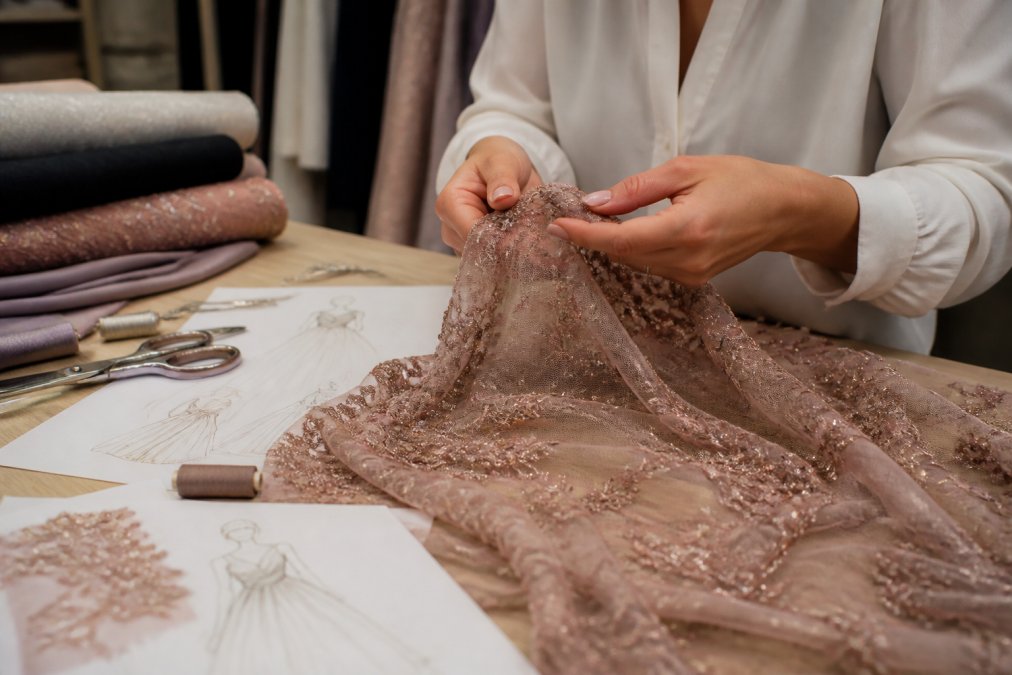
For designers seeking a britexfabrics alternative for bulk orders, the core issue is consistency across multiple rolls. The remnant model of some retail stores creates inherent challenges when you need 50 yards of the same lace for a production run, because remnant inventory turns over quickly and cannot be guaranteed for reorders.
Managing Dye Lots and Color Consistency Across Production Runs
Dye lot variation is the silent killer of production quality. When you source from a retail floor, you may receive fabric from several different dye lots mixed together, and even a slight shift in color becomes visible in a finished garment seam.
A more reliable approach is working with a supplier that manages inventory specifically for repeat orders. New Creations Fabric & Foam Inc offers embroidered lace fabrics sold by the yard, and when you purchase more than one yard, it ships in a continuous piece. This detail protects your color consistency because every yard comes from the same bolt and the same dye lot.

Wholesale Fabric Sourcing for Fashion Designers: Comparing Price and Value
Wholesale fabric sourcing is about calculating the true cost per finished garment when you factor in waste, reorders, and quality failures. Milan Fabrics and Britex both cater to walk-in retail customers, so their pricing reflects single-roll economics rather than textile trade discounts for volume.
What You Pay For: Trade Discounts, Yardage, and Minimums
A lower per-yard price at a retail counter does not necessarily translate to savings. If your supplier cannot guarantee dye lot consistency, you will pay for it in rejected pieces and delayed production. A specialty beaded mesh at $47.95 per yard only delivers value if the embellishment pattern stays uniform across every yard you order.
Suppliers structured for production build their pricing around the realities of garment prototyping and scaling. They stock enough depth in a single textile to fulfill recurring orders, which is what event planners and costume designers need.
Digital vs. Physical Swatch Procurement for Design Teams
For designers who cannot walk into either store in person, the procurement workflow is a logistical challenge. This section addresses how to source materials remotely, manage shipping and bulk ordering logistics, and secure trade discounts where they exist.
The Remote Sourcing Workflow: From Digital Catalog to Physical Swatch
A hybrid workflow is the only reliable method for remote fabric sourcing. The process breaks down into five stages:
-
Digital screening: Use online catalogs to shortlist fabrics by fiber content, color family, and pattern. Many retail fabric stores maintain searchable online inventories. Treat the digital catalog as a filter, not a final decision tool.
-
Physical swatch request: For any fabric where drape, texture, or embellishment density determines your design, request a physical swatch before ordering yardage. Ask for the dye lot number and the roll width; these are essential for calculating yardage requirements and matching future orders.
-
Sample yardage order: Before committing to a bulk order of any embellished textile, order a single yard first. Sew a test seam, check how the fabric behaves under a presser foot, and confirm the embellishments do not catch or break. This sample yard also allows you to run a wash test for shrinkage and color bleed.
-
Bulk order logistics: Retail stores typically ship via standard parcel carriers with transit times of 3-7 business days. Bulk orders of 50+ yards may require freight shipping (LTL trucking), which adds 5-10 business days and requires a loading dock or forklift at the receiving end. Wholesale suppliers who specialize in production runs often maintain their own inventory and can ship continuous yardage from a single bolt, eliminating dye lot mismatch risk.
-
Receiving and inspection: Upon delivery, inspect every roll immediately. Verify the yardage against the invoice, check dye lot numbers are consistent, and unroll a few yards from each bolt to confirm there are no defects. Document any issues with photos and notify the supplier within 48 hours.
Shipping Costs and Transit Times: A Practical Comparison
Shipping costs are typically calculated by weight and distance. A 10-yard bolt of medium-weight silk might cost $15-$30 for ground shipping. A 50-yard order of beaded lace could cost $50-$100 for ground shipping, or $150-$250 for expedited 2-day service (fedex.com). These costs add $0.50-$2.00 per yard to your effective fabric cost.
Trade Discounts and Minimums: What Designers Can Actually Expect
Some retail fabric stores do not operate as traditional wholesale fabric suppliers with published trade discount programs. However, professional designers can often negotiate better terms by:
- Registering as a trade customer: Many retail fabric stores offer a 10-15% trade discount to designers who provide a business license, tax ID, or proof of professional status (e.g., a portfolio or industry association membership) (the American Dental Association).
- Inquiring about volume pricing: Even without a formal wholesale program, a store manager may offer a per-yard discount for orders above a certain threshold (often 25-50 yards of a single fabric).
- Asking about remnant lots: Some remnant inventory is priced at a discount, but the trade-off is that remnants are non-reorderable and may come from different dye lots. For small projects or sampling, this can be an excellent value; for production runs, it can be a liability.
The Wholesale Alternative for Remote Design Teams
For design teams that need consistent yardage, guaranteed dye lot continuity, and predictable shipping timelines, a wholesale fabric supplier with dedicated production inventory is often the more reliable remote sourcing option. These suppliers typically offer:
- Continuous yardage: When you order 50 yards of a fabric, it ships as a single continuous piece from one bolt, not as multiple remnant cuts.
- Dye lot management: Wholesale suppliers track dye lots and can hold inventory for repeat orders, ensuring that a reorder six months later matches the original color.
- Trade pricing: Volume pricing structures that reduce per-yard cost as order quantity increases.
- Dedicated account management: A single point of contact who understands your production schedule and can alert you to inventory availability or discontinuations.
Building a Remote Sourcing Protocol
Design teams that consistently source fabric remotely develop a documented protocol that includes: a standardized swatch request form, a sample evaluation checklist, and a supplier scorecard tracking on-time delivery, order accuracy, and communication responsiveness. This protocol turns remote sourcing from a gamble into a repeatable process.
Which Supplier Fits Your Production Workflow?
The best supplier for your studio depends on where you sit in the production chain. For a single bespoke garment, Milan Fabrics or Britex offer the tactile experience of browsing a vast textile selection and the immediate gratification of walking out with your fabric.
For a fashion brand managing a production calendar, you need a partner who can supply consistent yardage, respond when a supplier falls through, and deliver fabric that meets fashion industry standards for material durability. This is where New Creations Fabric & Foam Inc fits, offering a catalog that spans embroidered lace, sequins, velvet, and faux fur with the consistency required for professional-scale manufacturing.
Conclusion: Aligning Your Fabric Choice with Your Design Process
Choosing between milanfabrics vs britexfabrics is ultimately a decision about production philosophy. If your work is strictly bespoke and you value the in-store experience of evaluating textile quality firsthand, a retail fabric store is a legitimate choice. But if your designs need to scale beyond a single sample, the consistency of your fabric supply protects your brand's reputation.
New Creations Fabric & Foam Inc supports designers who need refined finishes and dependable sourcing for apparel, tablecloths, and backdrops. Our collections, from the Ivory/Gold metallic French inspired embroidered lace fabric at $17.95 per yard to the All Over Luxury Beaded Mesh with Pearls at $47.95, are selected to meet both creative and production demands. Explore our fabrics and build a supply chain that matches your design process.
Frequently Asked Questions
What are the main differences between Milan Fabrics and Britex Fabrics for designers?
The main differences come down to sourcing model and product focus. Some suppliers operate as large-scale online suppliers with a vast inventory of laces and specialty textiles, suitable for bulk and repeat orders. Others are physical retail institutions known for their curated selection and remnant inventory, which appeals to designers seeking unique pieces. For professional production needing consistent dye lots and yardage, an online bulk model often proves more reliable.
Is Britex Fabrics suitable for large-scale design production?
Some retail stores, while offering unique selections, may have models of remnant sales and limited in-store inventory that are not designed for large-scale production runs. Sourcing enough yardage of a single dye lot for commercial manufacturing can be difficult. For bulk orders, designers typically turn to wholesale fabric sourcing options that can guarantee continuous pieces and consistent quality across hundreds of yards, ensuring your garment construction is not delayed by stock shortages.
What should I look for in a britexfabrics alternative for bulk orders?
When seeking an alternative for bulk orders, prioritize supply chain transparency and consistency. Look for suppliers that state fabric width and composition clearly, ship multiple yards as a continuous piece, and maintain stable stock levels. A dedicated online supplier like New Creations Fabric & Foam Inc offers specific products, such as the Ivory/Gold embroidered lace at $17.95 per yard, ensuring you can order 50 yards and receive the same quality as a single-yard sample.
How does fabric quality impact professional garment construction?
Fabric quality directly affects how a garment drapes, holds its shape, and withstands repeated wear. In professional garment construction, issues like fraying, inconsistent drape, and color variation between rolls cause costly delays. High-quality natural fibers and well-constructed knits and laces are more predictable to sew and produce a refined finish. Sourcing from a supplier that offers detailed product specs and quality control ensures your final pieces meet the standards of high-end designer clothes.