

Table of Contents
- Why Fabric Supply Consistency Matters for Production
- Wholesale Fabric Suppliers for Fashion Brands
- How to Vet Textile Manufacturers for Quality Control
- Managing Fabric Lead Times for Apparel Manufacturing
- Sustainable Fabric Sourcing and Material Performance
- Building a Standardized Vetting Checklist
- Cost-Benefit Analysis: Local vs. Global Sourcing
- Conclusion
Last Updated: August 27, 2026
Why Fabric Supply Consistency Matters for Production
Maintaining reliable fabric supply consistency is the difference between meeting production deadlines and scrambling for emergency solutions. When textile sourcing breaks down, manufacturing schedules slip, customer orders get delayed, and your brand reputation suffers.
The real challenge isn't finding fabric, it's finding fabric that arrives on time, meets quality standards, and maintains consistent characteristics across batches. Many apparel manufacturers discover this problem too late, after committing to production timelines based on supplier promises that didn't materialize.
At New Creations Fabric & Foam Inc, we've built our entire operation around solving this exact problem: delivering the consistency that professional-scale manufacturing demands. Fabric supply consistency directly impacts your ability to scale production without constant firefighting.
Wholesale Fabric Suppliers for Fashion Brands
Finding wholesale fabric suppliers that meet professional production standards requires more than browsing an online catalog. You need suppliers who understand the difference between retail purchases and committed manufacturing relationships.
Evaluating Supplier Reliability and Stock Depth
Reliability starts with stock depth. Before committing to any wholesale fabric supplier, verify three things: whether they stock materials in the quantities you need, whether they maintain that stock consistently, and whether they can guarantee availability on your timeline.
Ask direct questions about their inventory model. Do they keep finished stock on hand, or do they order from mills on demand? How long is their lead time for standard items versus custom orders? A supplier who can't answer these questions clearly isn't ready for professional relationships.
New Creations Fabric & Foam Inc maintains deep inventory across multiple fabric types, including specialty options like velvet, taffeta, and spandex blends. This depth means you receive materials on a predictable schedule rather than waiting weeks for mill orders.
Comparing Low MOQ and Bulk Order Capabilities
Minimum Order Quantity (MOQ) requirements vary dramatically across suppliers. A supplier with high MOQ forces you to buy more than you need; a supplier with low MOQ flexibility lets you test materials and scale gradually.
The best wholesale fabric suppliers offer both options. They should be comfortable with small orders when testing new designs and offer pricing that rewards bulk purchases when you're ready to commit.
When comparing suppliers, calculate total cost of ownership: unit price plus shipping, plus inventory carrying costs, plus dead stock risk. A slightly higher per-yard price from a supplier with low MOQ and fast delivery often beats a lower price from a supplier requiring 500-yard minimums.
New Creations Fabric & Foam Inc offers materials like Imitation Silk Taffeta at $14.95 per yard and Micro Velvet Fabric at $17.95 per yard, with flexible ordering for both small designers and larger manufacturers.

How to Vet Textile Manufacturers for Quality Control
Quality control in textile manufacturing isn't a single checkpoint, it's a system that starts with material selection and continues through every production step.
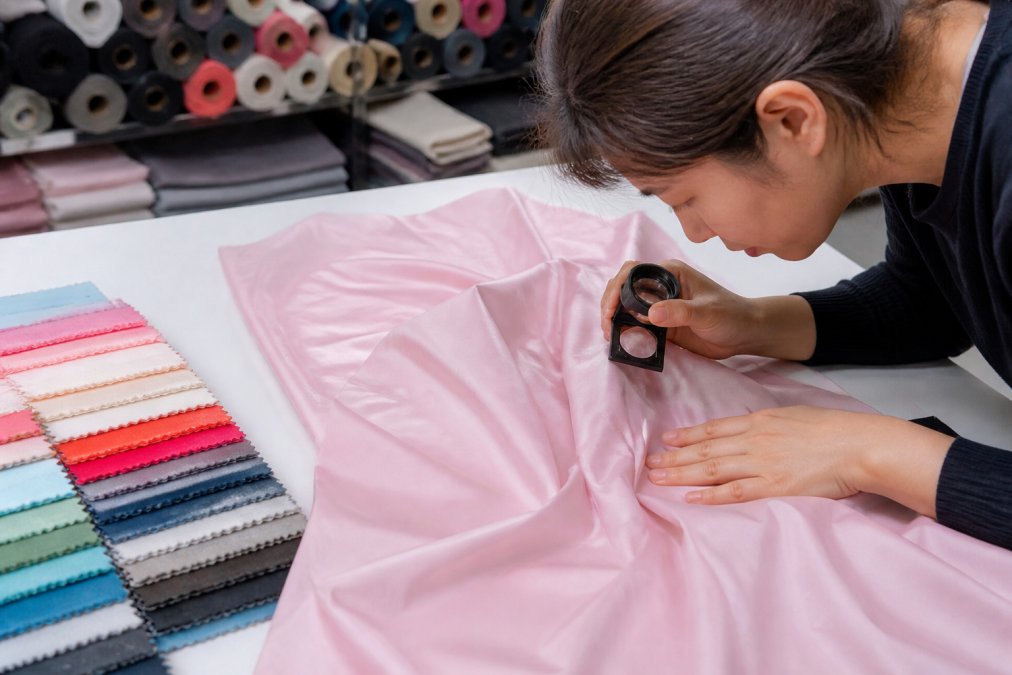
Start by understanding their quality assurance process. Do they test materials before shipping? Do they have documented protocols for checking color consistency, weave integrity, and finish quality? Suppliers worth working with can explain their testing methodology and acceptable tolerance ranges.
Ask for samples before placing large orders, samples from multiple production batches of the same material. Compare them directly for consistency in color, weave tightness, finish quality, and feel. Small variations are normal; large variations indicate quality control problems.
Traceability and Certification Standards
Traceability means you can track materials back to their source. A supplier who can't tell you where materials come from or how they were produced should be avoided.
Look for suppliers who work with certified mills and maintain documentation. Common certifications include OEKO-TEX (tests for harmful substances), GOTS (Global Organic Textile Standard), and environmental certifications depending on fiber type (oeko-tex.com). Certification indicates third-party verification of standards.
Sample Testing and Batch Consistency Protocols
Establish a sample testing protocol with your supplier before committing to large orders. Request samples from different production batches and test them under the same conditions you'll use for production.
Document everything. Keep records of sample quality, testing dates, and variations. This documentation becomes your baseline for comparing incoming production materials. Batch consistency protocols should include color matching, weave uniformity checks, and finish quality verification.
Managing Fabric Lead Times for Apparel Manufacturing
Lead time is the interval between placing an order and receiving materials ready for production. In apparel manufacturing, lead time management is the difference between smooth production and constant crisis management.
Just-in-Time vs. Deadstock Inventory Models
Just-in-time (JIT) manufacturing minimizes inventory by ordering materials exactly when needed. It works beautifully with reliable suppliers but creates disaster when they're not. Deadstock inventory ties up capital and creates risk if designs don't sell as expected.
The practical answer for most growing brands is a hybrid approach: maintain deadstock of core materials you use consistently, and use JIT ordering for specialty fabrics and seasonal items. This balances JIT efficiency with reliability buffer.
Your supplier choice determines how aggressive you can be with JIT. A supplier with proven reliability and short lead times lets you run leaner.
Supply Chain Contingency Planning
Supply chain contingency planning means having a backup plan when your primary supplier fails. Build relationships with at least two suppliers for critical materials. You might use one supplier for 80% of volume and maintain a secondary supplier for the remaining 20%.
Document your contingency suppliers in writing: lead times, pricing, MOQ requirements, and communication protocols. Test the relationship periodically with small orders. A supplier who can turn around emergency orders in 48 hours is worth more than a cheaper supplier who takes two weeks.
Sustainable Fabric Sourcing and Material Performance
Sustainability in fabric sourcing isn't just about environmental impact, it's about long-term supply chain reliability. Suppliers who source sustainably tend to have more stable supply chains because they invest in relationships with mills rather than chasing spot-market prices.
Natural vs. Synthetic Fiber Options
Natural fibers like cotton, silk, and wool offer better breathability and comfort in apparel and are biodegradable (peer-reviewed research). The trade-off is less consistency between batches, more careful care requirements, and higher costs.
Synthetic fibers offer consistency, durability, and easier care (peer-reviewed research). Polyester and nylon are stable, predictable materials that hold properties across batches. The trade-off is they're petroleum-based and not biodegradable.
New Creations Fabric & Foam Inc offers both options. Our Imitation Silk Taffeta provides silk's look and feel in a polyester blend that's more durable. Our Solid Polar Fleece is 100% polyester engineered for comfort. Our Retro Paisley Spandex combines polyester and spandex for stretch and recovery. Match the fiber to your actual needs rather than chasing sustainability narratives that don't fit your application.

Building a Standardized Vetting Checklist
Creating a standardized vetting process removes emotion from supplier decisions and ensures consistent evaluation.

Your vetting checklist should include:
- Stock availability and lead times: Can they supply quantities you need on your timeline?
- Minimum order quantities: Do MOQ requirements fit your business model?
- Quality control documentation: Can they demonstrate testing protocols?
- Batch consistency samples: Do samples from different runs match?
- Certification and traceability: Can they document material sources?
- Pricing and payment terms: Is pricing transparent with reasonable terms?
- Communication and responsiveness: Do they respond quickly to questions?
- Contingency planning: What happens when they can't fulfill orders?
- References: Can they provide contact information from other brands?
Rate each criterion on a simple scale: meets requirements, partially meets, or doesn't meet. Document your vetting process so you have a record of what you verified upfront.
| Vetting Criterion | Why It Matters | Red Flags |
|---|---|---|
| Stock availability | Determines if they can fulfill orders | Vague answers, "usually have stock" |
| Quality control | Ensures consistency across batches | No documented testing process |
| Lead time transparency | Lets you plan production accurately | Inconsistent delivery history |
| Certification | Indicates third-party verification | No certifications or documentation |
| Pricing clarity | Prevents surprise costs | Hidden fees, unclear structure |
| Communication speed | Critical for problem-solving | Slow responses, hard to reach |
Cost-Benefit Analysis: Local vs. Global Sourcing
Local sourcing offers shorter lead times, easier communication, and simpler logistics. You can visit suppliers in person and handle problems faster. The trade-off is higher costs and less inventory depth.
Global sourcing offers lower per-unit costs and access to specialty materials. The trade-off is longer lead times (4-8 weeks), language barriers, and less direct control over quality.
Many growing brands use a hybrid approach: source commodity materials globally for cost efficiency, and source specialty materials locally for faster turnaround and better control.
Calculate total cost of ownership, not just per-yard pricing. Factor in lead time impact on production schedules, inventory carrying costs, quality issues, communication costs, logistics, and currency exchange risk. A cheaper global supplier with inconsistent quality often costs more than a more expensive local supplier who's reliable.
Finding a fabric supply alternative that delivers consistency requires moving beyond price comparisons and building relationships with suppliers who understand professional manufacturing. New Creations Fabric & Foam Inc specializes in consistent, high-quality fabrics with reliable delivery and responsive support. Our materials like Metallic Polyester Dupioni Faux Silk and Micro Velvet are designed for production-scale projects where consistency matters. Explore Fabrics and discover how reliable fabric sourcing transforms your production timeline.

Frequently Asked Questions
How do I ensure consistent fabric quality when switching suppliers?
Request sample batches from multiple production runs before committing to bulk orders. Compare color consistency, weave tightness, and weight across samples. Establish written quality standards with your supplier and require third-party testing or certification. Document specifications for fiber content, width, and weight tolerance. Schedule regular audits of incoming shipments. New Creations Fabric & Foam Inc provides detailed product specifications and consistent quality across all fabric types, from micro velvet ($17.95) to silk taffeta ($14.95), with transparent material composition and care instructions.
What are the risks of relying on deadstock for fashion production?
Deadstock inventory creates unpredictable supply chains because once stock sells out, that exact fabric may never be available again. This disrupts production timelines, forces design changes mid-season, and makes it difficult to fulfill reorders. Color variations between deadstock batches can compromise brand consistency. Instead, prioritize suppliers with reliable reorder capabilities and transparent lead times. Wholesale fabric suppliers for fashion brands should maintain steady inventory and offer just-in-time ordering to balance cost with availability. Planning ahead and maintaining relationships with multiple vendors reduces deadstock dependency.
How do I vet wholesale fabric suppliers for bulk order reliability?
Request references from current clients and verify their experience with on-time delivery and order accuracy. Ask about their inventory management system and how they handle rush orders. Confirm their minimum order quantities (MOQ) match your production scale. Check whether they offer digital inventory tracking so you can verify stock before placing orders. Request documentation of their supply chain traceability and certification standards. Test their responsiveness by submitting sample orders first. Evaluate their ability to provide consistent lead time estimates and their contingency plans if stock runs out. New Creations Fabric & Foam Inc serves designers of all scales, from independent creators to larger manufacturers, with transparent ordering and bulk availability.
What is the difference between natural and synthetic fabrics for apparel production?
Natural fibers like silk and cotton offer breathability, comfort, and biodegradability but require more careful handling, higher care costs, and longer lead times for sourcing. Synthetic fibers like polyester and spandex provide durability, easier care, lower costs, and consistent performance. Polyester blends balance affordability with reliability. For production consistency, synthetics offer fewer variables in quality control because manufacturing is standardized. Natural fibers perform better for premium, heirloom garments where drape and breathability matter. Choose based on your brand positioning, target price point, and care requirements. New Creations Fabric & Foam Inc offers both options: silk taffeta ($14.95) for luxury apparel and polyester alternatives like metallic dupioni ($18.95) for cost-effective elegance.
How can I manage fabric lead times to avoid production delays?
Establish lead time agreements with suppliers in writing and build a 2-3 week buffer into your production schedule. Use digital inventory management to track stock levels and place reorders before inventory drops below your minimum threshold. Maintain relationships with backup suppliers so you can pivot if your primary supplier faces delays. Understand the difference between just-in-time ordering (lower storage costs but higher delay risk) and holding safety stock (higher costs but production security). Communicate forecast estimates to suppliers 60-90 days in advance so they can reserve material. Supply chain contingency planning should include alternative suppliers, expedited shipping options, and flexible design timelines.
This article was written using GrandRanker