

Table of Contents
- What Defines High-End and Luxury Textiles
- Where to Find High-End Fabrics: Mills, Converters, and Jobbers
- Best Wholesale Fabric for Fashion Brands: Selection Criteria
- Fabric Sourcing Checklist for Designers: Vetting Suppliers
- Sourcing Deadstock Fabric for Sustainable Fashion
- Geographic Hubs and Importing Luxury Textiles
- Building Your Textile Sourcing Strategy
- Conclusion
What Defines High-End and Luxury Textiles
High-end and luxury textiles are fabrics engineered for refined aesthetics, superior durability, and exceptional performance. They distinguish themselves through meticulous fiber selection, advanced weaving techniques, and finishing processes that elevate both tactile and visual qualities.
The difference between standard and luxury textiles lies in specificity. A luxury fabric delivers consistent hand feel across every yard, resists pilling, maintains color saturation after repeated washing, and drapes with intention. Fiber content matters enormously: high-end fabrics typically feature long-staple cotton, mulberry silk, premium wool, or technical synthetics engineered for performance.
At New Creations Fabric & Foam Inc, we work directly with designers and manufacturers who understand that fabric quality determines whether a garment feels premium or ordinary. A silk charmeuse with proper weight and finish creates movement that polyester blends cannot replicate. A damask sequin fabric with precision-embroidered embellishments communicates luxury through craftsmanship.

Luxury textiles also encompass specialized categories: beaded lace for bridal wear, sequin mesh for evening gowns, velvet for upholstery and costume work, and technical blends for activewear that demands both stretch and recovery.
Where to Find High-End Fabrics: Mills, Converters, and Jobbers
Sourcing high-end fashion fabrics requires understanding three distinct supply chain channels, each offering different advantages and constraints.
Direct Mills and Textile Manufacturers
Mills produce fabric and control the entire manufacturing process from raw material to finished bolt. Working directly with mills offers the highest customization and lowest per-yard cost at scale.
The challenge: mills rarely sell small orders. Most establish minimum order quantities between 500 and 5,000 yards per design (peer-reviewed research). Mills excel when you have specific vision and production volume to justify it. You can negotiate custom fiber blends, exclusive colorways, or proprietary weave structures. Lead times typically run 8-16 weeks from order confirmation to delivery (peer-reviewed research).
Finding mills requires industry connections or trade show attendance. Many mills don't maintain retail-facing websites; they work through established relationships and industry referrals.
Converters and Textile Wholesalers
Converters purchase finished fabric from mills in bulk, then break those production runs into smaller quantities for resale. A converter might buy 10,000 yards of damask sequin fabric from an Italian mill, then sell it in 100-yard or 500-yard increments.
This model dramatically lowers minimum order quantities. Most converters work with orders as small as 50-200 yards, making them accessible to independent designers. Converters maintain inventory, offering faster turnaround of 2-4 weeks instead of the 8-16 weeks mills require.
The trade-off: converters add markup. You'll pay more per yard than buying directly from a mill, but gain flexibility and speed. Quality varies significantly among converters, so supplier vetting becomes critical.
Jobbers and Deadstock Specialists
Jobbers purchase overstock, discontinued lines, and production overruns from mills and converters. They operate on thin margins but offer exceptional value on premium fabrics. A jobber might acquire 2,000 yards of luxury beaded lace because a manufacturer over-ordered, then sell it at 30-50% below retail pricing.
Jobbers excel for designers seeking distinctive, hard-to-find fabrics without volume commitment. Lead times are immediate, as jobbers ship from existing inventory.
The constraint: you can't reorder. Once stock is gone, it's gone. This works for one-off collections or limited-edition pieces, but not for ongoing production lines.
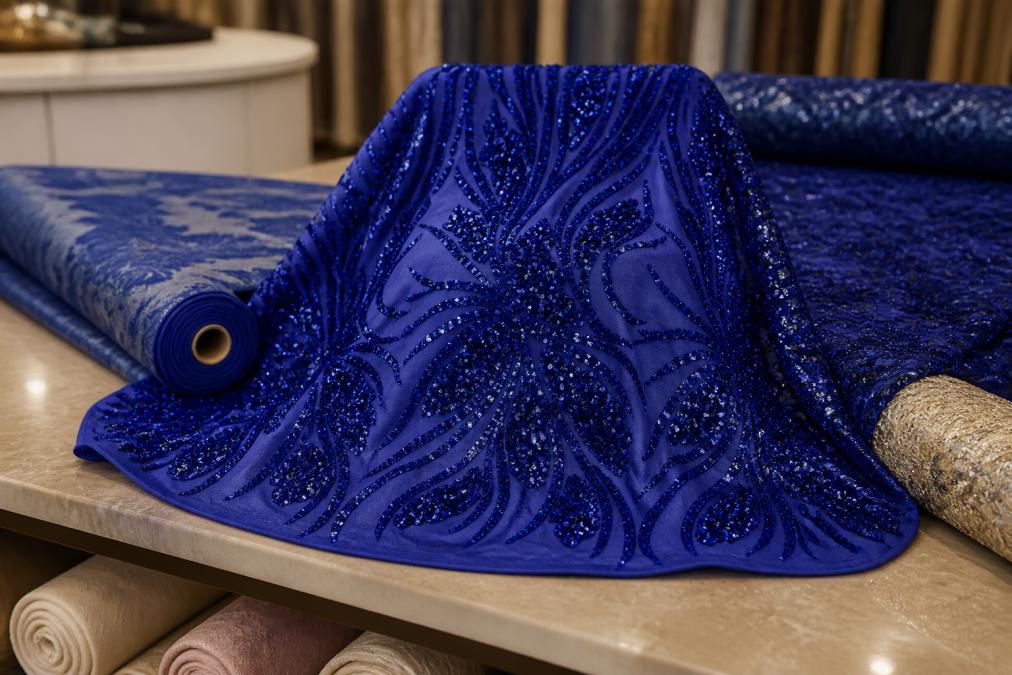
Best Wholesale Fabric for Fashion Brands: Selection Criteria
Choosing the right wholesale fabric requires moving beyond aesthetics. You're evaluating whether a fabric can deliver the performance, consistency, and cost structure your production demands.
Fiber Content and Fabric Weight
Fiber content determines how a fabric feels, performs, and ages. A luxury damask sequin fabric might be 100% polyester mesh with embroidered sequins, while a premium evening gown fabric could be silk charmeuse or silk-cotton blend.
Natural fibers, silk, cotton, linen, wool, offer breathability, moisture management, and aesthetic qualities synthetics can't replicate. Silk drapes with fluidity; cotton breathes; wool holds shape. Synthetic fibers and blends bring durability, stretch recovery, and cost efficiency.
Fabric weight, measured in grams per square meter (gsm), directly impacts drape, structure, and intended use (astm.org). A lightweight chiffon (80-100 gsm) floats; a midweight damask (150-250 gsm) holds structure; a heavyweight brocade (300+ gsm) creates architectural silhouettes. Match weight to intended garment.
Weave Structure and Durability
Weave structure determines how threads interlock and how the fabric behaves under stress. A tight weave resists pilling and snagging; a loose weave feels softer but wears faster. Damask weaves create intricate patterns through thread arrangement rather than printing, so patterns won't fade with wear.
Durability testing matters before committing to large orders. Check for colorfastness, shrinkage rates, and pilling tendency. Sequin and embellished fabrics present specific concerns: the base mesh must be strong enough to support embellishments without stretching or distorting. Quality manufacturers use reinforced mesh and secure embellishments with precision.
Minimum Order Quantities and Production Runs
Minimum order quantities (MOQs) are non-negotiable constraints that shape your sourcing strategy. A mill might require 2,000 yards minimum; a converter might accept 200 yards; a jobber might have 500-yard lots.
MOQs affect unit cost dramatically. Buying 5,000 yards of damask sequin fabric costs significantly less per yard than buying 500 yards. For established brands with predictable demand, higher volume orders make economic sense. For emerging brands testing market response, lower MOQs preserve cash flow and reduce inventory risk.
If you're sourcing for ongoing production, you need suppliers who can consistently fulfill repeat orders. A jobber selling deadstock can't guarantee reorders. A converter with established mill relationships can. A direct mill relationship offers the highest consistency but demands the largest commitment.
Fabric Sourcing Checklist for Designers: Vetting Suppliers
Before placing any significant order, systematically evaluate whether a supplier can deliver what you need.
Testing Fabric Swatches and Samples
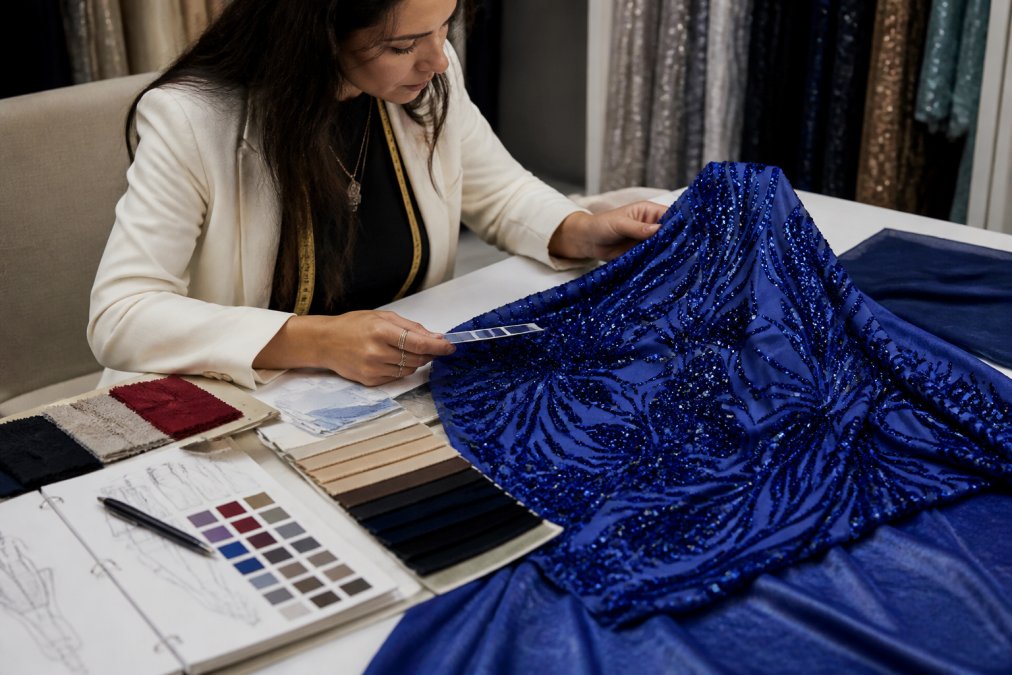
Request fabric swatches before committing to bulk orders. A swatch (typically 4x6 inches) lets you evaluate color, texture, and hand feel. A sample (often a full yard) allows production testing.
Evaluate swatches against your specifications: Does the color match your brand's palette? Does the texture align with your design intent? Is the hand feel consistent with expectations? Request multiple swatches if a supplier offers designs in multiple colorways, as colors can shift significantly between dye lots.
Samples allow production testing. Can you sew the fabric without needle breakage? Does it pucker or distort under machine stitching? For sequin or beaded fabrics, do embellishments stay secure through sewing?
Verifying Supplier Reliability and Lead Times
Supplier reliability determines whether your production timeline stays on track. Ask direct questions: What's the typical lead time from order confirmation to shipment? How do they handle rush orders? What's their on-time delivery rate?
Check references if possible. Have other designers or manufacturers worked with this supplier? Lead times vary dramatically: jobbers ship in days, converters typically deliver in 2-4 weeks, mills can take 8-16 weeks or longer. Understanding this timeline is critical for production planning.
Clarify what happens if stock runs out mid-order. Will they partial-ship and backorder the remainder, or cancel the order? This distinction matters for your production schedule.
Quality Assurance and Batch Consistency
Luxury fabrics demand batch consistency. The damask sequin fabric you receive in month three should match the fabric from month one in color, weight, and sequin placement.
Establish quality standards before ordering. Specify acceptable tolerances for color variation, weight deviation, and embellishment placement. Request inspection reports or quality certifications if available. Some mills and converters conduct gsm testing, colorfastness testing, and shrinkage testing.
Plan for batch testing. When a large order arrives, inspect a sample before accepting the entire shipment. Check color consistency across multiple bolts. Verify that weight and hand feel match your samples. For sequin or beaded fabrics, confirm that embellishments are secure and properly placed.
| Evaluation Criteria | What to Check | Why It Matters |
|---|---|---|
| Fiber Content | Match to spec; verify long-staple cotton, silk, or premium synthetics | Determines performance, cost, and aesthetic qualities |
| Weight (gsm) | Measure or request documentation; confirm consistency across bolts | Affects drape, structure, and durability |
| Colorfastness | Request testing data or conduct home testing on swatches | Prevents fading in finished garments or after cleaning |
| Sequin/Bead Security | Physical inspection; test durability through wear or washing | Ensures embellishments don't shed during use |
| Lead Time | Confirm from order to shipment; clarify rush options | Protects production timeline |
| Reorder Availability | Verify supplier can fulfill repeat orders | Critical for ongoing production lines |
| Batch Consistency | Compare multiple deliveries over time | Ensures finished products look uniform |
Sourcing Deadstock Fabric for Sustainable Fashion
Deadstock represents one of the most compelling opportunities in luxury textile sourcing, combining cost efficiency, sustainability, and access to premium fabrics.
Understanding Deadstock in the Textile Industry
Deadstock is overstock, discontinued inventory, or production overruns that manufacturers can't sell through normal channels. A mill might produce 50,000 yards of damask sequin design expecting strong demand, then see only 30,000 yards sell. The remaining 20,000 yards becomes deadstock.
Deadstock isn't defective. It's premium fabric that didn't move through retail channels for reasons unrelated to quality: a trend shifted, a retail partner canceled an order, or a manufacturer over-estimated demand. For designers and brands, deadstock offers access to luxury fabrics at 30-60% discounts. A beaded mesh that typically costs $40 per yard might be available as deadstock for $15-20 per yard.
The sustainability angle is equally important. Deadstock diverts premium textiles from landfills, reducing waste in an industry notorious for overproduction. Using deadstock aligns with growing consumer demand for sustainable fashion practices.
Finding and Evaluating Deadstock Opportunities
Deadstock sourcing requires different channels than traditional fabric suppliers. Jobbers and specialized deadstock platforms are your primary sources. Some converters maintain deadstock sections alongside regular inventory.
Verify credibility carefully. Check references, review customer feedback, and request samples before committing to large orders. Evaluate deadstock opportunities against your design needs. Can you incorporate the available colors and designs into your current collection?
Quantity constraints are the primary limitation. Deadstock typically comes in fixed quantities with no reorder option. This works for limited-edition collections or one-off pieces, but not for ongoing production lines.
Geographic Hubs and Importing Luxury Textiles
Luxury textile production concentrates in specific geographic regions where centuries of craftsmanship and specialized expertise create competitive advantages.
Italy dominates luxury textile production, particularly for high-end fabrics like silk, wool, and specialty weaves. Italian mills in regions like Piedmont and Tuscany produce some of the world's finest damask, jacquard, and embellished fabrics.
France leads in luxury fashion textiles, especially beaded lace, embroidered fabrics, and haute couture materials. French mills understand the exacting standards luxury apparel demands.
Switzerland specializes in precision textile production and finishing processes, producing high-performance technical fabrics with rigorous quality standards.
Importing luxury textiles involves logistics, tariffs, and customs considerations. Most fabric imports to the United States enter under harmonized tariff codes specific to fabric type and fiber content. Tariff rates vary by origin country and material composition. Working with a customs broker or freight forwarder familiar with textile imports simplifies the process.
Lead times for imported fabrics are typically 4-8 weeks for ocean freight from Europe, plus customs clearance. Air freight accelerates delivery but costs significantly more.
Building Your Textile Sourcing Strategy
Effective sourcing requires a deliberate strategy that aligns supplier relationships with your business model, production volume, and design philosophy.
Start by clarifying your volume and timeline requirements. Are you producing 500 units annually or 50,000? Do you need consistent reorders of core styles, or seasonal collections with different fabrics each season?
Emerging brands typically benefit from a mixed approach: work with converters for core fabrics supporting ongoing production lines, and explore jobbers or deadstock suppliers for special pieces and limited editions. This balances cost efficiency with flexibility.
Establish relationships before you need them. Contact potential suppliers during off-peak periods, request samples, and evaluate quality and communication. Diversify your supplier base to reduce risk. Maintain relationships with at least two suppliers for critical fabrics.
Document everything. Keep detailed records of fabric specifications, supplier contact information, lead times, and quality standards. When you reorder, you have reference documentation ensuring consistency.
At New Creations Fabric & Foam Inc, we understand that sourcing high-end fashion fabrics isn't transactional, it's relational. Our collections reflect supplier partnerships and quality vetting. We work with designers and manufacturers who understand that consistency, refined finishes, and reliable delivery are requirements for professional-scale production.
Sourcing high-end fabrics demands precision, patience, and strategic supplier relationships. New Creations Fabric & Foam Inc provides the consistency, quality assurance, and refined finishes that professional fashion brands require. Our curated collections, including Feather Damask Sequin Stretch Mesh Fabric by the Yard, Damask Sequin Stretch Mesh Fabric, King Damask Sequin Stretch Mesh Fabric, Vine Root Sequin Stretch Mesh Fabric, and All Over Luxury Beaded Mesh with Pearls, Sequins, support everything from emerging designer lines to established apparel manufacturers. Explore our fabrics and discover how premium materials transform production quality and brand perception.


Frequently Asked Questions
Q: Where do high-end designers source their luxury fabrics?
A: High-end designers source from three primary channels: direct mills (manufacturers producing specialty textiles), converters (wholesalers who purchase from mills and sell finished fabrics), and jobbers (dealers in deadstock and overstock materials). Many luxury fashion brands maintain relationships with mills in traditional textile hubs like Italy, France, and Switzerland, while others work with domestic converters for faster lead times. The sourcing strategy depends on order volume, budget, and whether the designer prioritizes exclusivity or sustainability through deadstock.
Q: What should I look for when selecting the best wholesale fabric for fashion brands?
A: Evaluate wholesale fabrics across four dimensions: fiber content (natural fibers like silk and cotton command premium prices and performance), fabric weight and weave structure (heavier, tightly woven fabrics offer durability), minimum order quantities (MOQs vary from 50 yards at specialty retailers to 500+ yards from mills), and supplier reliability (consistent color matching and on-time delivery prevent production delays). Request fabric swatches before committing to large orders, and verify that samples match the actual production run quality.
Q: What is the difference between deadstock and wholesale luxury fabrics?
A: Wholesale fabrics are actively produced by mills or converters and available for ongoing orders; deadstock consists of surplus, overstock, or discontinued materials from previous production runs. Deadstock is typically 30-50% cheaper and offers unique, exclusive patterns no longer in production, making it ideal for sustainable fashion brands. However, deadstock has limited quantities and no reorder capability, while wholesale fabrics provide consistency and scalability for larger production runs.
Q: How do I verify the quality of high-end fashion textiles before ordering?
A: Request fabric swatches and sample production runs from your supplier before placing bulk orders. Examine fiber content labels, test for color fastness and shrinkage by washing a small sample, check seam strength and weave tightness, and compare samples against your brand standards. Ask suppliers for documentation of their testing processes and quality assurance protocols. Building a relationship with suppliers who provide transparency about their textile sourcing and production methods reduces the risk of receiving materials that don't match your expectations.
Q: What are minimum order quantities (MOQs) for luxury textiles?
A: MOQs vary significantly by source. Direct mills typically require 500-2000 yards per style, converters usually ask for 100-500 yards, and jobbers or specialty retailers may accept orders as low as 25-50 yards. Emerging designers and small brands often start with jobbers or deadstock suppliers to keep initial investment low, then transition to converters or mills as production volume increases. Understanding MOQ requirements early in your sourcing strategy helps you budget accurately and choose suppliers aligned with your production scale.
Q: How can I build a reliable fabric sourcing strategy that doesn't disrupt production?
A: Develop relationships with 2-3 primary suppliers at different tiers (one mill or converter for core fabrics, one jobber for deadstock or specialty materials, one domestic retailer for emergency restocks). Maintain a fabric inventory log tracking lead times, MOQs, and performance. Order samples 6-8 weeks before production to allow for testing and adjustments. Communicate production timelines clearly with suppliers and request written confirmation of delivery dates. Diversifying your supply chain reduces dependency on a single source and provides backup options if a supplier experiences delays or stock issues.
Q: Where can I find deadstock fabric for sustainable fashion projects?
A: Deadstock is available through specialized jobbers, textile trade shows, and online platforms that aggregate overstock from mills and converters. Search for suppliers marketing 'deadstock,' 'overstock,' or 'closeout' fabrics. Many jobbers publish seasonal catalogs of available inventory. Attend textile trade shows in major hubs to meet jobbers directly and see materials in person. Deadstock sourcing requires flexibility on design and color, but offers significant cost savings and sustainability benefits for brands committed to reducing textile waste.
This article was written using GrandRanker