

Table of Contents
- Velvet vs Sequins for Event Decor: The Core Difference
- Visual Impact: Light Reflection and Color Palette
- Texture and Guest Experience: Drape vs. Dimension
- Sequin Backdrop Styling for High-Impact Moments
- Velvet Tablecloth Rental vs. Buying: What to Know
- Styling Velvet and Sequins Together for a Layered Look
- Durability, Maintenance, and Sustainability
- Frequently Asked Questions
Last Updated: September 5, 2026
Velvet vs Sequins for Event Decor: The Core Difference
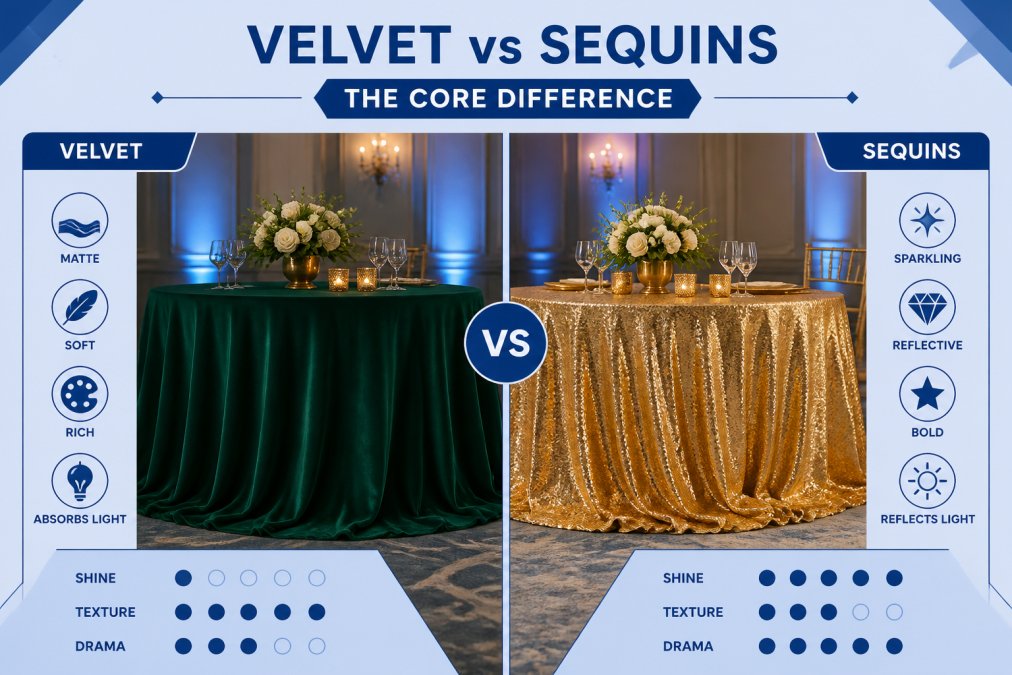
Choosing between velvet vs sequins for event decor comes down to a single question: do you want your guests to feel the room, or see it from across the venue? Velvet absorbs light and invites touch, while sequins reflect it and demand attention. At New Creations Fabric & Foam Inc, we supply both materials daily, and the most successful designs treat this as a functional decision, not just an aesthetic one.
Velvet is a woven fabric with a dense, soft pile that creates depth through light absorption. Sequins are small, shiny discs stitched onto a mesh or fabric base that create brilliance through light reflection. The choice between them shapes everything from the color palette to how your table linens photograph under uplighting.
Visual Impact: Light Reflection and Color Palette
Sequins win on visual impact in low-light settings because they catch and scatter light from every angle. Velvet delivers a more sophisticated, muted radiance that reads as opulence rather than glitz. If your event features candlelight or dimmed chandeliers, sequin accents will sparkle while velvet may disappear into the shadows.
The color palette behaves differently on each material. Velvet deepens colors, making jewel tones like emerald and sapphire feel richer and more saturated. Sequins, by contrast, add a luminous quality that shifts with the light source, which means a silver sequin table runner can look cool white under LED and warm champagne under tungsten. For photographers, this matters: velvet is forgiving and color-consistent, while sequins can create hotspots that require careful flash positioning.
Texture and Guest Experience: Drape vs. Dimension
A velvet tablecloth offers a plush, tactile experience that signals luxury the moment someone rests an arm on it. The fabric's weight gives it a graceful drape that hangs in clean, elegant folds, ideal for formal dining where you want a quiet, sophisticated atmosphere.
Sequins deliver texture of a different kind: dimensional, playful, and high-impact. A sequin chair sash or overlay invites touch, and reversible flip sequins add an element of surprise. However, sequins are not comfortable to lean against for long periods, and they can snag delicate fabrics like lace or chiffon on neighboring chairs.
Sequin Backdrop Styling for High-Impact Moments
A sequin backdrop is a powerful tool for creating a focal point, but its success hinges on how it interacts with your lighting design. Most planners choose the sequin color first and the lighting second; the reverse order is the professional approach.
The Lighting Interaction Guide: Matching Light to Shimmer
The entire visual effect of a sequin backdrop changes based on the type, angle, and color of light hitting it. Here is a practical guide.
- Pin-Spotting for Drama: A single, focused pin-spot on a sequin backdrop creates a tight pool of intense sparkle. This works best for a ceremony arch or a head table, where you want to draw the eye to a specific person or moment. The light will catch the sequins at a sharp angle, creating a brilliant, star-like effect. For this, use a warm white or amber gel to enhance gold or champagne sequins, and a cool white for silver or crystal tones.
- Uplighting for Depth: Uplights placed at the base of a sequin backdrop will create a gradient of shimmer, with the brightest sparkle at the bottom fading as the light travels up the fabric. This is an excellent way to add depth and dimension to a flat wall. However, be aware that uplighting can create harsh shadows on the sequins' mesh backing. To mitigate this, place the uplights at least 2 feet away from the backdrop and angle them slightly inward.
- Wash Lighting for Uniformity: For a photo booth wall where you want even, consistent sparkle, a broad wash of light is your best choice. This minimizes hotspots and ensures that every sequin catches the light equally, creating a smooth, glamorous surface that flatters skin tones. Use a diffused light source to soften the effect.
- The Color Temperature Trap: This is the most common pitfall. A silver sequin backdrop can look cool, almost blue-white, under LED lighting (typically 5600K), but it will shift to a warm, champagne tone under tungsten lighting (typically 3200K) (nist.gov). If you are mixing light sources, say, LED uplights with tungsten chandeliers, the backdrop will appear to change color across its surface. Always test your lighting setup against a swatch of your sequin fabric before the event. This single step prevents the most common and costly visual mismatch.
- Candlelight and Low Light: In a room lit primarily by candlelight, sequins will not sparkle as much as you might expect. Candlelight is low-intensity and warm, and it will create a soft, subtle glimmer rather than a bright flash. If your event is candlelit, consider using a larger sequin (like a 6mm or 10mm) which has more surface area to catch the limited light, or supplement with strategically placed pin-spots.
Controlling the Shine: The 70/30 Rule
The key to successful sequin backdrop styling is controlling the shine. A full room of sequins is visually overwhelming and can cause eye strain for guests. A more effective approach is to follow a 70/30 rule: use matte, light-absorbing textures (like velvet, linen, or raw wood) on 70% of the surfaces, and reserve the high-impact, light-reflecting sequins for the remaining 30%.
For a 6-foot backdrop, you will need roughly 4 to 5 yards of 54-inch wide sequin fabric, depending on how much gather you want. A flat, drum-tight backdrop requires less fabric, while a gathered, ruched look requires significantly more. Order a swatch and test the drape before committing to a full yardage purchase.
The Tactile Factor: A Guest Experience Angle
Don't overlook the tactile experience. Guests will touch the backdrop, especially in a photo booth setting. Large, flat sequins feel cool and smooth, while smaller, cupped sequins have a more textured, almost scaly feel. For a more interactive experience, some planners use reversible flip sequins, which allow guests to create their own patterns on the backdrop, a memorable engagement point beyond a simple photo.

Event design guidance from the International Live Events Association emphasizes that high-impact materials work best when used in deliberate contrast with quieter surfaces. The most successful sequin backdrops are not the ones that shine the brightest, but the ones that are framed by velvet drapes, matte florals, or textured wood, creating a visual conversation between light and shadow.
Velvet Tablecloth Rental vs. Buying: What to Know
The velvet tablecloth rental vs. buying decision hinges on how often you produce events. Renting makes sense for a one-time wedding or gala, since rental companies handle cleaning and pressing. But if you produce events regularly, buying your own velvet yardage often pays off, since velvet is durable and can be re-cut or repurposed for future designs.
Our Stretch Velvet at $14.95 per yard comes in 58-inch width, which is enough to cover a standard 6-foot banquet table with minimal seam work. Velvet's 4-way stretch simplifies fitting over odd table shapes, and the fabric's durability means it survives multiple events when cared for properly. For comparison, a single Round Sequin Fabric by the Yard 54” Wide - Shiny Sequin Mesh Fabric for Dresses, Costumes, Backdrops & Event Decor runs $19.95, making velvet the more economical choice for large surface areas like tablecloths.

Styling Velvet and Sequins Together for a Layered Look
Styling velvet and sequins together creates the most memorable tablescapes because it pairs velvet's sophistication with sequin's celebratory energy. The trick is proportion: use velvet as the base layer and sequins as the accent. A deep burgundy velvet tablecloth with a narrow gold sequin table runner running down the center gives you the luxury of velvet with the glitz of sequins without overwhelming the eye.
Consider these combinations that work consistently well:
- Velvet tablecloth with sequin napkin rings or chair sashes
- Sequin backdrop with velvet drapes framing either side
- Velvet lounge furniture with sequin throw pillows
- Sequin overlay on a velvet base cloth for head tables
For a truly unified look, fabric care guidance from the Textile Industry Affairs organization suggests checking the care requirements of both materials before combining them, since velvet typically needs gentler handling than sequin mesh.
Durability, Maintenance, and Sustainability
While velvet is the more durable choice for repeated use, the real test comes after the event. Proper cleaning and storage protocols are the difference between a fabric that lasts for years and one that ends up in a landfill after a single gala.
Velvet: The Long-Haul Performer
A quality stretch velvet, like our 90% polyester and 10% spandex blend, resists crushing and maintains its pile through multiple events with proper care. The key is addressing spills and stains immediately.
- Spot Cleaning: For fresh spills, blot (do not rub) with a clean, white cloth. Mix a small amount of mild detergent with cool water, test on an inconspicuous area, and gently dab the stain. Rinse by dabbing with a cloth dipped in clean water.
- Full Cleaning: For a full refresh, professional dry cleaning is the safest route for most velvet drapes and tablecloths, especially those with a delicate pile. If you choose to hand wash, use cold water and a gentle detergent, and never wring the fabric. Roll it in a towel to remove excess water.
- Drying and Storage: Always lay velvet flat to dry, away from direct sunlight which can fade the dye. Once dry, the most critical step is storage. Never fold velvet for long-term storage. The creases can become permanent. Instead, roll the fabric around a sturdy cardboard tube (a carpet tube works well) and wrap it in a clean, breathable cotton sheet or muslin. This prevents dust buildup while allowing the fabric to breathe. Store in a cool, dry place.
Sequins: Handling the Delicate Details
Sequin fabrics require a more cautious approach. The mesh backing is the weakest point; it can stretch or tear if pulled taut, and sequins can catch on other fabrics during storage.
- Cleaning: Hand washing is recommended for most sequin fabrics. Fill a basin with cold water and a mild detergent. Gently swish the fabric, do not scrub. Rinse thoroughly. The biggest risk is the sequins scratching each other or the mesh backing during agitation.
- Drying: Never wring or twist a sequin fabric. Lay it flat on a clean, dry towel, and roll the towel up to press out the water. Then, lay the fabric flat on a fresh towel to air dry. Avoid hanging it while wet, as the weight of the water can stretch the mesh.
- Shedding and Repair: As noted earlier, sequins shed. This is a normal characteristic, not a defect. After an event, inspect the fabric and collect any loose sequins. For minor repairs, you can reattach a sequin with a needle and thread, but for larger issues, a professional tailor is your best bet.
- Storage: Store sequin fabrics flat, rolled on a tube, or hung on a padded hanger. Never stack heavy items on top of a folded sequin fabric, as the weight can crush or bend the sequins. To prevent snags, wrap the fabric in a soft cloth or place it in a garment bag.
The Sustainability Angle: Buy Less, Choose Well
Both velvet and sequins are typically made from polyester, a petroleum-based plastic that does not biodegrade. However, the sustainability calculus is not just about the fiber; it's about the product's lifecycle.
Velvet's durability is its primary sustainability advantage. A well-maintained velvet drape can be used for dozens of events over several years, significantly reducing the per-event environmental cost. When a velvet item is no longer usable as decor, it can often be repurposed into upholstery, cushion covers, or even stage curtains, giving it a second life.
Sequin fabrics have a shorter functional lifespan due to shedding and the fragility of the mesh backing. They are harder to repair and less likely to be repurposed. For a more sustainable approach, use them for smaller, reusable accents like chair sashes or throw pillows rather than large, single-use backdrops.
The most sustainable choice is often the one you already own. Before purchasing new materials, audit your existing inventory. Can a velvet drape be re-dyed? Can a sequin runner be shortened? Creative reuse is the most effective sustainability strategy in the events industry.
===
Frequently Asked Questions
Do velvet and sequins go together in event design?
Yes, velvet and sequins pair beautifully when balanced intentionally. Use velvet as the dominant texture for tablecloths, drapes, or chair covers to create a rich, muted base. Then introduce sequins in smaller accents like table runners, throw pillows, or a single backdrop to catch light. The contrast between velvet's soft matte finish and sequins' high-shine surface adds visual dimension without overwhelming the space. A common approach is a velvet tablecloth with a sequin table runner down the center, which creates a layered, luxurious aesthetic.
Which fabric is better for formal event tablecloths: velvet or sequins?
Velvet is the better choice for formal event tablecloths. Its plush texture and fluid drape read as classic luxury, and it provides a neutral, sophisticated base for centerpieces and place settings. Sequin fabric as a full tablecloth can be visually overpowering, catch serving dishes, and reflect light unevenly across the table. If you want sequins on the table, use them as a runner or decorative overlay on top of a velvet cloth. This gives you the glamour of sequins with the practicality of velvet.
How do you balance the texture of velvet with the shine of sequins?
Balance comes from proportion and placement. Pick one dominant fabric and use the other as an accent. For a wedding, velvet drapes on walls or over chairs paired with sequin-covered cocktail tables creates a clear visual hierarchy. For a corporate gala, a velvet stage backdrop with sequin panels at the edges adds sparkle without competing with speakers. Match the undertones: a warm-toned velvet like burgundy pairs with gold sequins, while a cool-toned velvet like sapphire works with silver or iridescent sequins.
What are the maintenance differences between velvet and sequin linens?
Velvet linens require steaming or pressing to remove wrinkles and maintain their plush pile, and they should be dry-cleaned to preserve the texture. Sequin linens are more delicate: sequins can snag on chairs or other fabrics, and they should be hand-washed or gently dry-cleaned to prevent shedding. For rentals, confirm the cleaning process with your supplier. For purchased fabric, Stretch Velvet at $14.95 per yard is durable enough for multiple uses, while sequin fabrics starting at $19.95 per yard need careful handling to keep their shine intact.
Can you mix sequins and lace in event decor?
Yes, sequins and lace can mix successfully, but the effect is different from velvet and sequins. Lace adds a delicate, romantic texture that softens the high-impact shine of sequins. Use lace as an overlay on sequin fabric for tablecloths to mute the sparkle, or pair a sequin backdrop with lace-draped furniture. This combination works best for vintage-inspired or garden-party themes. For a more modern, glamorous look, velvet remains the stronger pairing with sequins because its weight and richness match the opulence of the sparkle.
This article was written using GrandRanker