

Table of Contents
- What Professional Designers Need From a Fabric Supplier
- Why dfwfabricmart Falls Short for Production Work
- Wholesale Fabric Suppliers for Fashion Designers: What to Compare
- Bulk Fabric Sourcing for Small Businesses: Logistics That Matter
- Textile Sourcing Best Practices for Consistent Dye Lots
- New Creations Fabric & Foam Inc: A Direct Alternative
- How to Test a New Supplier Before Committing
- Frequently Asked Questions
Last Updated: September 4, 2026
Finding a reliable wholesale fabric supplier is the difference between a collection that ships on time and a production nightmare. When your go-to supplier becomes a bottleneck, the search for a dfwfabricmart alternative for professional designers becomes urgent. At New Creations Fabric & Foam Inc, we see designers daily who have been burned by inconsistent dye lots, late shipments, and fabrics that look nothing like their photos.
What Professional Designers Need From a Fabric Supplier
Professional designers need a supplier that offers verified fiber content, consistent dye lots, and reliable lead times. A fabric supplier for production work must be a logistics partner whose failures become your delays.
The most common frustration involves quality surprises. A sequin fabric that looks stunning on screen arrives with sparse embellishment or a drape that ruins the garment's silhouette. One bad roll can wipe out an entire production run.
If you order the same fabric twice and receive two different shades, your customers notice. A reliable partner maintains stock continuity so your best-selling designs remain reproducible.
Why dfwfabricmart Falls Short for Production Work
The primary limitation of dfwfabricmart for professional use lies in its retail-oriented model, built for individual sewists and hobbyists, not for designers managing production calendars.
Their stock fluctuates without notice, so a fabric you sourced for a client's bridal collection may be unavailable for reorders. Their listings often lack technical specifications like precise fiber content percentages or shrinkage rates.
For a professional, this means every order carries risk. You cannot build a seasonal collection on a platform that treats each purchase as a one-off transaction.
Wholesale Fabric Suppliers for Fashion Designers: What to Compare
Most consumer-facing guides tell you to compare price and color. For production work, that is table stakes. The real comparison happens at the level of technical specifications and supply-chain mechanics.
Technical Specifications: GSM, Fiber Content, and Shrinkage
A fabric listing that says "polyester" is not a specification. It is a category. You need three numbers from any supplier before you order yardage:
- GSM (grams per square meter): This tells you the fabric's weight and directly impacts drape and opacity. A 200 GSM sequin mesh behaves completely differently from a 350 GSM one. If a supplier cannot state the GSM, they are not tracking their own inventory closely enough for you to rely on it.
- Fiber content percentages: A "stretch mesh" could be 85% nylon and 15% spandex, or 95% polyester and 5% spandex. Those two fabrics have different recovery rates, heat sensitivity, and care requirements. Ask for the exact percentage breakdown, not just the primary fiber.
- Shrinkage rate: Most woven and knit fabrics shrink between 2% and 5% on first wash or steam (peer-reviewed research). If you are cutting a pattern that relies on precise measurements, a 4% shrinkage rate will change your grading. A supplier that cannot provide a shrinkage estimate is a liability for any designer producing garments meant to last beyond one season.
Request a full technical datasheet before sampling. If a supplier hesitates or sends a generic description instead of numbers, treat that as a red flag.
Dye Lot Consistency and Color Matching
Dye lot variation is the silent killer of production runs. Even premium mills produce slight shade differences between batches. The question is how the supplier manages it.
Ask these three questions directly:
- Can you guarantee that all yardage in a single order comes from the same dye lot?
- If I reorder the same SKU in 60 days, what is your process for matching the original lot?
- Do you hold back inventory from the same dye lot for reorders, or do you sell through everything immediately?
A supplier that sells through stock without tracking dye lots forces you to re-approve colors every time you reorder. A supplier that maintains lot continuity, even for a limited window, protects your ability to reproduce a best-selling design.
MOQs, Lead Times, and Reorder Windows
Minimum order quantities (MOQs) define your entire production flexibility. A supplier with a 100-yard MOQ excludes independent designers who need 20 yards for a capsule collection. But a supplier with no MOQ at all may not be a true wholesaler.
Look for a supplier that offers tiered pricing: a higher per-yard rate for small runs and a lower rate once you cross a volume threshold. This lets you sample and produce small batches without overcommitting, then scale up as your sales justify it.
Lead times matter just as much. A supplier that stocks core fabrics can ship in 3-5 business days (trade.gov). A supplier that cuts to order from a mill may take 4-6 weeks. Ask for their current lead time in writing, and verify it with a test order.
The Unique Angle: Trade Accounts and Net Terms
Professional designers can and should apply for a trade account. A trade account is not the same as a retail login. It typically includes:
- Net 30 payment terms, so you can receive fabric and invoice your client before the material bill comes due.
- Dedicated account support for resolving dye lot issues or order discrepancies.
- Access to back-in-stock notifications and pre-order windows for high-demand fabrics.
To apply, you usually need to provide a business license, resale certificate, and proof of professional activity. The approval process takes a few days, but the payoff is that you stop being treated as a one-off buyer.
When you compare suppliers, ask whether they offer trade accounts and what the application requires. A supplier that only offers retail checkout is not built for your workflow, no matter how good their fabric looks.
Bulk Fabric Sourcing for Small Businesses: Logistics That Matter
Bulk fabric sourcing for small businesses fails when logistics are an afterthought. Shipping costs, packaging, and order accuracy determine your true cost-per-yard, not just the listed price.
Order Accuracy: The Invoice Is Not the Shipment
A common failure pattern is the mismatch between what you ordered and what arrives. This is not about fraud, it is about SKU confusion. A supplier with thousands of sequin fabrics may have two similar SKUs with slightly different base colors or sequin densities.
Protect yourself with a simple protocol:
- Request a packing list before shipment and verify the SKU numbers match your purchase order.
- When the shipment arrives, photograph the bolt labels before you cut anything.
- Compare the received fabric against your approved swatch within 24 hours of delivery.
A supplier that cannot provide a packing list with SKU-level detail is not equipped for B2B orders. Move on.
Continuous Cutting: Why It Matters More Than You Think
When you order 30 yards of fabric, how it is cut determines whether you get 30 usable yards or 28. A supplier that cuts from a single bolt in one continuous piece gives you a full, uninterrupted length. A supplier that cuts from multiple bolts, or worse, sends remnants, leaves you with seams where you needed a continuous panel.
Ask directly: "If I order 30 yards, will it come as one continuous cut from a single bolt?" If the answer is anything other than a clear yes, factor that into your decision. For garments like evening gowns, a seam in the middle of a panel is a ruined piece.
Shipping: Ground vs. Freight for Bulk Orders
Most small-batch designers default to ground shipping because it is familiar. For orders under 50 pounds, ground shipping is usually fine. For orders over 100 pounds, roughly 50+ yards of a medium-weight sequin mesh, freight or LTL shipping often costs less per pound and reduces the risk of damage (fmcsa.dot.gov).
Ask the supplier for both options and compare the total cost, not just the shipping line item. A supplier that automatically defaults to freight for large orders is thinking about your package's safety. A supplier that only offers ground may be passing on handling risk to you.
The Hidden Cost: Restocking Fees and Return Policies
Every supplier has a return policy, but the details vary wildly. The critical question is not "can I return defective goods?", it is "what happens if the fabric is wrong for my project?"
Some suppliers charge a 20-30% restocking fee on returns, which can wipe out your margin on a small batch. Others require you to pay return shipping on a 40-pound bolt. Before you place a bulk order, get the return policy in writing and calculate what a worst-case return would cost you.
A supplier that offers a swatch-matching guarantee, where they will accept returns if the bulk shipment does not match the approved swatch, is worth a premium. That guarantee transfers the risk of dye lot variation from you to them.
The Unique Angle: A Logistics Checklist for Small-Batch Designers
Use this practical checklist before you place any bulk order:
| Checkpoint | What to Confirm | Why It Matters |
|---|---|---|
| SKU Verification | Packing list matches your PO | Prevents wrong-fabric disasters |
| Continuous Cut | Single bolt, one continuous length | Avoids unusable seams in panels |
| Dye Lot Hold | Same lot available for reorders | Keeps future runs color-matched |
| Shipping Method | Ground vs. freight at weight threshold | Saves money and reduces damage |
| Restocking Fee | Written policy before ordering | Protects your margin on returns |
| Swatch Guarantee | Bulk matches approved swatch | Transfers dye lot risk to supplier |
A supplier that cannot answer these six questions clearly is not a B2B partner, they are a retailer that happens to sell in bulk. The supplier that passes all six is the one you can build a collection on.
Textile Sourcing Best Practices for Consistent Dye Lots
The core of textile sourcing best practices is protecting against dye lot variation. Even premium fabrics can shift slightly between production runs.
Order enough fabric for your entire project at once. If you need 40 yards for a line of dresses, do not place two 20-yard orders weeks apart. They may come from different dye lots, and the color difference will be visible in the finished garments.
Before committing to a large order, request a physical swatch. Photos and screen settings distort color. A swatch lets you verify the sequin density, the base mesh weight, and the hand feel.
New Creations Fabric & Foam Inc: A Direct Alternative
Our top pick as a direct dfwfabricmart alternative for professional designers is New Creations Fabric & Foam Inc. We stock designer-quality materials with the consistency needed for scalable production, offering a wide variety of fabric types including sequins, velvet, and faux fur.
Where we differ from retail-focused suppliers is our understanding of production needs. Our collections are selected for refined finishes and consistent quality across orders, so the fabric you sample is the fabric you receive in bulk. We cater to everyone from home-based independent designers to larger manufacturers, without forcing you into rigid MOQs that strain a small studio's budget.
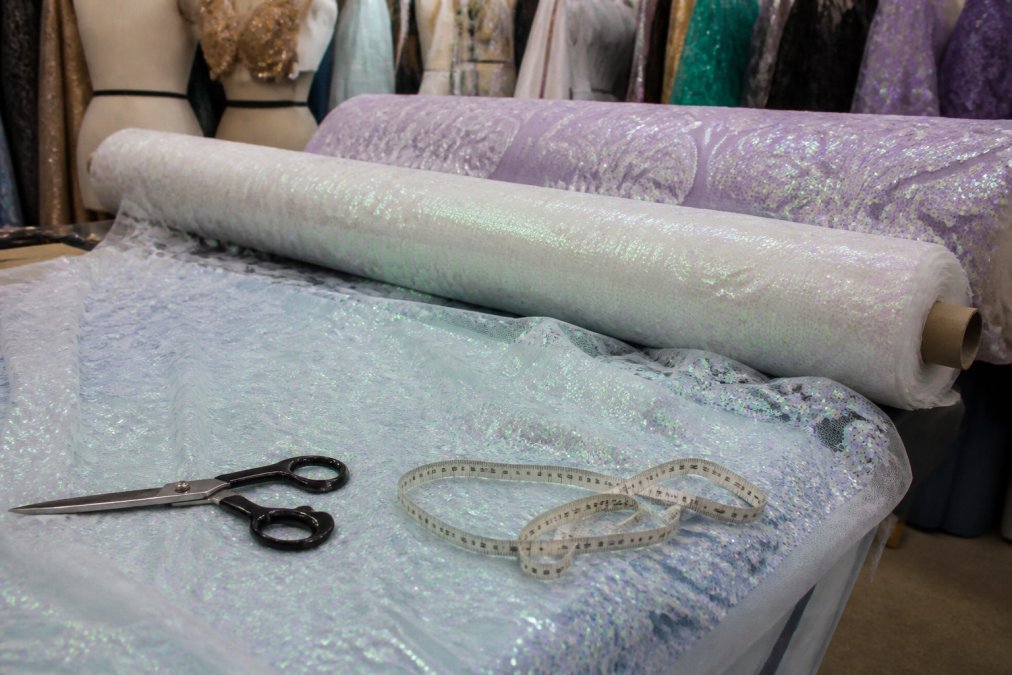
Sequin Stretch Mesh Options for Evening Wear and Event Decor
For designers working on prom dresses, bridal wear, or event decor, our sequin stretch mesh collection offers the high-impact shine and flexibility that production work demands.
The damask sequin stretch mesh fabric, priced at $29.95 per yard, features an intricate floral damask pattern embroidered on a 4-way stretch mesh base. It is ideal for evening gowns and luxury fashion pieces that need a couture look. For designers who prefer a bolder, geometric shine, the chain sequin 4-way stretch mesh at $22.95 per yard delivers an iridescent, multi-tone sparkle that works well for costumes and statement event styling.

These fabrics are sold by the yard in continuous pieces, ensuring you receive usable lengths for full garments. The 54-inch width provides ample coverage for large designs, whether you are building a gown or covering event chairs.
How to Test a New Supplier Before Committing
Before you transition your entire supply chain, run a structured test with any new wholesale fabric supplier.
Start with a single order for a small project, not a full collection. Check the fabric's fiber content against the listing and test how it handles during garment construction. Compare the received goods to the original swatch under natural and artificial light, and time the shipment to see if their lead times match their promises.
A supplier that passes this test earns the right to handle your larger production orders. One that fails saves you from a much bigger problem down the line.
Switching suppliers always carries risk, but staying with one that cannot guarantee dye lot consistency or stock continuity is a bigger gamble. New Creations Fabric & Foam Inc offers the refined finishes and production-ready consistency that modern fashion brands rely on, with options like our iridescent sequin stretch mesh for statement pieces. Explore the fabric collections at New Creations Fabric & Foam Inc to secure the quality your next collection deserves. Get started with New Creations Fabric & Foam Inc and source fabrics that perform as well in production as they do in your sketches.
Frequently Asked Questions
Where do top designers get their fabrics from?
Professional designers typically source from specialized wholesale fabric suppliers rather than retail fabric marts. These suppliers offer consistent dye lots, verified fiber content, and reliable lead times. Many designers maintain trade accounts with multiple suppliers to protect against stock outages. Look for suppliers that provide detailed technical specifications like fabric weight, drape, and stretch percentage, since those details determine how a garment performs in production.
What should designers look for when switching fabric suppliers?
Before switching, order swatches first. Compare the swatch against your current fabric for color accuracy, hand feel, and drape. Ask about minimum order quantities and whether multiple yards ship as one continuous piece. Confirm their restock timeline for the specific material you need. A supplier that documents dye lot numbers and offers consistent 54-inch widths reduces the risk of production delays and quality surprises.
How do professional designers ensure fabric consistency for bulk manufacturing?
Consistency starts with ordering enough fabric from a single dye lot to cover your entire production run. Request a pre-production sample and measure the fabric weight and width upon delivery. Professional suppliers document fiber content clearly, which helps you verify the material meets your specifications. For stretch fabrics, test the recovery and hand feel on a sample garment before committing to bulk yardage.
What is the difference between wholesale and retail fabric purchasing?
Wholesale fabric purchasing involves buying larger quantities at a lower cost-per-yard, often through a trade account. Retail purchasing means buying smaller cuts at full price. For production work, wholesale suppliers typically offer consistent inventory across orders, which matters when you need to reorder the same fabric for a second batch. Small businesses can access wholesale pricing by ordering above the supplier's minimum order quantity.
This article was written using GrandRanker