

Table of Contents
- Why Foam Quality Determines Cushion Lifespan
- High-Density Upholstery Foam: What It Is and Why It Matters
- How to Choose Foam Density for Cushions
- Upholstery Foam Firmness Guide: Soft, Medium, or Firm
- Comparing Online Retailers vs. Local Supply Stores
- What to Look for in a Reliable Foam Supplier
- Conclusion
- Frequently Asked Questions
Last Updated: September 9, 2026
Why Foam Quality Determines Cushion Lifespan
The question of where to buy reliable upholstery foam usually starts after a cushion fails. You sit down, feel the baseboard through the fabric, and realize the foam has collapsed. That failure is rarely random, it traces back to the density and construction of the cushion core itself.
Upholstery foam is the structural foundation of any seat, and its quality dictates how many years of use you get before replacement becomes necessary. Low-grade foam compresses permanently under regular weight; higher-grade material rebounds after each use, maintaining dimensional stability for years. When you search for where to buy reliable upholstery foam, you are really searching for a supplier who understands these material differences, not just someone who sells blocks of polyurethane.
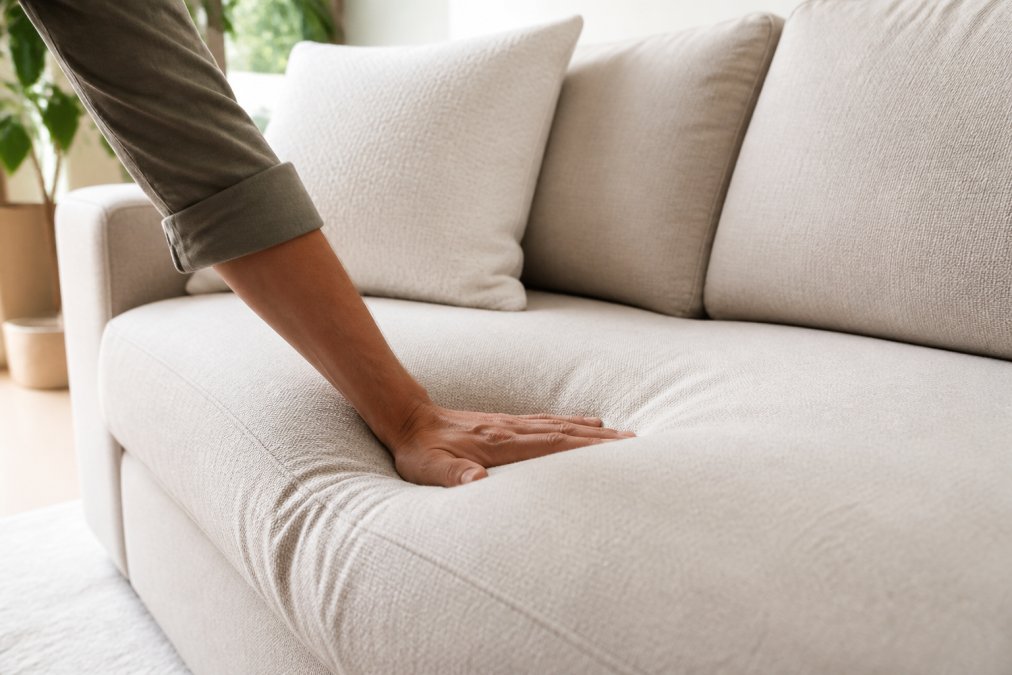
The fix is not buying thicker foam, it is buying higher-density foam from a source that can explain the difference. The real cost of cheap foam is not the purchase price but the labor of reupholstering, the fabric waste, and the downtime of a sofa sitting in pieces for a week.
High-Density Upholstery Foam: What It Is and Why It Matters
High-density upholstery foam is measured by weight per cubic foot, and that number tells you how much polyurethane material is packed into the cushion. A higher density rating means more material, which translates directly to longer cushion longevity and better support over time.
Low-density foam feels soft initially but develops a permanent compression set, the technical term for the dent that stays after you stand up (peer-reviewed research). High-density foam resists that deformation because the open cell structure is more strong. For seat cushions that see daily use, density matters more than any other specification.
Reading Density Ratings and ILD Numbers
Two numbers define any upholstery foam: density and ILD. Density, measured in pounds per cubic foot, indicates durability. ILD, or Indentation Load Deflection, measures firmness, or how much force is required to compress the foam a certain percentage.
A common mistake is assuming high density means firm. It does not. Density is about lifespan; ILD is about feel. You can buy high-density foam with a low ILD that feels plush but still lasts for years. Understanding both numbers before you order prevents the disappointment of a cushion that feels like a rock or collapses in six months.
How to Choose Foam Density for Cushions
Choosing the right density starts with how the cushion will be used, not how it feels in the showroom. A dining chair that sees brief, frequent sitting has different needs than a deep lounge sofa where people nap. Matching the foam to the application is the core of how to choose foam density for cushions.
For everyday seating, a density rating in the range of 1.8 to 2.5 pounds per cubic foot handles regular use well (the FDA). High-traffic commercial seating demands more, often 2.5 pounds and above, to withstand constant compression. Decorative throw pillows and headboards can use lighter foam since they bear minimal weight. The support factor, or the ratio of support at different compression depths, also matters for seating. A higher support factor keeps you from bottoming out on the frame.
Matching Foam to Your Specific Project
Before ordering, measure your existing cushion cover carefully. Foam thickness should match the cover dimensions, accounting for the fact that upholstery batting adds volume. A common error is ordering foam that fits the cover perfectly, then adding a dacron wrap and finding the cushion bulges.

If you are recovering an existing piece, the original foam tells you a lot. A cushion that lost its shape likely had too low a density for its use, replace it with a step up in density, not the same grade. This is where a knowledgeable supplier earns their keep. A retailer that only asks for dimensions, without asking about the furniture type and usage, is selling foam, not solutions.
Upholstery Foam Firmness Guide: Soft, Medium, or Firm
An upholstery foam firmness guide breaks down by ILD numbers, which range from roughly 10 to 60. Soft foams, around ILD 10 to 20, suit backrests, armrests, and decorative pillows. Medium foams, ILD 20 to 35, work for most residential seating. Firm foams, ILD 35 and above, fit heavy-use furniture, truck seats, and commercial applications.
The firmness you choose should align with the furniture's purpose. A firm seat base with a soft topper, often created by wrapping firm foam in a softer layer or using dacron batting, provides both support and comfort. This layered approach is standard practice in quality upholstery.
Comparing Online Retailers vs. Local Supply Stores
The choice between buying online and visiting a local shop comes down to how you weigh lead time, cost, and the need for tactile feedback. Each channel serves a different type of buyer, and knowing the operational realities of each will save you from a stalled project.

Online Retailers: The Case for Convenience and Selection
Online suppliers offer the widest range of densities, ILD ratings, and custom cutting options, often at lower base prices per cubic foot. However, the true cost is shipping: foam is bulky and lightweight, so carriers charge dimensional weight. A standard 24” x 24” x 4” seat cushion can easily cost $15 to $30 in freight alone, scaling quickly for larger pieces. Most online orders are cut-to-order and take 3 to 7 business days to fabricate and ship, plus transit time, a potential dealbreaker on a strict deadline.
Local Supply Stores: The Value of Immediate Gratification
The primary advantage of a local store is that you can leave with the foam the same day, critical when you are mid-project and a cushion has failed. The trade-off is inventory depth. A typical local hardware or craft store stocks only a handful of common grades, usually a 1.5 lb density for general use and a 1.8 lb for seating, and rarely offers custom cutting beyond slicing a block in half with a serrated knife. For a project requiring a specific ILD or a high-resilience (HR) foam, you will likely be disappointed.
The Specialty Fabric & Foam Shop: The Hybrid Solution
A specialty upholstery supplier bridges this gap. These businesses maintain a warehouse of full buns (large blocks of foam) and use industrial cutters to fabricate any dimension you need. They can match a density and ILD spec precisely, and they often stock companion materials, bonded dacron batting, spray adhesive, and zippers, that you would otherwise have to order separately. While they may not offer the rock-bottom price of a high-volume online discounter, the freight cost is often eliminated if you pick up, and the expert advice on your specific furniture frame is included in the price.
A practical approach for first-time DIYers is to visit a specialty shop first to feel the difference between a standard polyurethane foam and a high-resilience (HR) foam. The tactile difference is unmistakable, HR foam has a springier, more immediate recovery. Once you have that reference point, you can confidently order online for future projects, knowing exactly what spec to request.
| Option | Best For | Key Drawback | Logistics Reality |
|---|---|---|---|
| Online Retailer | Repeat buyers with known specs | Cannot test firmness | Lower base price, but $15-$30+ shipping and 5-10 day lead time |
| Local Supply Store | Emergency fixes and small projects | Limited grade selection, no custom cutting | Immediate pickup, but limited to stock on hand |
| Specialty Fabric & Foam Shop | Custom cut, expert advice | May have a minimum order | Cut-to-order in 24-48 hours, often with local pickup options |
The middle path is a specialty supplier that combines online ordering with expert guidance. New Creations Fabric & Foam Inc stocks foam alongside upholstery supplies like our [bonded dacron upholstery batting(/products/5-oz-bonded-dacron-upholstery-grade-polyester-batting-48-inch-wide-10-yards) | newcreationsfabricsinc.com], which is essential for wrapping foam cores. A supplier that offers both the foam knowledge and the companion materials simplifies the entire project.
What to Look for in a Reliable Foam Supplier
A reliable supplier answers questions about density and ILD without hesitation. But beyond the sales pitch, you need to verify that they understand why foam fails. The most common reasons cushions die are not manufacturing defects, they are specification errors. A supplier that helps you diagnose the failure mode of your old cushion is worth more than one that just sells you a new block.
Diagnose the Failure Before You Buy
Before you contact a supplier, look at your old cushion and identify why it failed. This diagnosis determines what you need to buy.
- Compression Set (The Permanent Dent): If the foam stays compressed after you press on it, the density was too low for the weight it supported. The open-cell structure collapsed and cannot rebound. The fix is a higher density, not a thicker piece of the same grade.
- Oxidation (The Crumbly Yellowing): If the foam has turned a deep yellow or brown and crumbles when you bend it, it has oxidized. This is a chemical breakdown caused by prolonged exposure to air and light. It is a natural aging process for polyurethane, but it is accelerated by low-quality foam with high levels of fillers. The fix is a higher-quality foam with a more stable polymer structure, often a high-resilience (HR) foam.
- Moisture Damage (The Musty Smell): If the foam feels damp or smells musty, it has absorbed moisture. This is common in basements or humid climates. The fix is to ensure the new foam is well-ventilated and to consider a foam with a higher density, which is less porous to moisture.
- Fabric Wear at the Corners: If the fabric has worn thin or torn at the corners, the foam's edges were too sharp. This is not a foam quality issue; it is a lack of batting. The fix is to wrap the new foam core in a bonded dacron batting to create a rounded profile that reduces friction on the fabric.
Verifying Supplier Claims
Once you have diagnosed the problem, verify the supplier can meet the spec. Ask for the specific density and ILD numbers, not just a name like "premium" or "super soft." A reputable supplier will have this data printed on the foam bun or on a spec sheet. If they cannot provide it, they are likely buying from a secondary source and do not know the material's true properties.
Also, ask about the foam's compression set rating. This test measures how much a foam sample loses its thickness after being compressed for a set period. A lower compression set percentage (e.g., under 10%) means the foam will better retain its shape over time, a more meaningful indicator of durability than the density number alone.
The Environmental Angle
Polyurethane foam is petroleum-based, and its production has a significant carbon footprint. However, the most environmentally responsible choice is often to buy the highest-quality foam you can afford, because it will last longer and keep a cushion out of the landfill for a decade or more. Some suppliers now offer foam with recycled content or bio-based polyols derived from soy or castor oil. While these options are not yet mainstream for every grade, asking about them signals that you are a discerning buyer. If you are replacing foam, check if your local waste management facility accepts polyurethane foam for recycling into carpet padding or other products.
A supplier that can discuss these failure modes and environmental considerations is not just selling a commodity, they are providing a solution that addresses the root cause of your original problem.
Conclusion
Reliable upholstery foam comes down to specifications, not guesswork. Density determines lifespan, ILD determines feel, and the supplier's expertise determines whether you get the right combination for your project. When you know where to buy reliable upholstery foam, the process becomes straightforward: ask for the numbers, verify the application, and confirm the supplier stocks the companion materials you need.
The most expensive foam is the one that fails in two years and forces you to redo the job. New Creations Fabric & Foam Inc carries upholstery supplies that complete the job correctly, from high-quality batting for that finished, rounded look to fabrics that hold up under daily use. Explore our range of upholstery batting and fabrics, and start your project with materials built to last.
Frequently Asked Questions
What is the best quality upholstery foam?
The best quality upholstery foam is typically high-resilience (HR) polyurethane foam with a density rating of 1.8 pounds per cubic foot or higher. This grade offers a strong support factor and maintains its shape over time. For most residential seating, look for a density between 1.8 and 2.5 pounds per cubic foot. Pairing the core with a dacron wrap, like the 5 oz Bonded Dacron Polyester Batting, adds softness while protecting the foam's structure.
What is the difference between high-density and low-density upholstery foam?
The difference lies in the foam's density rating, which measures pounds per cubic foot. High-density upholstery foam (1.8 pounds or more) contains more polyurethane material, making it heavier, more durable, and better at resisting compression set. Low-density foam (under 1.5 pounds) is lighter and cheaper but breaks down faster, often showing sagging within a couple of years. For projects like seat cushions that endure daily pressure, high-density foam is the reliable choice.
Is it better to buy upholstery foam online or in-store?
Buying online is often better for selection and convenience. Online suppliers provide detailed specifications like density ratings and ILD numbers, so you can compare products precisely rather than relying on the feel of a display sample. Look for retailers that offer custom cutting to your exact measurements.