

Last Updated: November 5, 2026
Quick Summary
Wholesale faux fur fabric shipping costs are driven by dimensional weight, so vacuum packing and tight palletizing raise density and can lower your freight class. Book LTL or truckload capacity before confirming a production date, and get the freight class in writing before you book.
- Carriers bill on dimensional weight, charging whichever is higher between actual weight and volume occupied.
- Vacuum packing compresses the pile and shrinks the carton, which lowers dimensional weight.
- Price both LTL and truckload once a shipment exceeds roughly 6 to 8 pallets or about 10,000 to 15,000 pounds.
- Note damage on the delivery receipt at the dock, not after the driver leaves.
- Build landed cost as fabric cost plus freight plus duty plus broker fees plus a demurrage contingency.
Table of Contents
- Why Freight Planning Decides Your Faux Fur Fabric Margins
- What Drives Wholesale Faux Fur Fabric Shipping Costs
- How to Build a Wholesale Fabric Shipping Quote That Holds Up
- Ordering Faux Fur Fabric Samples Before You Commit
- Freight Logistics for Large-Scale Manufacturing Runs
- Customs, Duties, and Import Paperwork for Bulk Fabric
- How to Inspect a Fabric Shipment on Arrival
- Planning Your First Bulk Faux Fur Order
- Frequently Asked Questions
Why Freight Planning Decides Your Faux Fur Fabric Margins
Wholesale faux fur fabric shipping and logistics is the part of sourcing most buyers underestimate, and it is usually where the margin quietly disappears. According to IndexBox's market overview of the artificial fur trade, imports of artificial fur rose 80% to 149 tons, a signal that demand is climbing fast while freight capacity tightens.
Faux fur is bulky, and carriers bill on space, not just weight. A light bolt can cost more to move than a denser fabric twice its weight because it takes up so much room in the trailer.
Below, we break down the seven rules that keep freight from eroding your margins, from dimensional weight to customs paperwork.
What Drives Wholesale Faux Fur Fabric Shipping Costs
Wholesale faux fur fabric shipping costs are set by three variables: how much space the goods occupy, how they are packed, and how far they travel. Get any one wrong and the quote you budgeted against will not survive contact with the carrier.
A peer-reviewed study of faux fur trade networks published in Sustainability examined total import and export volumes of faux and animal fur materials and found that trading patterns are shaped heavily by major participants and material handling.
Pile Height, Weight, and Dimensional Weight
Pile length is the hidden cost driver. A shaggy faux fur with a high pile traps air, so a roll occupies far more cubic space than a flat velvet of the same weight.
The Husky Faux Fur runs about a 2 inch pile and weighs 3 lbs per yard at 58-60 inches wide. That ratio matters when you stack 30 yards for a production run. Ask your supplier for fabric weight per yard and roll diameter before requesting a quote.

Vacuum Packing, Folding, and Roll Packaging
Packaging is where you claw back cost. According to New Creations Fabric & Foam's wholesale buyer guide, most mills vacuum-pack and fold fabric for shipping to keep freight costs down.
The trade-off: compressed pile arrives wrinkled. A hair dryer on low heat restores the fluff, but factor in that finishing step if you ship straight to a cutter. Roll packaging protects the pile better but takes more trailer space.
How to Build a Wholesale Fabric Shipping Quote That Holds Up
A wholesale fabric shipping quote only holds up when it prices the shipment the way the carrier will bill it: dimensional weight, plus accessorials and a buffer.
Use this checklist before you accept any freight number:
- Confirm total cubic volume, not just total yards
- Get actual and dimensional weight side by side
- Ask whether packing is vacuum, folded, or roll
A common mistake is comparing quotes that assume different packaging. Two suppliers can quote the same fabric at the same price and produce freight costs 40% apart purely because one vacuum-packs and the other ships full rolls.
Ordering Faux Fur Fabric Samples Before You Commit
Faux fur fabric samples are the cheapest insurance in sourcing. A swatch confirms pile length, drape, backing, and color before you commit a production run to a fabric that photographs differently than it feels.
We recommend ordering a swatch of any long pile option you are considering, especially if the project depends on the fur reading as realistic under stage or studio lighting. You can order a long pile faux fur swatch to check pile height and color before a bulk commitment.

Sample requests also settle the dye lot question early. Colors ordered at different times can come from a different dye lot and may not match exactly, so approve a physical sample and keep it as your reference for the full run.
Freight Logistics for Large-Scale Manufacturing Runs
Freight logistics for large-scale manufacturing runs is a different discipline from parcel shipping. Once volume crosses a few hundred yards, you move from parcel carriers to less-than-truckload (LTL) or full truckload (FTL), and planning shifts to pallet configuration, freight class, and delivery windows.
The LTL Versus Truckload Decision
LTL means your shipment shares a trailer with other shippers' freight. You pay for the space you occupy plus accessorials, and the carrier may route the trailer through a terminal network where your pallets are handled more than once.
The crossover is not a fixed yardage, it depends on how densely the fabric palletizes. A practical rule is to price both once the shipment exceeds roughly 6 to 8 pallets or about 10,000 to 15,000 pounds, and compare the LTL quote against a truckload quote rather than assuming LTL stays cheaper.
Freight Class and Why Faux Fur Is Awkward
Class is set by density, handling, stowability, and liability, and density is what bites faux fur.
Two moves protect the rate:
- Get the class in writing from the carrier or broker before you book. Do not let a quote assume a class the carrier will reclass at pickup.
- Pack for density. Vacuum packing and tight palletizing raise density, which can pull the shipment into a lower class. Loose, airy pallets invite a reclass and a reweigh.
Watch out: a reclass or reweigh after pickup is billed back to you as an adjustment, often weeks later, and it can erase the savings you negotiated. Photograph the pallet and record dimensions and weight at origin so you can dispute an adjustment with evidence.
Pallet Configuration for Pile Fabric
Pallet build is where large runs are won or lost. Faux fur is compressible but not crush-proof, and a pallet that leans or bulges will be refused or rehandled.
- Keep pallets square and stable. Overhang invites damage and can void a claim; keep the load inside the pallet footprint and band it.
- Cap the stack height to what the pile tolerates. Heavy rolls stacked high flatten the pile on the bottom layers, and that flattening is a quality claim waiting to happen.
- Separate rolls from cartons. Mixing roll and carton freight on one pallet complicates handling and can change the class.
Booking Capacity and Delivery Windows
Two rules keep large runs on schedule. First, book capacity before you confirm a production date, because freight demand and parcel tariffs shift constantly and a truckload booked late costs more and arrives later. Second, ship to a dock with a forklift rather than a residential address, because liftgate and residential accessorials add cost and time.
Husky Faux Fur 58" Wide| New Creations Fabric & Foam Inc. →
For volume orders, point buyers toward shaggy faux fur options built for bulk production, like our shaggy jacquard faux ostrich eye lash fabric, so the pile and backing are consistent across the run. Consistency across rolls protects your cut yield, and consistent roll diameter makes the pallet build predictable.

Customs, Duties, and Import Paperwork for Bulk Fabric
Customs clearance is where international fabric orders stall, and faux fur is easy to misclassify because the same roll can plausibly be described three different ways. Misclassification invites inspection, storage fees, and delays that cascade into your production calendar, so classification work has to happen before the purchase order is signed.
How Faux Fur Is Classified Under the HTSUS
Imported goods are classified under the tariff schedule and administered at the border by the relevant customs authority.
The practical distinction most buyers miss is between a pile fabric (a knitted or woven base with a raised cut or looped pile) and a finished article made from that fabric.
Three construction details drive the code:
- Fiber content by percentage. A 100% polyester pile fabric and a polyester/acrylic blend can land in different subheadings. Blends are classified by the component that predominates by weight, so an approximate "poly blend" on the invoice is not enough.
- Knit versus woven base. A knitted pile and a woven pile are classified differently even when the face looks identical. Ask the mill which one it is and get it in writing.
- Pile versus finished good. Confirm whether you are importing rolls or cut pieces, because the entry line changes with the form of the goods.
Watch out: declaring a made-up article as raw fabric to chase a lower rate is a misclassification, not an optimization.
What the Entry Actually Requires
A customs broker files an entry on your behalf, and the entry is only as good as the documents behind it. For a bulk faux fur shipment, the working set is:
- Commercial invoice showing the HTSUS classification, unit value, quantity, and terms of sale
- Packing list matching roll count and yardage to the invoice
- Fiber content and construction statement from the mill, by percentage and by knit/woven/pile type
The commercial invoice is where most holds originate. If the invoice says "faux fur fabric" with no fiber percentage and no construction type, the broker has to guess, and a guess triggers a request for information. Accurate specs on the invoice speed clearance and reduce the odds of a hold.
Duty Rates, Section 301, and Landed Cost
The duty rate follows the tariff line assigned to the goods. Additional tariff layers tied to country of origin can also apply, and they are assessed on top of the base rate, another reason classification has to be right before you commit.
Build landed cost as fabric cost plus freight plus duty plus broker fees plus a contingency for demurrage if the entry is held. Buyers commonly budget fabric and freight and forget the duty and broker line entirely.
A Practical Pre-Import Checklist
Before you place an import order, confirm these details with your supplier and hand them to your broker:
- Fiber content as a percentage, not a description
- Construction type: knit, woven, or pile, and cut or loop pile
- Width and weight per yard
Buyers importing specialty fabrics should review the polyester faux dupioni specification as a model for the fiber and width detail customs paperwork requires. The same discipline, percentage fiber content, construction, width, and weight stated plainly, keeps a faux fur entry moving.
How to Inspect a Fabric Shipment on Arrival
Inspection on arrival protects you from absorbing a supplier's mistake. Check the shipment against the packing list before you sign, and document any discrepancy the same day.
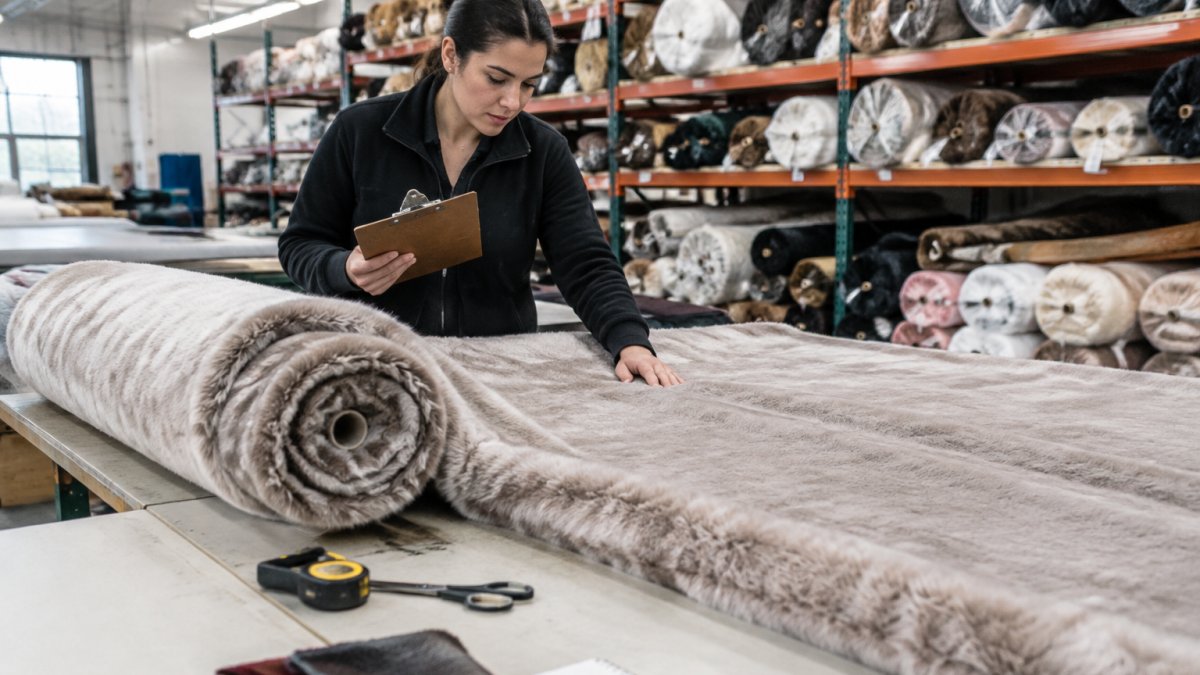
Run through this sequence:
- Count rolls and yards against the invoice
- Check for water damage or crushed cartons
- Unroll a section and inspect the pile for flattening
- Compare color against your approved sample
- Check the backing for fraying or separation
- Photograph anything that looks wrong before you move it
Watch out: signing a clean delivery receipt before inspecting removes your use for a freight claim. Note damage on the receipt at the dock, not after the driver leaves.
Planning Your First Bulk Faux Fur Order
Your first bulk faux fur order should be sized to your actual production schedule, not to a discount tier.
Start with a sample, then a small trial run, then scale. First-time buyers can see how a wholesale roll is packaged and sold by looking at our 40-yard tulle fabric bolt, which shows the roll format and quantity structure before you commit to a faux fur order.
A few practical anchors for the first order:
| Decision | What to Check | Why It Matters |
|---|---|---|
| Quantity | Yards per garment times units | Avoids dead stock |
| Packaging | Vacuum, folded, or roll | Sets freight cost |
| Carrier | Parcel vs. LTL vs. truckload | Matches volume to rate |
| Sample | Approved swatch on file | Locks color and pile |
| Terms | Shipping threshold and lead time | Protects timeline |
Confirm shipping terms in writing before ordering, because thresholds and service levels can vary.
Freight planning is the difference between a fabric order that protects your margin and one that quietly drains it. At New Creations Fabric & Foam Inc, we help apparel manufacturers and event businesses source consistent faux fur.
Frequently Asked Questions
How is wholesale faux fur fabric shipped?
At New Creations Fabric & Foam Inc, the Husky Faux Fur ships in 3-5 days, with delivery taking up to 4-10 days after shipping, excluding holidays and weekends. Confirm packaging method and shipping terms before ordering.
How can I estimate shipping costs for a bulk fabric order?
Start with the fabric weight and yardage. The Husky Faux Fur weighs 3 lbs per yard, so a 30-yard order is roughly 90 lbs before packaging. Faux fur also has a high pile, which adds dimensional weight, so carriers may bill on volume rather than actual pounds. Ask whether the seller vacuum-packs or folds, since that changes the box size and the rate.
Can I order faux fur fabric samples before buying wholesale?
Yes, and you should. The Husky Faux Fur has roughly a 2 inch pile, while the Solid Faux Fur and Shaggy Vegan Faux Fur are softer fox-style options, so a swatch tells you which matches your design. Note that colors ordered at different times come from different dye lots and may not match exactly, so approve a sample from the same lot you plan to buy.
How should I inspect a fabric shipment when it arrives?
Open the shipment the day it lands and check three things: count, condition, and color. Verify the yardage matches your invoice, then unroll several feet to look for fraying, pile shedding, or crushed areas from vacuum packing. Compare the color against your approved swatch under daylight. Vacuum-packed faux fur arrives wrinkled; a hair dryer restores the fluff. Photograph any defects before you cut, and report issues to the supplier within their return window.
