

Last Updated: November 5, 2026
Quick Summary
Pair a velvet table runner with a flat, matte base cloth such as polyester or cotton so the pile carries the texture, then add a metallic accent in the third layer. Emerald with ivory and gold, burgundy with cream and brass, or navy with white and silver all read as elegant.
- Add 12 to 18 inches of overhang at each end beyond the table edge when sizing a runner.
- On round tables, a 6- to 9-inch drop per side reads as intentional without blocking diners' laps.
- Smooth velvet suits formal weddings, crushed velvet hides creases at outdoor or tented events.
- Match the weights of your runner and tablecloth so the lighter layer does not look thin.
- Store velvet runners rolled rather than creased, and steam instead of ironing to protect the pile.
Table of Contents
- Why a Velvet Table Runner Changes the Whole Table
- How to Mix and Match Tablecloths and Runners
- Velvet Table Runner Color Combinations That Work
- A Table Runner Length Guide for Every Table Size
- Round Velvet Table Runner and Tablecloth Combinations
- Velvet Types and Finishes: What Changes the Look
- Caring for Velvet Linens So They Last
- Ordering Velvet Fabric for Your Next Tablescape
- Frequently Asked Questions
Why a Velvet Table Runner Changes the Whole Table
A velvet table runner is the fastest way to change a table's character without replacing the linens you already own.
At New Creations Fabric & Foam Inc, we offer velvet by the yard for event planners, decor teams, and sewists who build their own tablescapes.
Most guides treat velvet as a decorative afterthought. We disagree. The runner is the piece guests actually touch, lean over, and photograph.
How to Mix and Match Tablecloths and Runners
Start with contrast, not coordination. The most reliable rule we know: pick a base cloth with a flat, matte finish and let the runner carry the texture.
CV Linens' guide to mixing tablecloths and runners makes the same point from a styling angle, describing velvet layered against polyester tablecloths as a way to add texture and elegance. The principle holds across budgets.
Three pairings that work every time:
- Matte base, velvet top. A smooth polyester or cotton tablecloth under a velvet runner. The pile stands out because nothing competes with it.
- Neutral base, saturated runner. White, ivory, or ecru linen with a deep jewel-tone velvet runner. The color does the talking.
- Textured base, crushed velvet runner. A burlap or woven cloth under crushed velvet. Two textures, one calm palette.
Watch out: pairing velvet with another high-sheen fabric, like satin, flattens both. The eye has nowhere to rest, and photos look busy rather than elegant.
Velvet Table Runner Color Combinations That Work
The safest velvet palettes are built on one saturated color against a neutral base, with a metallic accent in the third layer.
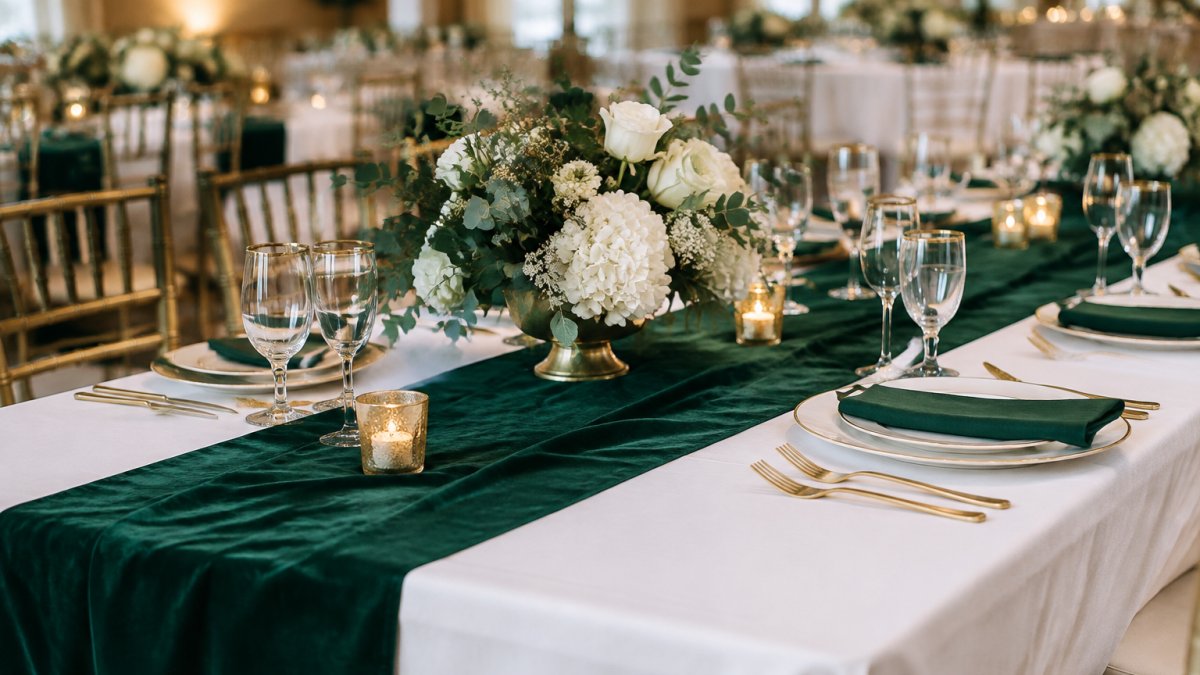
Ready-to-use combinations we recommend:
| Velvet Runner Color | Base Tablecloth | Metallic Accent | Best For |
|---|---|---|---|
| Emerald | Ivory or white | Gold | Weddings, holiday dinners |
| Burgundy | Cream | Brass or copper | Fall events, formal dining |
| Navy | White | Silver | Corporate banquets |
| Blush | Ecru | Rose gold | Bridal showers |
| Black | White | Chrome or gold | Evening receptions |
For a high-glamour look, PNR Decor's table decor trend notes pairs metallic embroidery with a velvet runner, which is the same idea: let the velvet hold the color and let metal supply the shine.
If you are still narrowing your palette, our guide to velvet tablecloth color trends for formal events goes deeper on which shades are gaining ground.
A Table Runner Length Guide for Every Table Size
Runner length is where most tablescapes go wrong. A runner that stops short looks accidental; one that pools on the floor looks careless.
Here is how that breaks down by table:
| Table Size | Seats | Recommended Runner Length |
|---|---|---|
| 4-foot (48 inch) | 4 | 72 to 84 inches |
| 6-foot (72 inch) | 6 to 8 | 96 to 108 inches |
| 8-foot (96 inch) | 8 to 10 | 120 to 132 inches |
| Round, 60 inch | 6 to 8 | 72 inches, centered |
| Round, 72 inch | 8 to 10 | 84 to 90 inches |
For a banquet table, an oversized runner that reaches nearly to the floor reads as more formal. For a dining table in a home, a shorter overhang keeps the look practical.
If you are sewing your own, use our guide to calculating fabric yardage for event tables to convert these lengths into an order quantity before you buy.
Round Velvet Table Runner and Tablecloth Combinations
Start with the tablecloth, then the runner. A floor-length round tablecloth is sized by adding twice the drop to the table diameter.
Once the cloth is set, size the runner to the diameter plus overhang:
| Table Diameter | Seats | Runner Length (straight across) | Overhang per Side |
|---|---|---|---|
| 48 inch | 4 | 60 to 66 inches | 6 to 9 inches |
| 60 inch | 6 to 8 | 72 to 78 inches | 6 to 9 inches |
| 72 inch | 8 to 10 | 84 to 90 inches | 6 to 9 inches |
Two runner layouts work on round tables:
- Single band through the diameter. One velvet runner laid straight across the center, with the centerpiece sitting on top. This is the cleanest look and the easiest to reproduce across multiple tables at an event.
- Crossed pair at 90 degrees. Two runners of equal length crossed at the center, with the intersection hidden under the centerpiece. This fills the round surface visually and works well when the tablecloth is a contrasting solid.
For the crossed layout, use two runners of the same length as the single-band recommendation. If the runners are different colors, keep them in the same tonal family so the crossing point does not look like a mistake.
Stretch Velvet 58" Wide| Apparel Costumes| New Creations Fabric & Foam Inc. →
Pairing options for round tables:
- Full velvet tablecloth plus contrasting velvet runner. A deep velvet cloth with a lighter velvet runner creates a tonal layer rather than a hard contrast. This works best when the two velvets share a pile direction so the light hits them consistently.
- Matte base cloth plus jewel-tone velvet runner in a cross. A white or ivory polyester cloth under two crossed velvet runners keeps the velvet as the focal point and controls cost on large tables.
- Floor-length velvet cloth plus a narrow satin-backed velvet runner. The satin back helps the runner lie flat on the slick cloth and reduces shifting during service.
Keep the centerpiece low and wide on round tables. A tall arrangement hides the runner and blocks sightlines across the table, which defeats the purpose of the layout.
Watch out: on a 72-inch round, a 72-inch runner leaves no overhang and looks like a misplaced strip.
Velvet Types and Finishes: What Changes the Look
Velvet type decides how the runner behaves on the table: how it drapes, how it catches light, how it wears through an event, and how forgiving it is to store.
The four finishes you are most likely to encounter for table linens:
- Smooth velvet (sometimes called flat or pile velvet). An even, upright pile with a soft sheen and a clean drape. It reflects light in one direction, so folds read as crisp lines. It suits formal dining and wedding receptions where you want a polished, mirror-like finish. The trade-off is that it shows creases and pressure marks more than textured finishes, so it needs careful rolling and steaming before an event.
- Crushed velvet. A pressed, irregular pile that scatters light and hides wrinkles. It suits casual-luxe settings, outdoor-adjacent events, and any table where the linens will be packed and unpacked repeatedly, because the texture masks handling marks. The trade-off is that the crushed pattern can look busy next to heavily patterned dinnerware, so keep the rest of the table calm.
- Stretch velvet. Usually a polyester-spandex blend with a smooth pile and four-way stretch. It is the most forgiving option for fitting over a table edge and for sewing, because the stretch accommodates slight measurement errors. It is also the easiest to machine wash. The trade-off is that very lightweight stretch velvet can look flat under strong banquet lighting, so weight matters more than color when you are choosing.
- Suede-like or faux-suede velvet. A shorter, denser pile with a matte hand and almost no sheen. It reads as understated luxury and photographs well under low light without glare. The trade-off is that it is less forgiving of spills and generally requires spot cleaning rather than machine washing.
How to choose by event:
| Event Type | Best Finish | Why |
|---|---|---|
| Formal wedding reception | Smooth velvet | Crisp folds and a polished sheen under lighting |
| Outdoor or tented event | Crushed velvet | Texture hides creases from packing and humidity |
| Multi-table corporate banquet | Stretch velvet | Consistent fit and easy care across many tables |
| Intimate dinner party | Suede-like velvet | Matte, understated look under low light |
Weight is the variable most buyers overlook. A lightweight velvet with a thin pile looks flat under banquet lighting and can show the tablecloth underneath through the runner.
Our article on the best velvet fabric for tablecloths breaks down the trade-offs in more detail, including weight and drape. If you want to see a crushed option in person, the stretch crushed velvet, 58 inches wide has a full, heavy drape when hung and is rated for table covers as well as apparel.

Watch out: pairing a lightweight stretch velvet runner with a heavy velvet tablecloth makes the runner look thin by comparison.
Caring for Velvet Linens So They Last
Velvet survives events well if you handle storage correctly. The pile is the fragile part, not the fabric itself. Fold velvet loosely rather than pressing it flat, and store runners rolled rather than creased.
Practical care rules:
- Shake out, do not brush. Brushing flattens the pile in one direction and leaves a visible track.
- Spot clean first. Blot spills with a dry cloth before reaching for water.
- Follow the fabric's care label. Our crushed stretch velvet is machine washable cold and tumble dry low, and it is recommended to wash it with similar colors to prevent bleeding or fading.
- Steam, do not iron. Direct heat crushes the pile permanently.
Store velvet away from direct sunlight between events. Fading in velvet is gradual and easy to miss until you compare two runners side by side.
Ordering Velvet Fabric for Your Next Tablescape
Buying velvet by the yard beats buying finished runners when you need multiple tables to match.
Measure each table, add your overhang, and add a seam allowance if you are joining panels. Order everything in one continuous length where possible.
For stretch velvet, our stretch velvet, 58 inches wide ships in continuous yard lengths and comes in a 90% polyester, 10% spandex blend with a silky hand and four-way stretch, which makes it forgiving to sew and easy to fit over a table edge.

A common mistake is ordering just enough for the runner and forgetting the tablecloth underneath. Plan both layers in the same order so the colors are dyed consistently.
Frequently Asked Questions
Can you use a tablecloth and runner together?
Yes, and pairing them is the standard approach for formal settings. The tablecloth acts as the base layer, while the runner adds a decorative overlay down the center. Choose a runner that contrasts with the cloth in texture or color so the layering reads clearly. A velvet table runner over a smooth polyester or satin cloth gives you that textural contrast, and the cloth protects the table underneath.
What color tablecloth goes with a velvet table runner?
Neutral bases work with almost any velvet color: white, ivory, ecru, and soft gray let the runner stand out. For a richer look, match the cloth to the runner in a lighter or darker shade of the same hue. A jewel-tone velvet runner pairs well with a crisp white cloth, while a black velvet runner looks sharp over a champagne or blush base.
How long should a table runner be for a dining table?
Measure your table length and add 12 to 24 inches for overhang on each end, depending on how much drape you want. A 72-inch runner suits a 48-inch table with a 12-inch drop per side. For long banquet tables, an oversized runner that hangs 6 to 12 inches over each end keeps the look proportional without pooling on the floor.
Can you use a velvet table runner on a round table?
Yes. A round table works best with a runner that crosses the center in one direction, or two runners crossed at right angles for a layered look. Keep the runner width proportionate to the table, roughly one-third of the diameter. A crushed velvet runner with a soft drape sits well over a round cloth because the pile hides folds and creases.
Velvet rewards planning. Measure your tables, choose one saturated color against a neutral base, and buy your fabric in a single continuous order so every table matches. New Creations Fabric & Foam Inc supplies velvet by the yard with continuous lengths, wholesale pricing on bulk orders, and finishes built for event work, from stretch velvet to crushed velvet for table covers. Explore Fabrics and start your next tablescape with material you can trust to drape the same way on every table.
