

Table of Contents
- Why Polyester Quality Varies So Much
- Polyester Fabric Denier Explained: What the Number Tells You
- Fabric GSM Testing Methods You Can Do at Home
- How to Verify Fabric Drape Online Before You Order
- Physical Tests: Weave Density, Abrasion, and Pilling Resistance
- Recycled vs. Virgin Polyester: Sustainability and Quality Signals
- How to Tell 100% Polyester From Blends
- Frequently Asked Questions
Last Updated: September 29, 2026
Why Polyester Quality Varies So Much
Not all polyester is made the same, and that gap shows up fast in finished garments. Polyester is a synthetic polymer fiber, and how it performs depends on how it was spun, stretched, and finished. Two rolls can look identical online and behave nothing alike on a cutting table. This guide from New Creations Fabric & Foam Inc breaks down how to identify quality polyester fabric using tools you already own.

The fiber itself isn't the problem. The processing is.
Low-grade polyester skips steps that cost money: slower extrusion, less controlled stretching, cheaper dyes. The result frays, pills, and loses shape after a few washes.
Polyester Fabric Denier Explained: What the Number Tells You
Denier measures fiber thickness, and it's the fastest quality signal on a spec sheet. One denier equals one gram per 9,000 meters of yarn. Lower numbers mean finer, softer fibers. Higher numbers mean thicker, stronger ones.
Denier Ranges and What They Mean for Durability
Thin fibers feel luxurious but abrade faster. Thick fibers survive heavy use but feel coarser.
| Denier Range | Feel | Durability | Best For |
|---|---|---|---|
| Under 50 | Very soft, silky | Lower abrasion resistance | Linings, lightweight apparel |
| 50-150 | Balanced | Moderate to high | Dresses, tablecloths, decor |
| Over 150 | Heavy, sturdy | High tensile strength | Upholstery, industrial use |
Filament Count and Texturized Yarn: Reading the Label
Filament count is the number of individual strands twisted into a single yarn. More filaments generally mean a smoother, more uniform fabric with better drape.
Fabric GSM Testing Methods You Can Do at Home
GSM stands for grams per square meter, and it's the clearest measure of fabric weight. Heavier isn't automatically better, but consistent GSM across rolls is a strong sign of quality control.
You can check it yourself in about five minutes.
The Kitchen Scale Method
- Cut a fabric square exactly 10 cm by 10 cm using a ruler and rotary cutter.
- Weigh it on a kitchen scale that reads in grams.
- Multiply the weight by 100.
- Compare the result to the listed GSM.
A 10 cm square of 105 GSM fabric should weigh about 1.05 grams. If your sample is far off, the spec sheet is wrong. Test three squares from different parts of the roll to check consistency.
GSM vs. Fabric Weight: Why Both Matter
GSM tells you density. Fabric weight in ounces per yard tells you how it feels in hand. A 7-ounce fabric and a 105 GSM fabric can look similar but behave differently.
How to Verify Fabric Drape Online Before You Order
Drape is how a fabric falls and folds under its own weight. You can't feel it through a screen, but you can predict it with a repeatable method instead of guessing from a photo.
The Swatch Drop Test
When you have a physical swatch, run a drop test before you cut into it:
- Cut a square roughly 6 inches by 6 inches.
- Hold it by one corner at eye level and let it hang.
- Measure how far the opposite corner drops from horizontal.
- Repeat with the fabric rotated 90 degrees.
Hand-Feel Cues You Can Read From a Swatch
Hand-feel is the combination of softness, surface texture, and body. Judge it from a swatch with three quick checks:
- Scrunch test: Crumple the swatch in your fist, hold for a few seconds, then release. Good polyester springs back with few deep creases. Fabric that stays crushed or feels papery usually has a stiff or under-finished hand.
- Edge rub: Rub the cut edge between your thumb and forefinger. A clean, tight edge means the weave is dense and the yarn is well set. A fuzzy or shedding edge points to loose weave or weak fiber cohesion.
- Surface drag: Slide your fingertip across the face of the fabric. A smooth, even glide suggests uniform filament and good finishing. A gritty or snaggy feel can mean uneven yarn or a low-quality texturizing step.
Questions to Ask Before You Buy
Ask these before committing to a bulk order:
Polyester Poplin 60" Wide| New →
- Can you send a 10-second video of the fabric in motion?
- What's the GSM and denier for this specific roll?
- Do you ship swatches from the current dye lot?
- Is the fabric flat filament or texturized yarn?
A supplier who answers all four quickly is worth keeping. One who dodges the video request is telling you something.
Physical Tests: Weave Density, Abrasion, and Pilling Resistance
Most guides stop at manufacturing specs. Here's a home test protocol you can run on a swatch with tools you already own: your eyes, your hands, a ruler, a kitchen scale, and a loose thread. Run all five tests before committing to a bulk order.
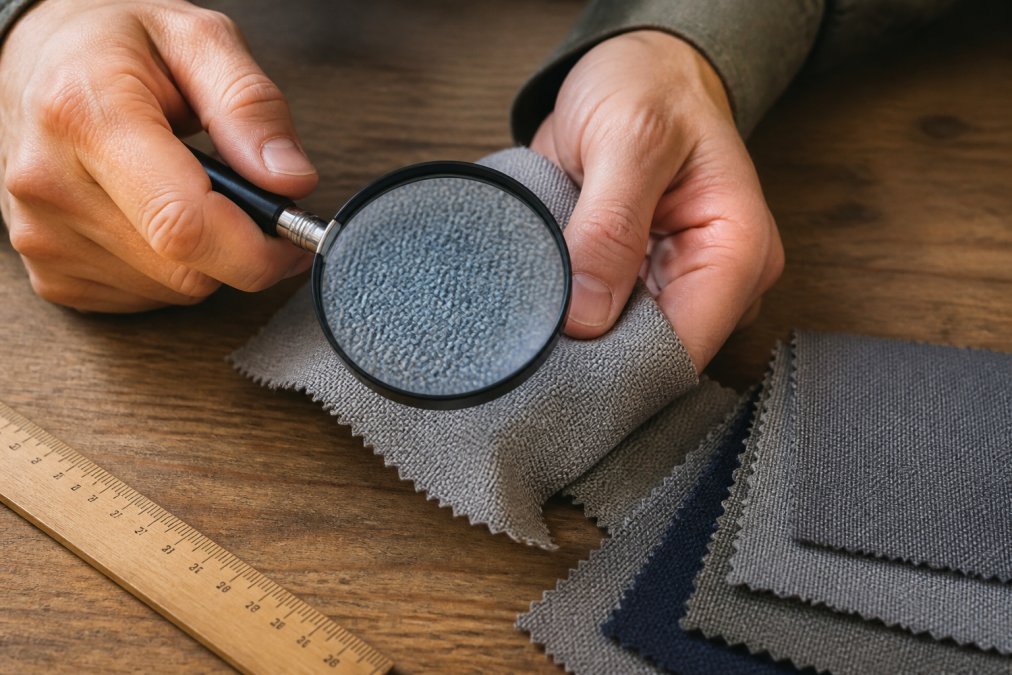
Test 1: Visual Inspection of Weave Density
Hold the fabric up to a bright window or lamp. Tightly woven fabric blocks most light; loose weaves let it pour through.
Test 2: The Rub Test for Abrasion and Pilling Resistance
Rub the fabric against itself twenty times with firm pressure, then check for two things:
- Pilling: small fiber balls on the surface
- Fraying: loose fibers pulling away at the edge
Test 3: The Stretch and Recovery Test
Cut a strip about 1 inch wide and 6 inches long. Hold both ends and pull gently. Then release.
- Good recovery: the strip returns close to its original length with little distortion.
- Poor recovery: the strip stays stretched, waves, or shows a permanent bulge.
Test 4: The Burn Test for Fiber Content
Pull a loose thread from a seam or edge. Hold it with tweezers over a flame, outdoors or near a window.
- 100% polyester: melts and shrinks away from the flame, smells chemical, leaves a hard black bead.
- Cotton blend: burns like paper, smells like burnt paper, leaves soft gray ash.
- Mixed: shows both behaviors.
Test 5: The Wrinkle Release Check
Crumple a swatch in your hand for five seconds, then let it go. Quality polyester with a good finish relaxes and sheds most creases within a minute. Fabric that holds deep, sharp creases or feels stiff and papery usually has a weak or missing finish.
What the Results Mean Together
No single test proves quality. Read them as a set:
- Tight weave, no pilling, clean edges, good stretch recovery, and fast wrinkle release point to polyester that will hold up in production and after repeated cleaning.
- Loose weave, pilling, poor recovery, or a stiff hand point to a fabric that will disappoint after a few washes.
Recycled vs. Virgin Polyester: Sustainability and Quality Signals
Recycled polyester comes from melted-down plastic bottles and post-industrial waste. Virgin polyester comes from new petroleum-based polymer. Both can be high quality, but the signals differ.
Watch for these signals on recycled polyester:
- A stated percentage of recycled content (not just "eco-friendly")
- Batch-specific swatches before bulk orders
- Clear disclosure of color variation risk
How to Tell 100% Polyester From Blends
Blends change everything about how a fabric performs. A polyester-cotton blend feels softer and breathes better, but it wrinkles more and pills differently than pure polyester.
- 100% polyester: melts and shrinks away from the flame, smells chemical, leaves a hard black bead
- Cotton blend: burns like paper, smells like burnt paper, leaves soft gray ash
- Mixed: shows both behaviors
Frequently Asked Questions
Are there different quality levels of polyester?
Yes. Polyester quality ranges widely based on fiber denier, filament count, GSM, and finishing treatments. A 7-ounce spun-weave polyester poplin with colorfast treatment performs very differently from a thin, low-GSM fabric. Higher denier and tighter weave density generally mean better abrasion resistance and dimensional stability. Look for specific specs like GSM, denier, and wash-cycle ratings rather than relying on the word polyester alone.
How does fiber denier affect polyester fabric quality?
Denier measures fiber thickness. Lower denier (below 1) creates softer, silkier fabric like microfiber. Higher denier (above 50) produces stronger, more durable fabric suited for upholstery and heavy-use items. For apparel, denier in the 50-150 range balances drape with tensile strength. A fabric with consistent denier across its filaments resists pilling and holds its shape through repeated washing.
Does fabric weight determine the quality of polyester?
Weight is one indicator, not the whole picture. A 225 GSM faux suede polyester has a heavy, durable hand-feel ideal for upholstery, while a 105 GSM polyester dupioni works well for drapery and apparel. Both can be high quality for their intended use. What matters is whether the GSM matches the fabric's purpose. Verify GSM with a kitchen scale and compare it to the supplier's stated spec.
How can I verify fabric drape online before ordering?
Request a video showing the fabric draped over a mannequin or hand. Look for how it falls: stiff fabrics hold angular folds, while fluid fabrics cascade smoothly. Check for close-up photos of the fabric folded or gathered, and read reviews mentioning hand-feel. Ask the supplier for the fabric's GSM and denier, since heavier, higher-denier fabrics drape more stiffly.